

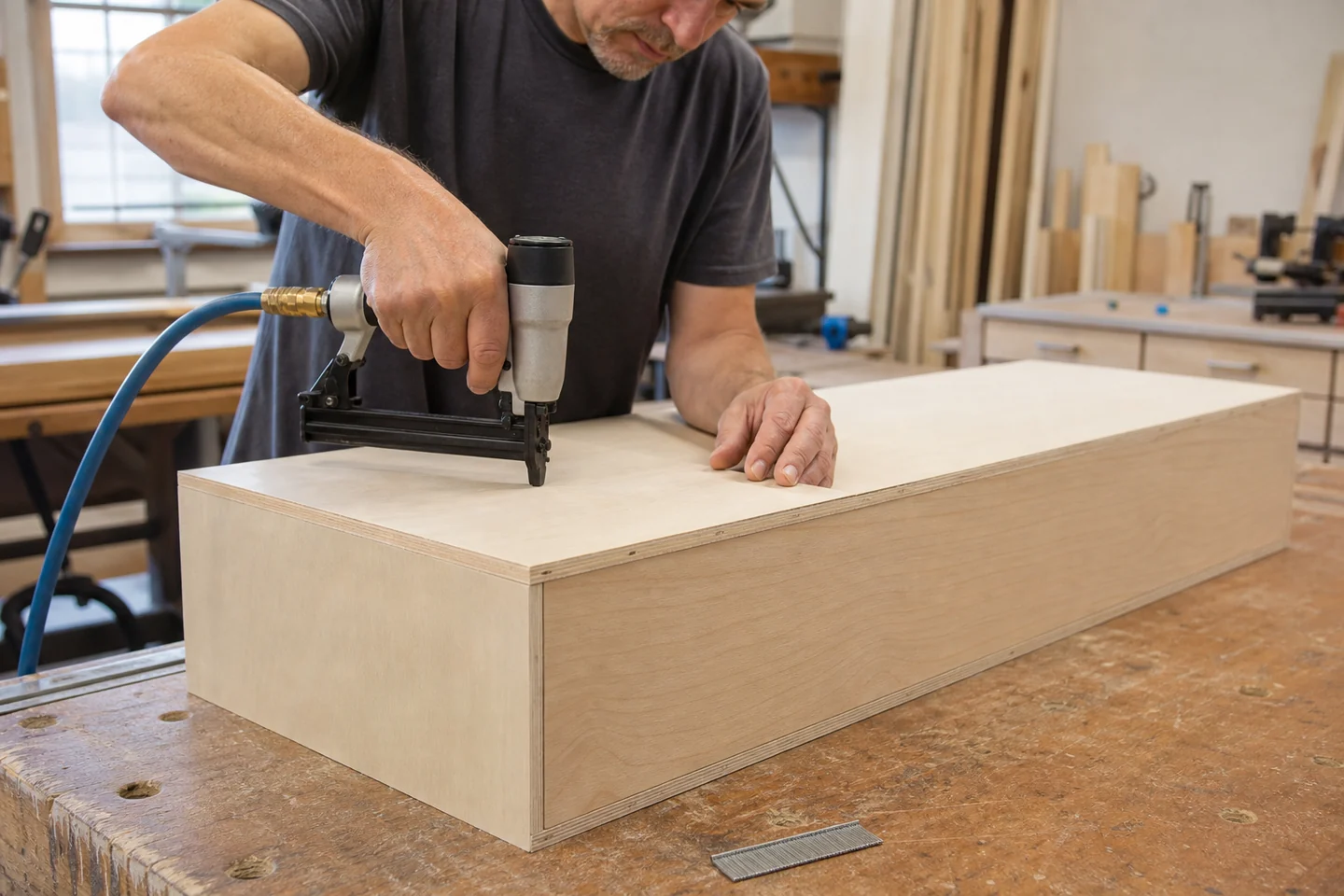
Ask a cabinetmaker where time disappears and the answer is rarely “cutting the big panels.” It is the small correction that has to be made twenty times: a back that crept out of square, a drawer component that lifted, or a fastener that sat proud and needed attention. In the right joint, 18 gauge staples help prevent those interruptions.
The appeal is not mysterious. Two legs steady the material, while the crown bears across a wider area than a brad head. For cabinet backs, drawer parts, light frames, and selected furniture work, that can be a very useful shape. The staple does not need to be impressive. It needs to let the next operation begin on time.
The crown can be helpful or conspicuous
On the hidden face of a cabinet, the crown can help keep thin sheet material from lifting around a single point. The same crown on a finished face may create work for the sanding and filling team. Context changes the answer.
Before choosing the fastener, walk around the finished product in your mind. Which surfaces face the wall? Which are covered by hardware? Which will receive paint or laminate, and which will remain visible timber? A staple is most valuable when its geometry solves the joint without moving the problem into finishing.
The material stack decides whether the leg is “long enough”
Imagine a 3 mm back panel over a narrow plywood edge. The leg must pass through the panel and find useful purchase below it, yet there is not much room for error. Add a knot, a void in the plywood, or a staple driven too close to the edge and the path can change.
This is why a test block gives only a partial answer. Trial the actual panel, frame, adhesive, and air setting. Include corners. Include the narrowest edge. Let the operator work at normal speed instead of placing every shot as if it were a laboratory demonstration.
A reliable strip is almost boring, and that is a compliment
The operator loads it and keeps moving. There is no broken collation to pick from the magazine and no unexplained change in depth halfway along a cabinet. Attention stays on the workpiece, where it belongs.
For a furniture factory or distributor, this calm behavior should continue beyond the first presentation sample. Run several strips from different inner boxes. Watch what happens after the tool has warmed up and the operator has returned to ordinary production speed. That is closer to the experience the eventual customer will buy.
Where 18 gauge staples fit in a wider fastening program
18 gauge staples may be a strong option for cabinet backs, drawer components, light frames, and selected furniture assembly, but they are not a substitute for every brad, screw, or heavier staple. Visible trim may favor a smaller mark. A loaded joint may call for a different fastener or a connection designed specifically for that duty.
This is why buyers benefit from discussing the application, not only the carton label. Tool model, crown width, leg length, wire finish, material stack, and expected order volume all belong in the same conversation.
How ProAirNails supports repeatable workshop results
ProAirNails works with importers, distributors, cabinet factories, and furniture producers sourcing 18 gauge staples and related pneumatic fasteners. A useful inquiry might include a tool model, a photo of the joint, the present staple box, and the problem seen on the line. From there, buyers can test samples in the actual assembly and confirm packing details before a bulk order is approved.
Explore the Air Staple Pin range, compare related Brad Nails, or learn more at About ProAirNails. For a broader view of process consistency, see the official ISO 9001 quality management overview.
FAQ
Are 18 gauge staples suitable for visible cabinet surfaces?
They can be used where the crown mark is acceptable or hidden, but appearance-sensitive trim may call for a brad, pin, adhesive, or another fastening method.
What details help select the right leg length?
Share the top material thickness, receiving material, edge distance, required penetration, tool model, and whether the joint also uses adhesive.
Why should factories test more than one staple strip?
A longer test reveals consistency in collation, feeding, driving depth, and material response more reliably than a handful of selected shots.
Discuss your cabinet or furniture application through the ProAirNails inquiry page.