

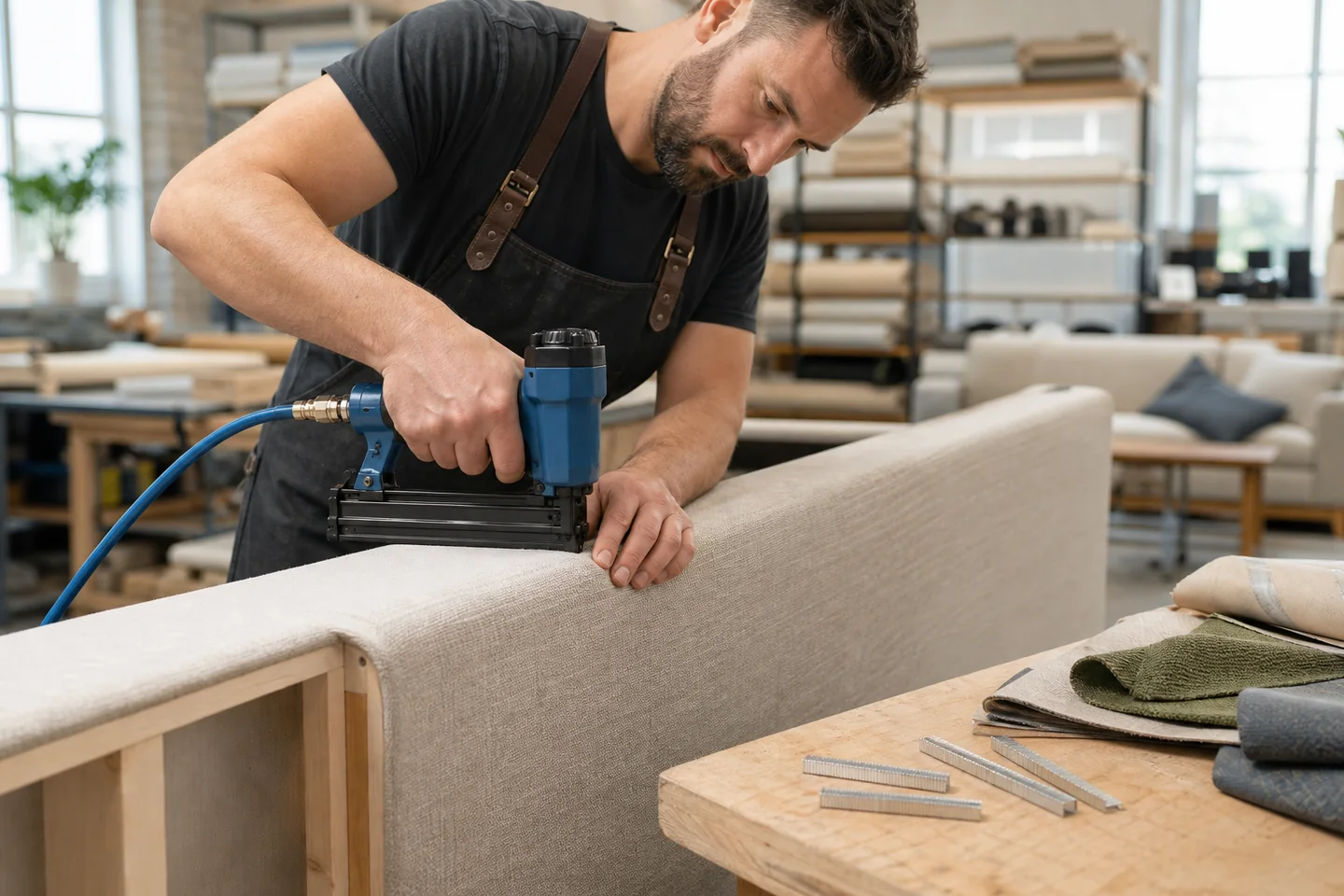
Run a hand along the back of a well-upholstered sofa. The fabric feels even, the edge stays crisp and nothing underneath announces how it was attached. That quiet finish depends on dozens of choices the customer will never see.
22 gauge staples are one of those choices. Their fine wire can hold fabric with less bulk and a less aggressive mark than a heavier staple. When the tool and leg length are right, the fastener disappears into the work.
Fine wire gives the upholsterer more control
An upholsterer is always balancing tension, alignment and speed. Pull too little and the cover looks loose. Pull too hard and a pattern may distort. A fine-wire staple helps lock in that decision without adding an unnecessarily heavy crown around folds, piping and corners.
Small is not automatically better. The point is fit: a fastener light enough for the material, yet reliable enough to keep the work where the operator placed it.
The material stack tells the real story
The visible fabric is only the beginning. Underneath may sit foam, batting, webbing, board and timber. The staple must cross that stack, seat cleanly and still find enough frame material to hold.
That is why a test on scrap wood can mislead. Leg length needs to be tried through the real construction. A long staple that turns in dense timber or makes rework miserable has not improved the job.
Production teams feel inconsistency immediately
A brittle strip or a missed drive breaks concentration immediately. Across a full sofa or a run of chairs, the delay adds up. There is another risk too: operators may compensate by increasing air pressure, driving the next staple harder than the fabric or frame needs.
Clear labels prevent a simpler problem. Upholstery shops often keep several near-identical sizes beside the same benches. The correct staple should be obvious before it reaches the tool.
Where 22 gauge staples fit best
Fabric attachment, decorative trim and light upholstery layers are natural places to consider fine wire. Structural or heavily loaded areas are a different matter. A 22 gauge staple should be chosen because it suits the work, not because a smaller mark sounds attractive on its own.
ProAirNails supports the whole fastening conversation
Furniture manufacturers and distributors often approach ProAirNails with a tool model in one hand and an existing staple box in the other. That is a sensible starting point. We can compare the fastener, the material stack and the packing together, then keep the approved details available when the order repeats.
Review Air Staple Pin, compare related Pneumatic Nails, or learn more at About ProAirNails. ISO explains the role of consistent quality processes in its overview of ISO 9001 quality management.
FAQ
Are 22 gauge staples suitable for every upholstery joint?
No. They are fine-wire fasteners suited to appropriate light and appearance-sensitive work; heavier or higher-load areas may require another staple.
Why does leg length matter in upholstery?
It affects how the staple passes through fabric and padding and how securely it engages the frame without turning or causing damage.
Can ProAirNails support distributor packing?
Yes. Buyers can discuss box quantities, size labels, barcodes, private labels, master cartons, and repeat-order controls.
Share your upholstery application through the ProAirNails inquiry page.