

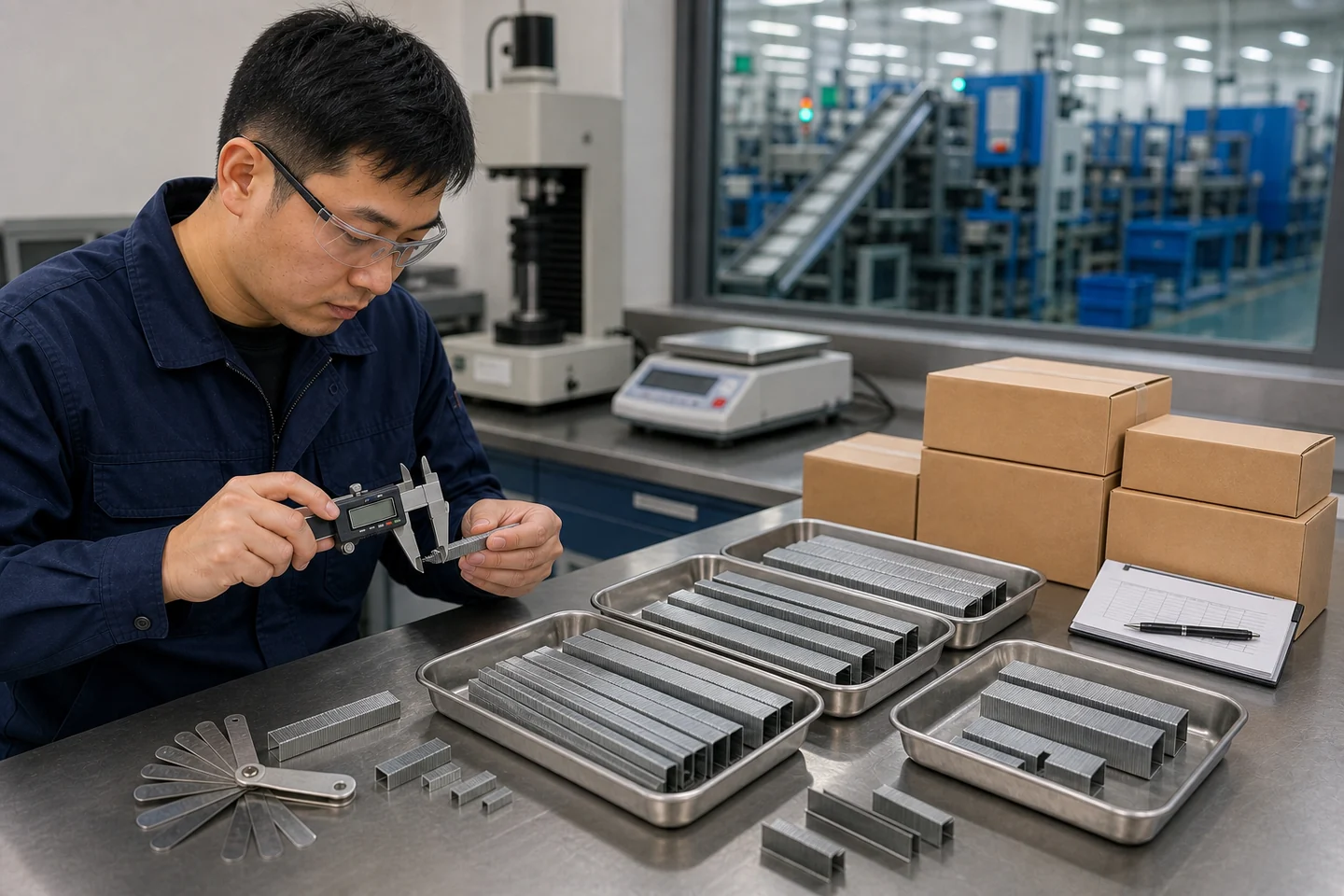
A buyer often begins a custom staple project with a small box, a worn strip, and one practical sentence: “This works in our machine.” That sample is valuable, but it is not yet a production specification. A custom staples manufacturer has to translate the sample into controlled dimensions, material, collation, tool performance, packaging, and acceptance criteria.
The most useful first conversation is about the application. Upholstery, carton closure, insulation, furniture frames, wire attachment, and industrial assembly place different demands on the crown, legs, point, finish, and feeding system.
Measure the sample, then explain why it works
Crown width, leg length, wire width and thickness, point geometry, strip length, adhesive, and strip alignment can all affect fit. Dimensions should be recorded with tolerances rather than copied as one perfect reading from one staple.
The buyer should also identify the tool or machine, material stack, production speed, and any current problem. A staple may need to hold dense timber, pass through fabric without cutting it, clinch against an anvil, or feed through an automated head. Those conditions decide which dimensions are truly critical.
A drawing needs a matching trial plan
A drawing controls what will be produced; a tool trial shows whether the controlled product works. Samples should be run in the intended equipment and real materials. Record loading, feed resistance, misfires, drive depth, leg behavior, crown marks, splitting, and the result after the assembly is handled.
If several tool models are in use, list them before approval. A strip that runs smoothly in a new stapler may expose wear or fit differences in older equipment. The goal is a realistic operating window, not a demonstration prepared around one favorable tool.
Packaging can change a correct staple into a bad delivery
Collated staples rely on alignment. Rough inner boxes, excess carton weight, humidity, or loose packing can bend strips and weaken adhesive. Approve the number per strip, inner-box quantity, master-carton arrangement, moisture protection, labels, and pallet pattern alongside the metal product.
Private-label artwork should use a controlled revision. Dimensions, quantity, compatible tool family, warnings, barcode, language, and carton marks must agree with the approved item.
Repeat orders depend on retained evidence
A capable custom staples manufacturer should be able to connect the approved drawing, material and finish, trial sample, inspection record, artwork, and packing specification. Retained samples and revision numbers make later discussions concrete when a buyer adds a size or reports a field issue.
ISO provides an overview of ISO 9000 quality management standards. Certification alone does not approve a staple, but disciplined document and process control are useful foundations for repeat production.
How ProAirNails handles custom staple development
ProAirNails works as a custom staples manufacturer for distributors, brand owners, furniture producers, packaging companies, and industrial users. Projects can begin with a drawing, an existing strip, a tool model, or a troublesome application. Sample feedback is then tied to measurable product and packing details.
Explore the Air Staple Pin range, compare related Pneumatic Nails, and review About ProAirNails.
FAQ
What should buyers send a custom staples manufacturer?
Send a drawing or sample, tool model, application materials, performance concerns, dimensions, finish, annual volume, packing, and destination requirements.
Why is one existing staple not enough for full approval?
One piece does not define tolerances, strip consistency, material, finish, feeding behavior, packaging, or variation across a production lot.
Can custom staples include private-label boxes?
Yes. Artwork, barcodes, languages, quantities, carton marks, warnings, and packing protection can be developed with the fastener specification.
Start a custom staple discussion through the ProAirNails inquiry page.