

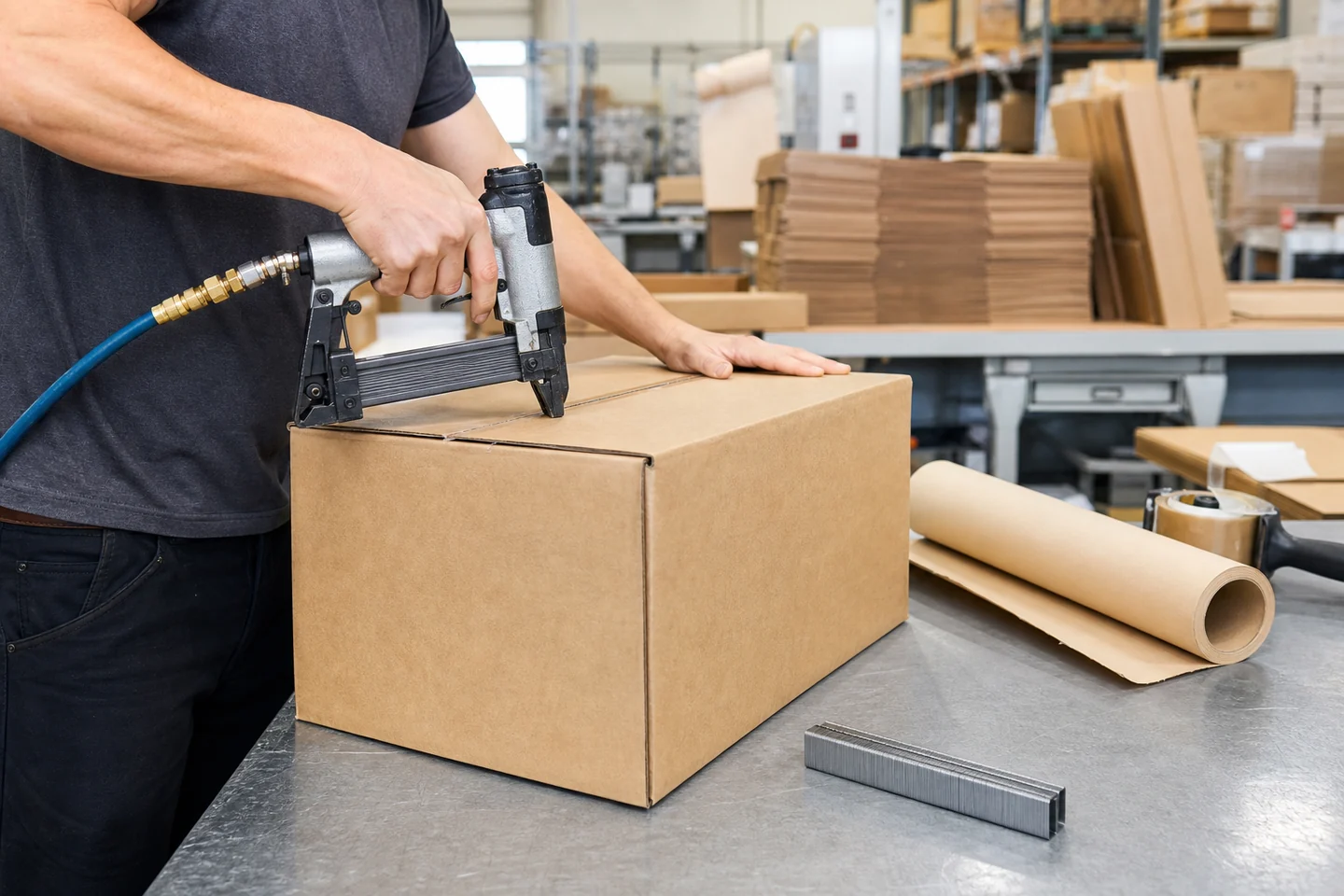
A carton can leave the packing line looking perfect and still arrive with a lifted flap, torn seam, or crushed corner. By then, the closure is no longer a small production detail. It has become part of the customer's first impression. Staples for packaging can provide a strong mechanical closure for suitable corrugated cartons, especially when loads and handling conditions place more demand on the seam.
The result depends on more than choosing a metal staple. Board grade, flute structure, staple crown and leg, tool setting, seam design, contents, and transport route all meet at the same line on the box.
Mechanical closure can help where the carton works hard
Heavy contents, long warehouse journeys, repeated handling, and changing temperature or humidity can challenge a carton. A correctly selected staple creates a visible mechanical connection through the flaps. That can be valuable where the packaging design calls for more than tape or adhesive alone.
It is not automatically the best closure for every shipment. Retail presentation, opening method, product sensitivity, export rules, and recycling practices all deserve consideration. The packaging system should be designed around the product and distribution route rather than around one familiar tool.
The crown and legs must cooperate with the board
The crown bridges the seam while the legs penetrate and form or clinch. If the dimensions do not suit the combined board thickness, the closure may sit proud, cut into the liner, fail to clinch correctly, or provide less holding area than expected.
A practical test uses the actual corrugated board, filled carton weight, closure pattern, and production tool. Empty-box demonstrations can miss the way a loaded carton flexes during lifting, stacking, and impact.
Operator safety and opening experience belong in the same review
A closure needs to be secure without leaving sharp, poorly formed legs where packers, warehouse staff, or customers can contact them. Tool maintenance, air pressure, anvil or clincher condition, and operator technique all affect the finished seam.
The receiver also has to open the carton. Closure placement should protect the shipment while allowing an appropriate unpacking method. Packaging that survives transit but creates avoidable damage or frustration at opening has only solved half the problem.
Transport trials reveal more than a clean seam
Buyers evaluating staples for packaging should look beyond the first closed box. Repeated drops, vibration, compression, storage, and changes in humidity can expose weak points in the carton and closure. The International Safe Transit Association provides resources related to transport packaging performance and testing.
Consistent collation also matters on the line. A carton stapler that misfeeds during a busy shift creates a queue immediately, so longer trials across several strips or rolls are more meaningful than a few careful cycles.
ProAirNails connects the staple with the packing operation
ProAirNails supports importers, packaging distributors, and industrial users sourcing staples for packaging and related pneumatic fasteners. Buyers can share the carton construction, combined flap thickness, contents, tool model, closure pattern, monthly volume, label, and master-carton needs before samples are approved.
Review the Air Staple Pin range, explore related Pneumatic Nails, or learn more at About ProAirNails.
FAQ
Are staples for packaging suitable for every corrugated carton?
No. Suitability depends on the packaging design, board construction, product, closure requirement, transport route, opening method, and applicable market rules.
Why should a staple be tested on a filled carton?
The filled package reveals flexing, seam stress, handling, stacking, and impact behavior that an empty carton may not reproduce.
What details help identify a carton closing staple?
Provide the tool model, staple crown and leg if known, board grade and thickness, closure pattern, carton weight, production speed, and current sample.
Discuss your carton closure project through the ProAirNails inquiry page.