
A coil nail quotation becomes useful when it describes the work already happening at the customer's factory. Pallet assembly, wooden crates, fencing, packaging, and general wood fastening can all use coil nails, but they do not automatically use the same nail, shank, finish, or nailer.
This coil nail export packing checklist is for importers, distributors, industrial buyers, and private-label programs. Buyers can begin with the coil already used in their market, the nailer model customers own, or a short size list supported by real sales.
Updated July 22, 2026. This guide is based on the current ProAirNails catalog and a buyer RFQ workflow; final product and packing details require written confirmation.
Direct answer: Approve the coil and the shipping unit separately. Record nails per coil, coils per carton, gross weight, liner or moisture protection, label fields, carton strength, pallet pattern, and mixed-load position before production.
Coil Nail Export Packing Checkpoints
| Checkpoint | Approval evidence | Risk controlled |
|---|---|---|
| Inner product | Coil count, wrap, and approved sample | Loose or damaged collation |
| Master carton | Gross weight, board strength, size label | Torn cartons and handling errors |
| Moisture | Liner, storage, and route expectation | Finish or collation deterioration |
| Pallet and loading | Pattern, marks, restraint, and mixed-load position | Crushing, shifting, and slow receiving |
A current coil says more than a broad catalog request
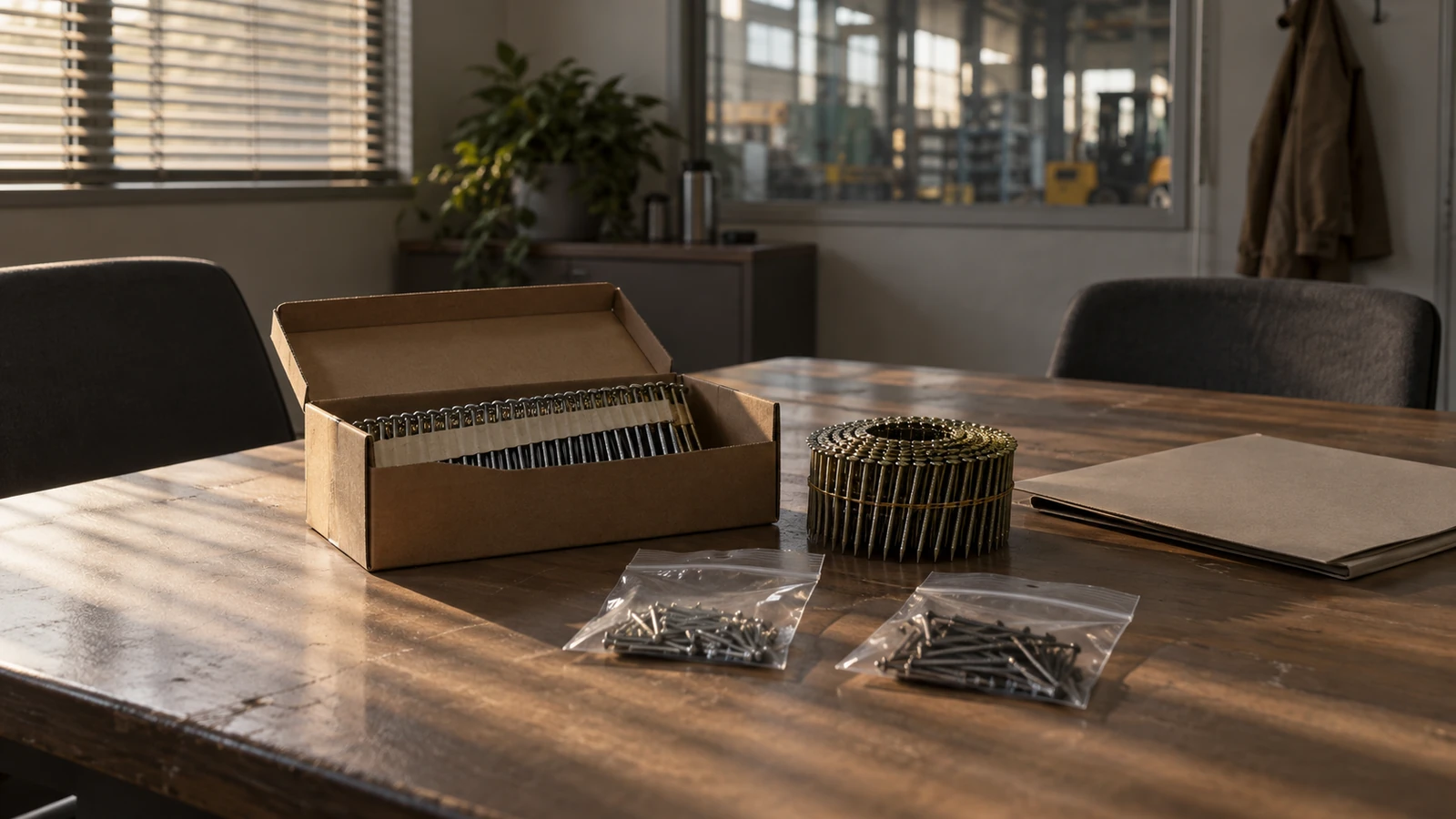
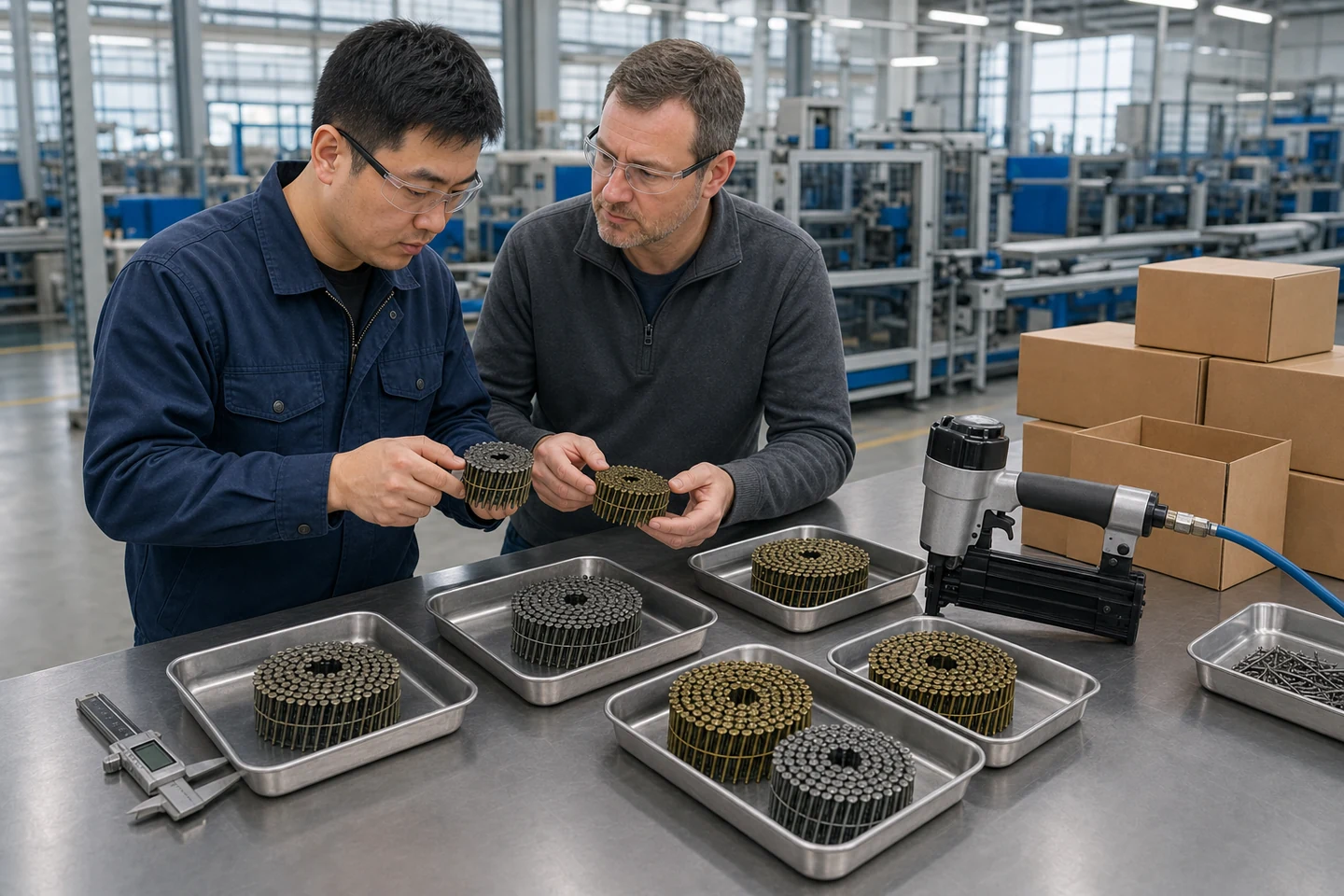
A buyer who sends an existing coil gives the supplier a physical starting point. Add the application, nailer, target length, shank preference, finish, box quantity, destination, and expected volume. This is usually enough to decide which product details still need confirmation.
Field complaints are valuable too. A coil that deforms in the box, feeds poorly near the end, arrives with damaged collation, or carries an unclear size label creates costs that do not appear in the unit price. Include those problems in the request.
See the current Coil Nail category and related Pneumatic Nails before preparing samples.
The opening range should follow customer demand
A distributor does not need to stock every combination of length, diameter, shank, and finish. The first order can focus on the coils already moving through pallet shops, crate builders, woodworking customers, or construction supply accounts.
Once the core items are stable, slower sizes can be added from customer requests. This gives the warehouse a range it can understand and reduces the chance of tying up cash in coils that look complete in a catalog but rarely leave the pallet.
Export cartons are part of the product
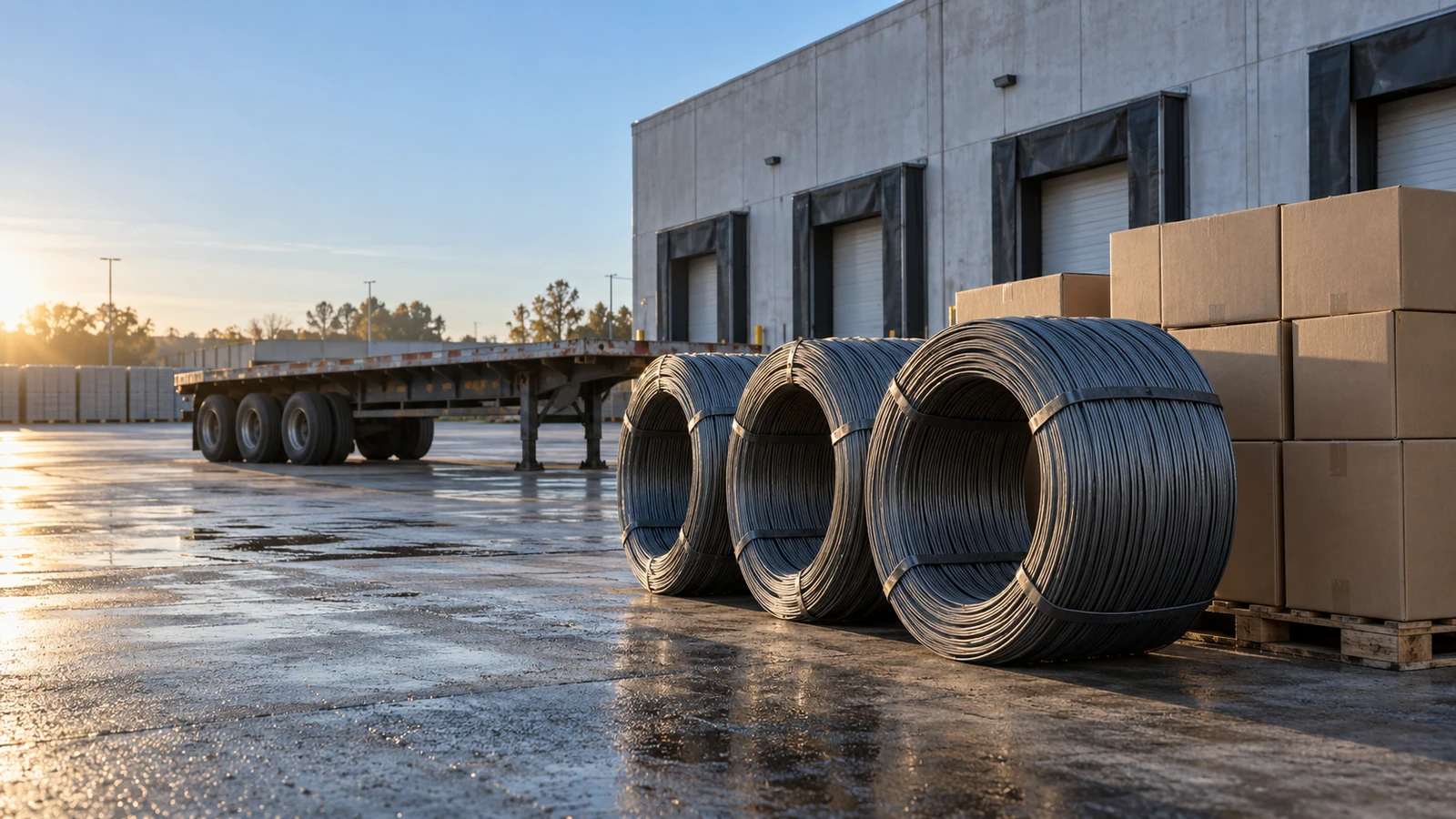
Coil nails are dense. An inner box that looks fine on a sample shelf may fail when master cartons are stacked, moved by forklift, or loaded beside other heavy fasteners. Buyers should discuss inner support, master-carton weight, moisture protection, labels, pallet pattern, and mixed-load position.
Private-label boxes also need unmistakable product identification. Length, diameter, shank, finish, quantity, tool reference, barcode, and carton marks should agree with the approved item. A controlled artwork version prevents an old label from returning on a repeat order.
Samples connect the product to the nailer
A sample coil can be run in the intended tools and production material. The useful observations are simple: loading, feeding, drive result, collation condition, and whether the carton protects the product during handling.
Tool use should follow the manufacturer's instructions and local workplace requirements. OSHA provides general guidance on pneumatic-tool safety for employers and users.
Manufacturing depth supports the wider account
ProAirNails represents Huajian, a fastener manufacturer established in 1997. The company profile describes international production, export markets, and annual capacity above 100,000 tons across the wider group. Those figures do not promise availability for one coil nail SKU, but they show the platform behind a repeat-order program.
A buyer may also combine coil nails with brads, staples, pins, screws, or pneumatic tools. Read more at About ProAirNails.
Send the coil your customer already recognizes
A productive inquiry can be short: current coil or photo, nailer model, application, size, shank, finish, packing, destination, and order estimate. ProAirNails can then confirm product options, samples, and packing details against the checklist.
Submit the program through the ProAirNails inquiry page.
Implementation Checklist, Cost, and Limits
- Weigh the packed carton, not only the fasteners.
- Make diameter, length, shank, finish, and coil count readable from the aisle.
- Keep approved sample and packing photos with the PO record.
- Place heavy cartons where they cannot crush lighter fastener products.
Cost and value: Export packing adds material and pallet cost, but weak cartons create repacking, claims, slow receiving, and product damage. Compare quotations with the same pallet, carton, and moisture-protection assumptions.
Limit: Packing needs vary by carton weight, route, container loading method, climate, warehouse handling, and customer requirements. A checklist must be approved for the actual order rather than copied from a different shipment.
FAQ
Who normally imports coil nails in bulk?
Typical buyers include fastener distributors, pallet and crate suppliers, industrial importers, construction-material companies, and private-label brands.
What should be sent for coil nail matching?
Send the current coil, nailer model, application, dimensions, shank, finish, packing, destination, and expected order quantity.
Can coil nails share a shipment with other fasteners?
A mixed order can be discussed, with attention to carton weight, product protection, palletization, and loading arrangement.
Contact ProAirNails to discuss coil nail samples and export packing details.