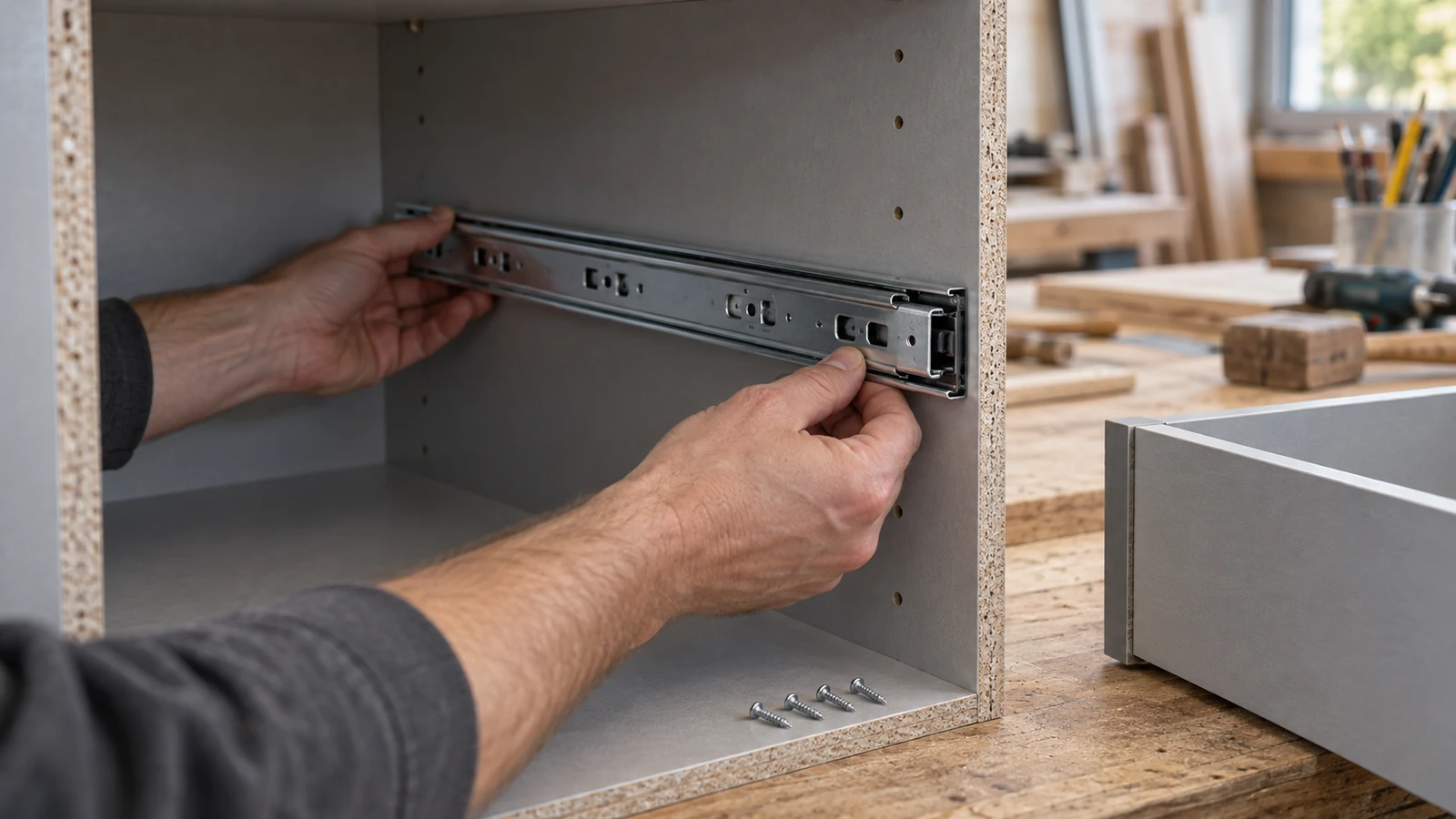

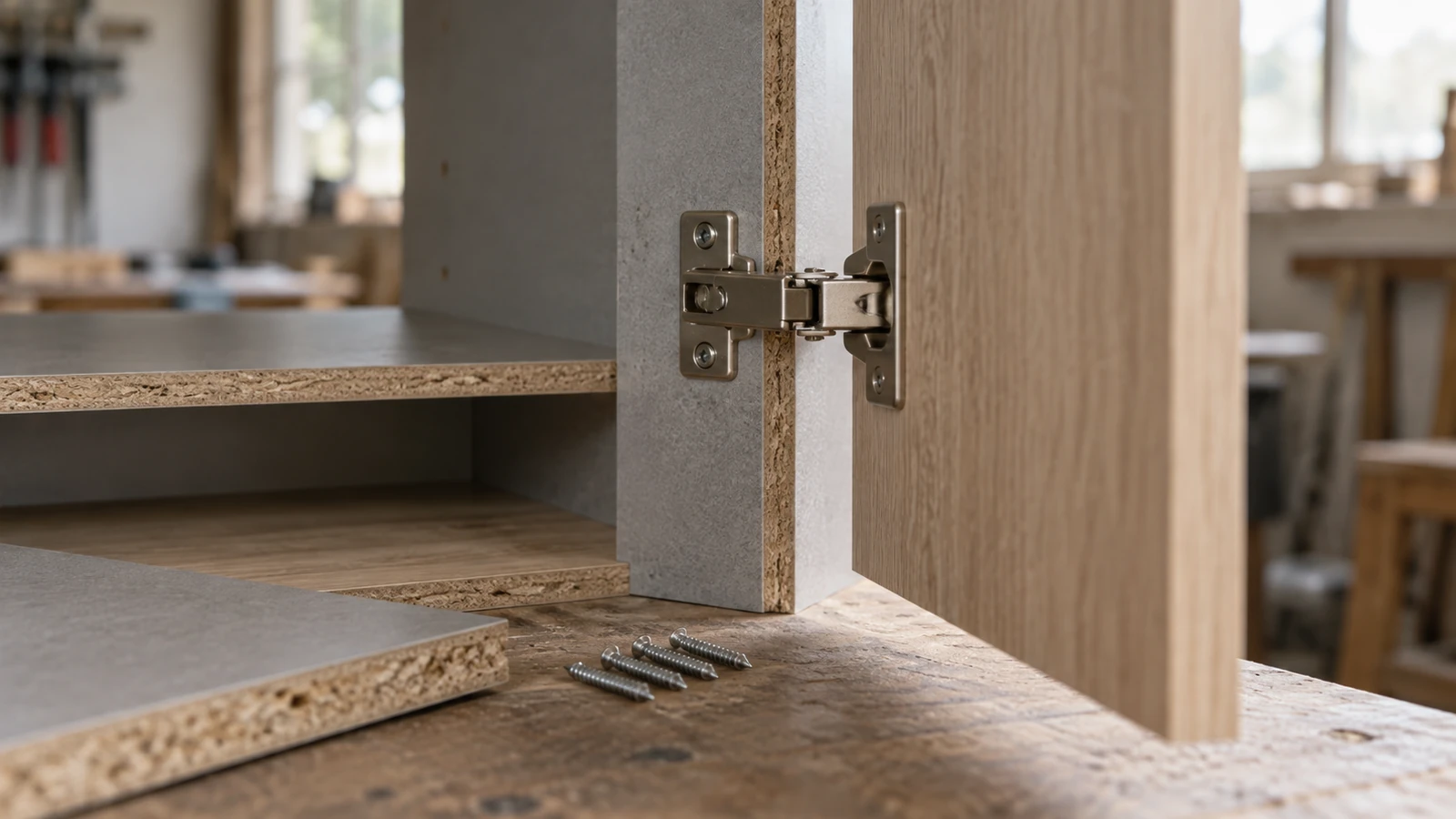
A cabinet door is a lever with a two-metre handle. Every time it is swung, the plate inside the carcass takes the reaction, and on a chipboard panel that reaction arrives at four small holes.
When a door sags, the conversation immediately turns to the hinge, which is usually innocent. Most of the calls ProAirNails takes about chipboard screws for hinge plates end with the same finding: the fixing was asked to hold in a material with almost no ability to resist a screw being pulled sideways out of it.
A hinge plate is a lever anchor, not a fixing
Hinge manufacturers publish the loads their hardware will carry. What they cannot publish is the panel, because the panel is yours. Chipboard is a bonded mat of particles and voids, and a screw in it holds through the friction and interlock along a very short length of engagement. Whoever specifies chipboard screws for hinge plates is specifying a joint rather than buying a component.
Add a door, a handle and a person pulling on the handle and the load is no longer pointing out of the panel. It is pointing sideways, over and over, several thousand times a year.
Six ways chipboard screws for hinge plates fail
They fail in predictable ways, and the way it fails tells you what to change. Work down the table before you change the screw.
| Failure | What caused it | What actually stops it |
|---|---|---|
| Screw turns but never tightens | Stripped threads in a hole that was never the right size | The correct pilot diameter for that panel, not for wood |
| Hinge pulls straight out with a plug of board | Engagement too short for the panel thickness | Longer screw, or a plate with a larger mounting footprint |
| Door sags after a few months | Repeated lateral load opening up the same holes | More fixing points, and a plate that spreads the load |
| Panel bulges on the visible face | Fixing too close to the surface, over-torqued | Depth control on the driver and a shorter screw |
| Crack from the plate hole to the panel edge | Edge distance too small for the panel | Move the plate inboard, or add a solid timber block |
| Loosens only on the heaviest door | Panel grade too light for the door mass | A heavier board grade, or a solid timber insert |
Length, panel thickness and the engagement that matters
The chipboard screws for hinge plates that actually hold are the ones with enough thread in sound board, and nothing else about the screw makes up for a short engagement. A 15 mm screw into an 18 mm panel sounds generous until the plate, the clearance and the panel facing are subtracted from it.
| Panel | What the fixing has to pass through | Where it usually goes wrong |
|---|---|---|
| 15 mm board | Plate face, panel facing and a short engagement | Not enough thread left in sound material |
| 16 mm board | The same plate on a marginally thicker panel | The far face is closer than it looks once the panel is skimmed |
| 18 mm board | The common case for a standard hinge plate | Depth control rather than screw length |
| 25 mm and above | Enough thread to matter without approaching the far face | A screw chosen for what was in the box |
The working rule is to keep well clear of the far face while still getting enough thread into the board to matter. Where the numbers do not work, the honest answer is a thicker plate, more fixing points, or a solid insert bonded into the carcass rather than a longer screw driven towards the outside of a visible panel.
Pilot holes: wood rules do not transfer
Drill a chipboard hole with the same diameter you would use in softwood and it will strip, because the panel has no fibres to spring back and grip the shank. Too small and the screw will still cut, but it will push the particles apart as it goes and leave a hole with nothing around it.
The pilot diameter follows the shank diameter rather than the thread, and the right size is confirmed on an offcut, not on the door. Most failures with chipboard screws for hinge plates begin at this one decision. Cut a test hole in a piece of the same board, drive the same screw, and feel for the point where the screw seats firmly without that final half turn that gives way.
Torque, the setting nobody records
An impact driver will happily turn a screw until the panel fails, and it does it without asking. On a batch of cabinets the torque setting is a real specification: it decides whether the fixing is tight or whether the panel around it has been crushed into dust. With chipboard screws for hinge plates that difference is invisible from the outside of a finished unit.
Set the clutch low enough that a fully seated screw stops the tool, run two or three samples, then leave the setting alone. A record of that number is what makes a second batch match the first.
Adjustment means the same hole is used twice
Hinges are adjusted after the door goes on, which means the fixing is loosened and re-tightened in the same hole. Every re-tighten costs a little of the interlock, and a door adjusted three times by three different people has had three chances to lose it.
Two habits reduce the damage. Adjust once, with the door hung and the cabinet levelled, rather than repeatedly at the bench. And where a hole has already given way, treat that as a repair: fill it, or move the plate to fresh material, instead of driving the next screw a size larger.
When a repair plate is the honest answer
There is a point where the panel has failed rather than the fixing. If the holes have enlarged, if the board around them crumbles, or if the door is heavy enough that the panel is visibly deforming, no screw will return the cabinet to what it was.
The trade answers are all replacements rather than repairs: cut a solid timber block into the carcass, fit a repair plate with a wider footprint, or replace the side panel. Said plainly, a longer screw in a failed hole is not a fix, it is one more hole, and ProAirNails would rather hear about a failed plate than supply a screw for one.
Checks before the doors go on
- Confirm the panel grade and thickness against the door mass, in writing, before any hardware is ordered.
- Drill a trial hole in an offcut of the same board using the same bit and screw, then inspect it.
- Set the driver clutch on those trials and record the setting with the batch paperwork.
- Check edge distance on the worst plate position, which is usually the bottom hinge on a tall door.
- Hang one door and adjust it fully before the rest of the run is fixed, so the method is proved on a single unit.
- Keep the drill and driver bits together as a pair, because a worn bit is how a hole ends up the wrong size.
What a fixing cannot correct
None of this rescues a carcass built from a board grade that was chosen on price. The Architectural Woodwork Institute casework supplement is a useful reference for how hardware loads, panel grades and tolerances are normally described to a client, and the USDA Wood Handbook covers how screws actually hold in wood-based panels, which is not the same behaviour as in solid timber.
Where a cabinet carries a safety requirement, is wall hung or holds a heavy appliance, the fixing schedule belongs to the designer. This article does not substitute for that.
FAQ
What size screw suits a hinge plate in an 18 mm panel?
Long enough to engage sound material without breaking the far face, which is usually set by the plate thickness. Confirm on an offcut with the screw you intend to run.
Should I pilot chipboard for hinge plates?
Yes, with a diameter that follows the shank rather than the thread, and no larger than the trials show. A pilot that is one size too big is the quickest way to ruin a set of chipboard screws for hinge plates.
Why does a door sag when the hinges are new?
Because the panel, not the hinge, is giving. Adding a stronger hinge into the same four holes does not change that.
Can I use a longer screw in the same hole?
Only if the hole is still sound. If the thread has already stripped, the longer screw will strip too.
Is glue in the hole a real workshop method?
It is a recognised repair where the panel is still intact: fill the hole, let it cure and re-drill. It is not a substitute for correct engagement in the first place.
Does an impact driver damage chipboard?
It can, and usually does, when the clutch is left high. The failure appears at the surface where the fixing stops.
How far from the panel edge can a plate sit?
Far enough that the fixing does not split towards the edge under lateral load. The safe distance follows the panel grade and thickness.
Do cabinet hinges need more than two screws per plate?
On a heavy or frequently used door, more fixing points reduce the load on each. Where the design allows it, that is the cheapest improvement available.
What causes a crack from the plate hole to the edge?
Edge distance that was too small for the panel, or a screw that was driven without a pilot hole to open the path.
What should a cabinet hardware enquiry include?
Panel type and thickness, door mass and size, hinge model, plate footprint, the driver being used and the number of hinges per door.
What to send with a cabinet enquiry
Send the carcass, not the screw: panel type, grade and thickness, door size and mass, the hinge and plate being fitted, and the driver on the bench. ProAirNails supplies screws, pneumatic staplers and staple pins into furniture and casework production, and a photograph of a failed plate with a rule across it tells us more than a description. Start at Contact Us.