
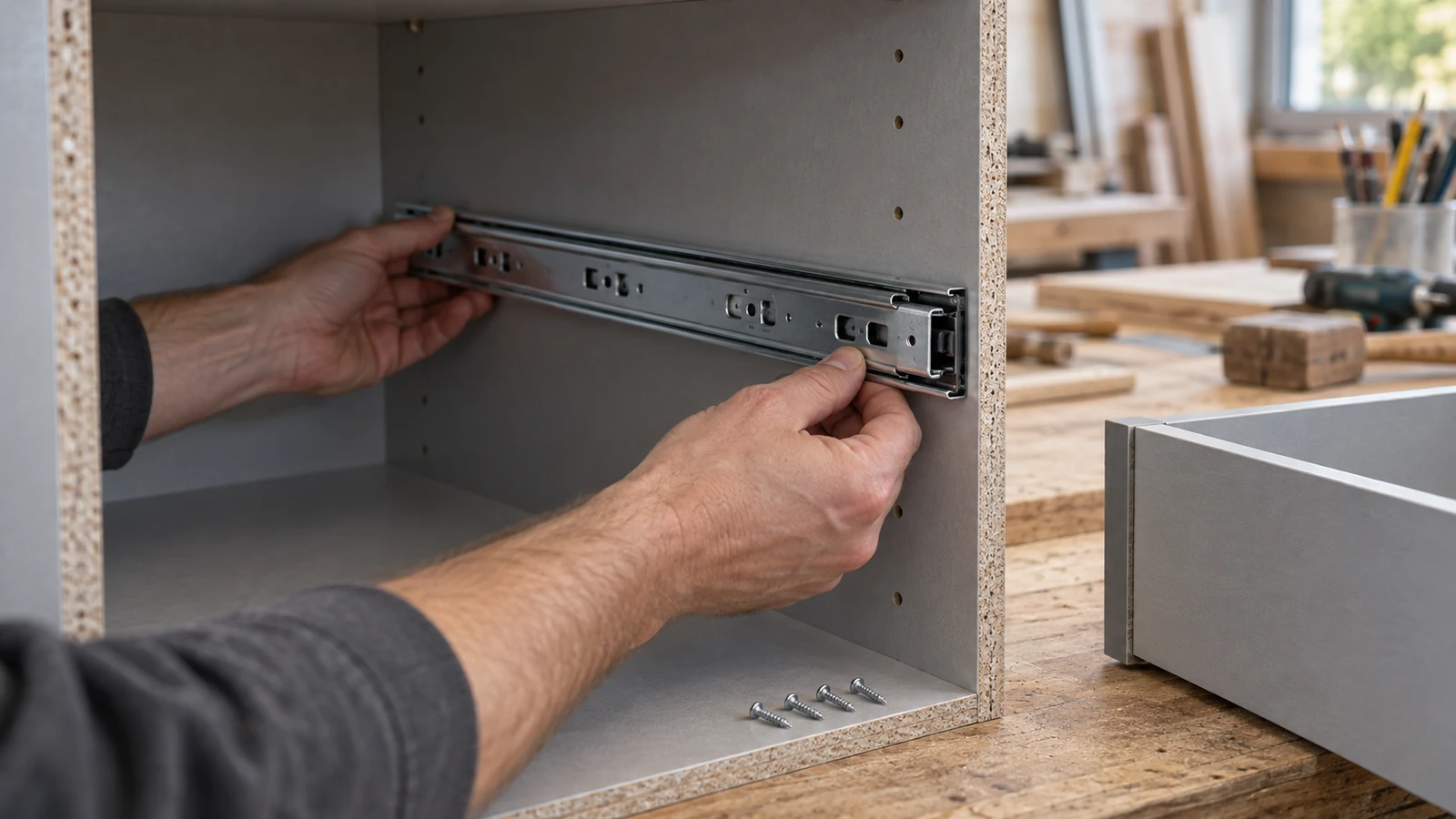
Open a drawer that grinds and you will find the runner, not the screw. Close it again and it may run perfectly, which is the clue: the problem is alignment, and the fixings only decided where the runner ended up.
Cabinet makers ask ProAirNails about chipboard screws for drawer runners as though the screw were the variable. On most of the cabinets we hear about, the screw is doing exactly what it was asked to do, in a position that was set two operations earlier.
Three lines have to agree before a drawer runs
The cabinet has a vertical line at the front edge, the runner has a mounting line drilled by its maker, and the drawer box has its own centre. A drawer runs smoothly when those three agree, and fights the operator when any one of them drifts.
Which means the fixing has one job: hold the runner on the line it was positioned on. If the runner is set 2 mm low at the front and 1 mm high at the back, no screw length or thread form will correct that, and every drawer mounted from the same carcass inherits the same problem. Chipboard screws for drawer runners are the last operation in a chain of three settings and cannot repair the two that came before them.
How chipboard screws for drawer runners take the load
A loaded drawer pulls out horizontally, and the load arrives at the runner as a downward and outward force. The panel carries that through the fixing holes, so the fixing is loaded in a mix of shear and pull-out rather than in a straight pull.
Two things follow. Longer engagement matters more than a larger head, and several correctly placed fixings share the load far better than one deep one. Chipboard screws for drawer runners are usually specified because they cut cleanly in a particleboard panel, and that is exactly the property you want here, provided the holes were positioned properly.
Depth, length and the panel you are actually fixing into
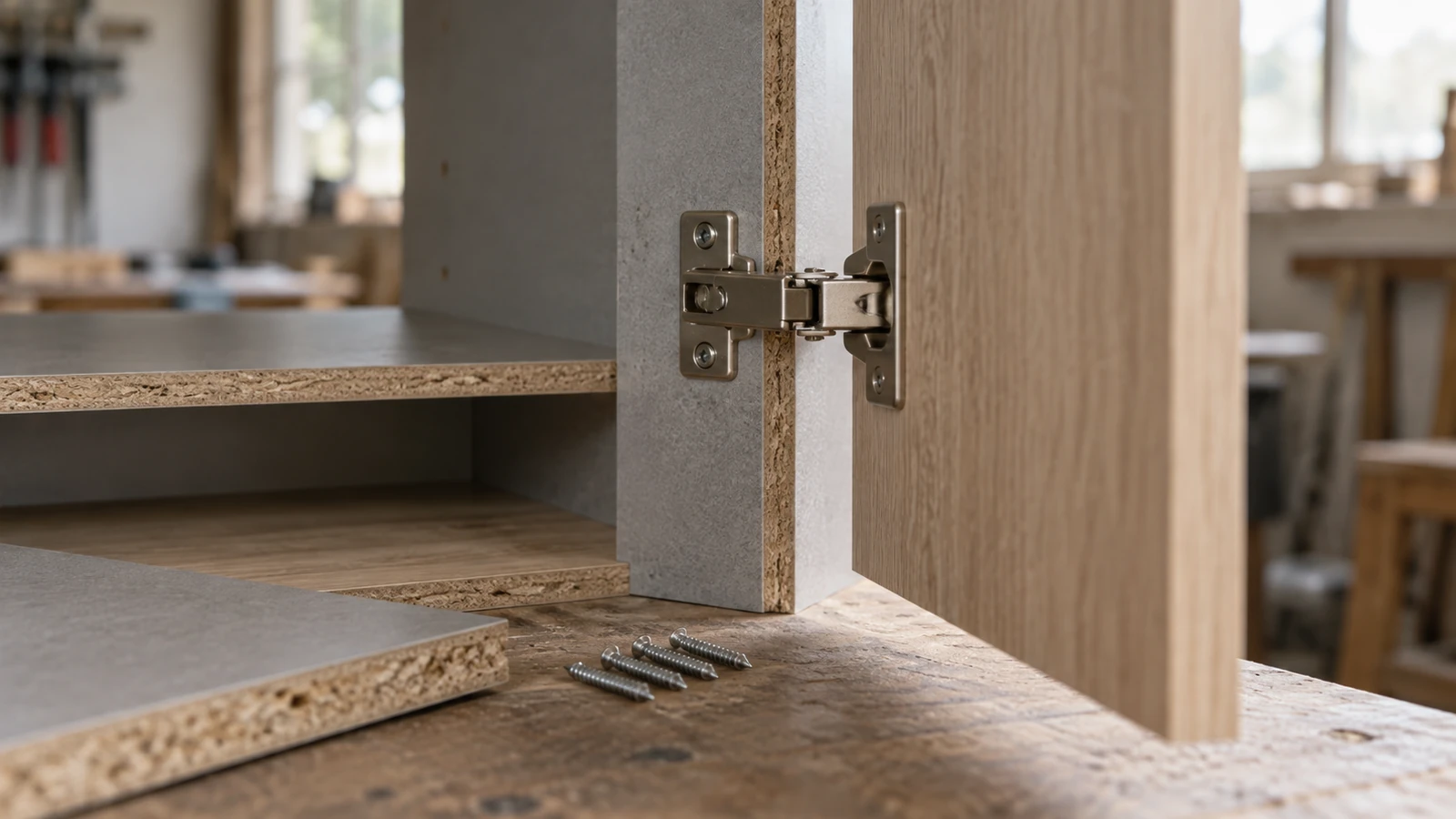
Runner makers publish a maximum screw length for a panel thickness, and the figure exists because a screw that emerges on the visible face of a carcass has ruined the cabinet. The published length is a limit rather than a target, and it assumes the panel is the thickness it claims to be.
| What is being decided | Why it matters | What to check |
|---|---|---|
| Screw length against panel thickness | A screw that breaks the outer face cannot be repaired invisibly | The thickest panel the fixing will sit in, measured |
| Engagement in sound material | The runner load is taken by the threads, not the head | Thread length actually inside the panel |
| Clearance through the runner | A screw that bottoms in the runner slot drags the runner off line | Clearance hole in the runner, not a driving fit |
| Depth control on the driver | Over-torque crushes the panel around the hole | Clutch setting proved on an offcut |
Alignment: the runner line, not the drawer line
Set out from the front edge of the carcass, not from the back, because the front is what the client sees and the front is where a drawer face is adjusted. A runner set to a back-edge dimension will be a few millimetres out whenever a cabinet is not perfectly square, which is most of them.
On a run of drawers, use the same datum and a jig rather than a tape. Set two cabinets out at slightly different heights and the client will feel it on the first pull, whatever was used for chipboard screws for drawer runners at the fixing stage.
Slotted fixing versus fixed fixing
Most runners carry slotted holes for a reason: they allow the runner to be moved in and out so the drawer face sits flush with the carcass. Tightening a fixing in the middle of a slot removes that adjustment permanently.
Fix the runner with one screw in a round hole first so it pivots, then adjust, then add a screw in a slot. Chipboard screws for drawer runners cannot be backed out and re-driven indefinitely without the hole losing its grip, which is another argument for getting the position right on the first pass.
Cycling: what a runner does a hundred times a day
A kitchen drawer opens and closes twenty or thirty times a day, and a shop display drawer can be cycled hundreds of times in a week. Every cycle puts a small reversing load through the same fixing holes.
This is where a screw that was slightly loose reveals itself. The hole enlarges a fraction at a time, the runner shifts, the drawer starts to rub, and the complaint arrives months later with no obvious cause on the surface.
What goes wrong, and which line to check first
| Symptom | Likely cause | Check first |
|---|---|---|
| Drawer rubs only when loaded | Runner out of line along its length | Runner datum against the front edge |
| Face sits proud of the carcass | Slot adjustment used up, or runner too far back | Slot position and whether the fixing is tight in a slot |
| Grinding that comes and goes | Panel movement or a screw that has lost its grip | Fixing condition in the same holes |
| Runner visibly loose after a season | Panel crushed around the holes by over-torque | Driver clutch setting and a pilot that was too small |
Checks before the drawer goes in
- Confirm the panel thickness and the runner maker's maximum fixing length before anything is drilled.
- Set out from the carcass front edge and use a jig so a run of drawers shares one datum.
- Drill clearance in the runner, not a driving fit, so the fixing cannot pull it off line.
- Fit the first runner with a round-hole screw and check the drawer before adding the rest.
- Set the clutch on an offcut of the same panel and leave it there for the batch.
- Cycle one finished drawer twenty times with a load in it before the run is signed off.
What a fixing cannot correct
A screw cannot correct a runner that was drilled off line, and it cannot correct a drawer box that was assembled out of square. ProAirNails supplies the fixing, not the setting out, and the difference between the two shows up as a drawer that runs or a drawer that complains.
For casework tolerances and how hardware is normally described to a client, the Architectural Woodwork Institute casework supplement is the practical reference. The USDA Wood Handbook covers how a screw holds in a wood-based panel, which behaves quite differently from solid timber.
FAQ
What length screw suits a drawer runner?
Long enough to engage sound panel material and short enough never to break the outer face. Take the runner maker's maximum as a limit. Length is the easiest part of chipboard screws for drawer runners to get right, and it is rarely the reason a drawer rubs.
Should runner screws be driven with an impact driver?
Only with the clutch set low. On a chipboard panel the difference between seated and crushed is a very small amount of torque.
Why does a drawer rub only at the back?
Usually because the runner was set out from the rear edge of a carcass that was not square. Reset the datum from the front.
Can the same holes be reused?
Once, maybe, and not with confidence. A hole that has already loosened will loosen again, so move the runner to fresh material.
How many fixings does a runner need?
Enough to hold it on line along its length, typically two or three, with the first in a round hole so the runner can be pivoted to adjust.
Do slotted holes need a different screw?
They need a screw driven with controlled depth. Binding a fixing mid-slot removes the adjustment the slot exists to provide.
Does the drawer weight change the specification?
It should. A heavy drawer puts more reversing load through the same holes, which argues for more engagement and more fixing points.
What causes a runner to work loose over time?
Cycling load on holes that were slightly enlarged from the start. The pilot hole and the clutch setting are the two variables worth recording.
Is glue used at a runner?
Not normally, because the runner may need to be adjusted or replaced. The fixing is the connection here.
What should a runner enquiry include?
Panel type and thickness, runner make and model, drawer size and expected load, and the driver being used in the workshop.
What to send with a runner enquiry
Send the cabinet rather than the screw: panel type and thickness, runner model and its drilling pattern, drawer box size, expected load and the tool on the bench. ProAirNails supplies screws, pneumatic staplers and pneumatic nails into furniture and casework production, and a photograph of one runner position with a rule against the front edge answers most of the questions in one look. Start at Contact Us.