
A staple range becomes difficult to sell when the warehouse calls one product by a series name, the box shows only a leg length, and customers identify it by the stapler they own. Good private-label work brings those references together.
This private label staple packaging guide is for distributors, furniture-material businesses, woodworking suppliers, packaging buyers, and brand owners. The current Air Staple Pin category includes different gauges and series, including P Series and 84 Series examples. Exact sizes and availability should be confirmed for the intended order.
Updated July 22, 2026. This guide is based on the current ProAirNails catalog and a buyer RFQ workflow; final product and packing details require written confirmation.
Direct answer: Approve the staple specification before the artwork. Then tie the series, gauge, crown, leg length, tool reference, piece count, barcode, language, and artwork version to one SKU and one approved packing sample.
Private Label Staple Artwork Matrix
| Artwork field | Required source | Approval risk |
|---|---|---|
| Product identity | Approved staple specification | A correct box containing the wrong staple |
| Tool reference | Verified compatible model or series | Customer loading complaints |
| Quantity and barcode | Packing count and buyer master data | Stock and scanning errors |
| Version and language | Signed artwork proof | Old files or missing market information |
Begin with one customer group, not every staple
A furniture distributor may begin with the staples used for frames, backs, fabric support, or light wood assembly. A packaging account may need wider crown products for cartons or other industrial work. The first range should follow the tools and applications already present in the market.
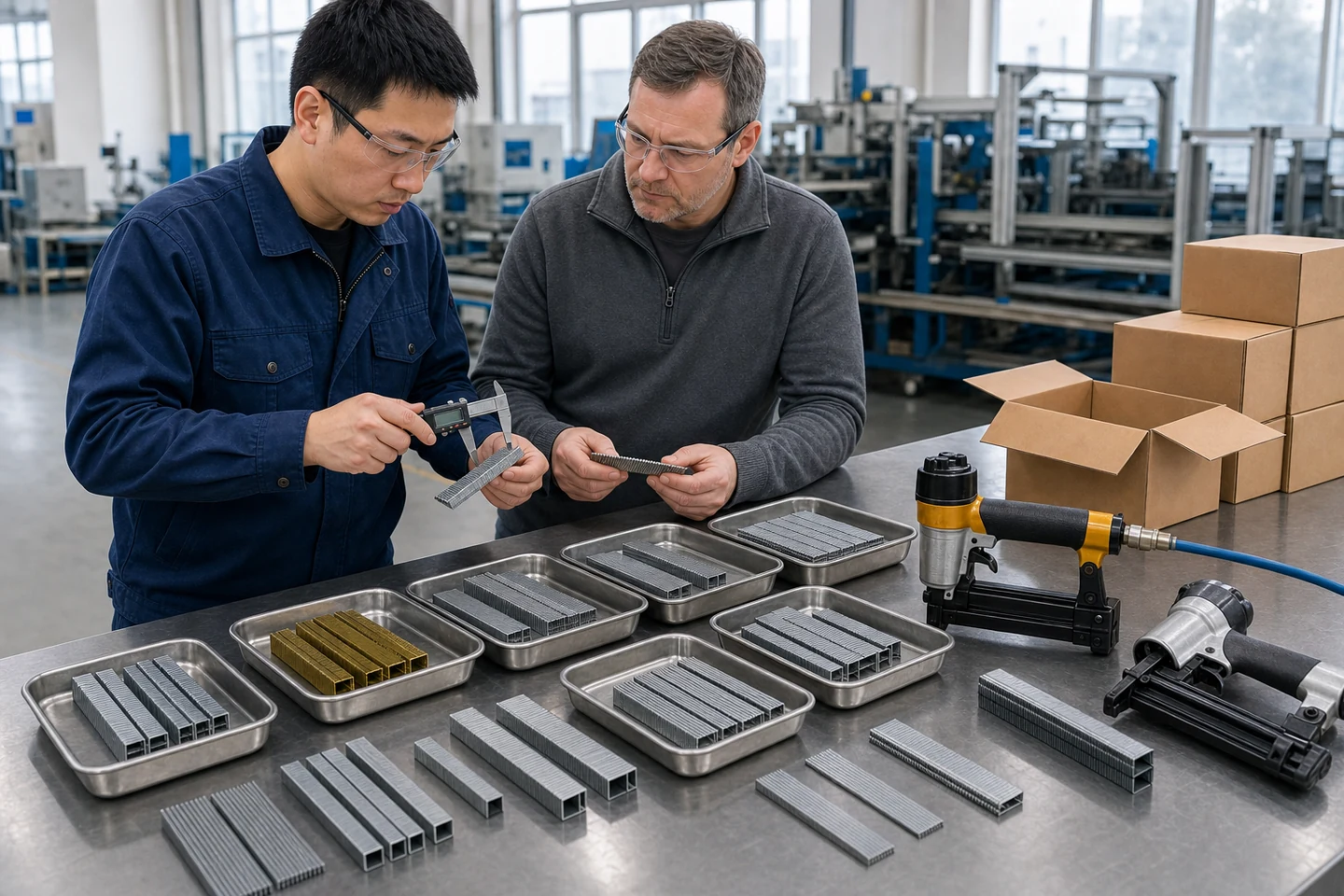
Send the existing strip, stapler model, application, series, leg lengths, finish, box quantity, and destination. When buyers do not know every dimension, the current box and tool reference can still give the discussion a useful direction.
Review the Air Staple Pin category and the wider Pneumatic Nails range.
The box should settle the identity question
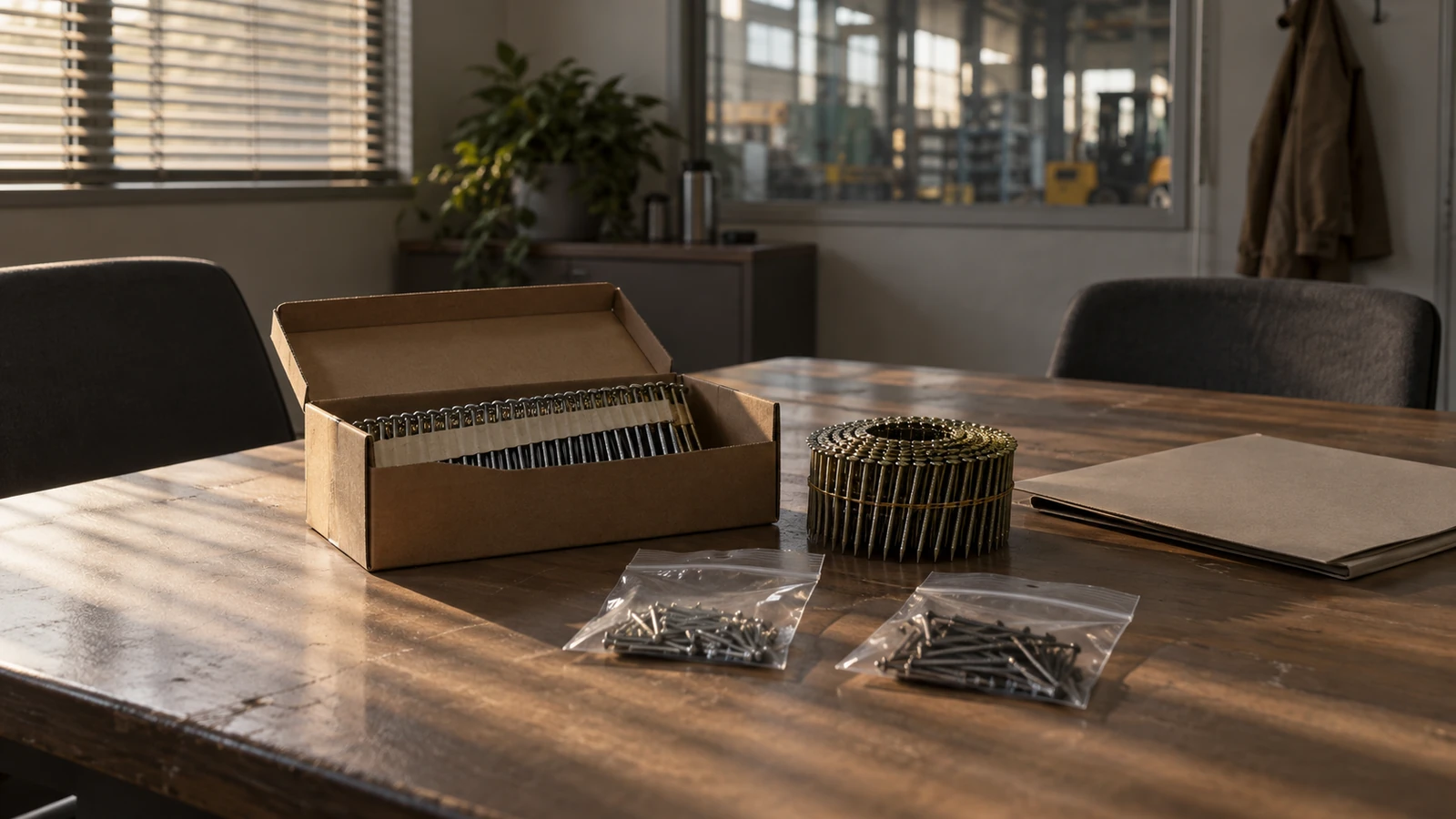
A private-label staple box needs clear product information: series, gauge, crown, leg length, finish, quantity, tool reference, barcode, and language where required. Similar lengths should not rely on a tiny number in one corner.
Artwork approval belongs beside sample approval. Keep the final box file, product reference, inner quantity, and master-carton marks connected. This matters on a repeat order, when an old barcode or an earlier length description can otherwise reappear.
Collation needs protection after production
A straight staple strip can become unusable after a weak inner box or a heavy mixed load. Buyers should discuss strip orientation, inner support, carton weight, moisture protection, pallet arrangement, and how different series will be separated during receiving.
Plain export cartons may be appropriate for one buyer, while another needs retail-ready color boxes and barcodes. Both still require the same basic outcome: the staples arrive aligned, identifiable, and ready to load.
Samples keep the conversation product-led
A sample can be tested in the intended stapler and actual material before artwork and production quantities are finalized. Feeding, drive result, crown marks, strip condition, and box handling give the buyer something concrete to approve.
Pneumatic tool operation must follow the tool manual and workplace rules. OSHA's overview of pneumatic-tool safety offers general guidance alongside local requirements.
A staple account can grow into a wider range
ProAirNails is backed by Huajian, established in 1997 and manufacturing several fastener categories for international markets. Buyers who begin with staples may later add brad nails, pins, coil nails, screws, or related tools for the same customers.
The broader operation is described at About ProAirNails. Product, packing, quantity, and commercial terms remain subject to order confirmation.
Send the staple customers already load
The best first inquiry is usually a current strip or box, the stapler model, the application, and the quantities that already sell. ProAirNails can then review the product, sample, artwork, and packing requirements.
Start through the ProAirNails inquiry page.
Implementation Checklist, Cost, and Limits
- Keep product approval separate from artwork approval.
- Print the exact series, gauge, crown, leg length, and quantity.
- Use one controlled artwork filename and revision for each SKU.
- Approve inner box, master carton, barcode, and pallet mark together.
Cost and value: Artwork changes look inexpensive until boxes are printed. Late corrections can delay production or create unusable packaging, while unclear labels increase returns and warehouse mistakes. A signed proof reduces both risks.
Limit: Packaging approval does not prove staple compatibility. The actual staple still needs a tool-and-material test, and destination-market labeling or legal requirements must be checked by the buyer.
FAQ
What buyers use pneumatic staples in bulk?
Furniture and woodworking suppliers, packaging buyers, fastener distributors, industrial importers, and private-label brands commonly purchase staple ranges.
Can buyers send an existing staple strip for matching?
Yes. Include the stapler model, application, target lengths, finish, quantity, packing, and destination so the product can be reviewed in context.
Can staple boxes carry a private label?
Private-label artwork, barcode, languages, quantities, and carton marks can be discussed with the product and packing specification.
Contact ProAirNails for a staple sample and private-label packaging discussion.