
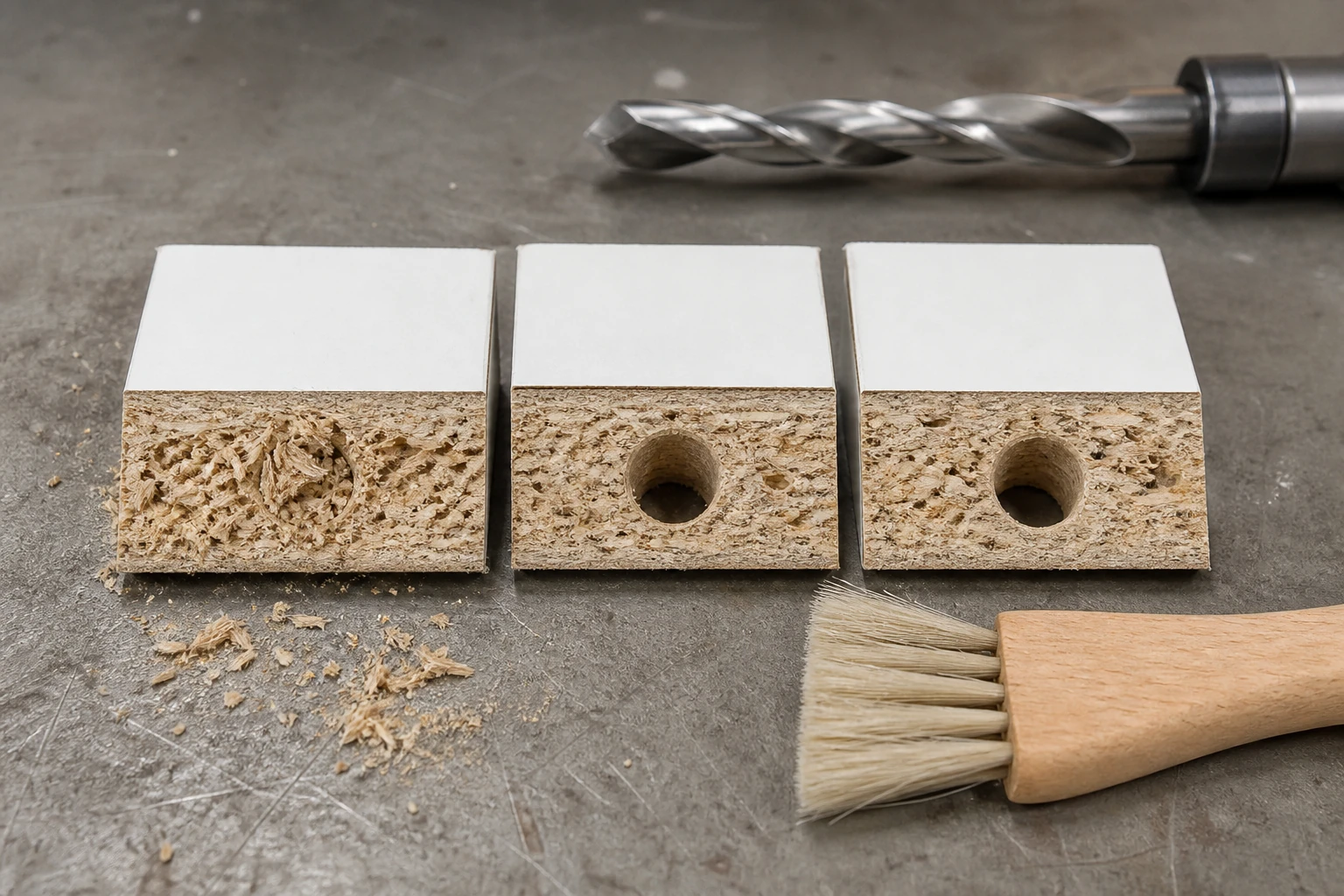
Chipboard screw pilot hole chip evacuation is the controlled removal or management of drilling debris so the screw enters the intended hole geometry instead of compacting a hidden plug at the bottom or along the wall. Drill travel alone does not prove usable depth: loose chips can settle, repack during driving, hold a screw proud, open a joint gap, or change the apparent stripping point.
ProAirNails recommends comparing matched holes in the same board rather than assuming that more aggressive cleaning is automatically better. The test should preserve the as-drilled state, quantify what was removed, and connect each method to seating and joint evidence.
Define the question the cleaning method must answer
Decide whether the concern is blocked depth, debris at the entry, wall smearing, screw seating, stripping, surface bulge, or joint closure. These are related but not identical outcomes. State the intended pilot diameter and depth, screw engagement, board construction, and whether the hole is blind or through-drilled.
Create matched holes before touching the debris
Use board coupons from the same panel and map density or face orientation where possible. Fix drill bit, speed, feed, runout control, entry angle, nominal depth, and dwell. Randomize the cleaning treatments across locations so an edge, denser zone, or warmed drill does not belong to only one group.
Compare three practical conditions
| Condition | Controlled action | Evidence to retain |
|---|---|---|
| As drilled | No cleaning or tapping | Entry image and sectioned control |
| Brush or vacuum | Declared tool, passes, suction, time | Collected debris and wall condition |
| Controlled air | Declared nozzle, pressure, distance, duration | Debris capture and safety setup |
| Procedure blank | Cleaning action without drive | Evidence of method-induced change |
Measure usable depth after debris treatment
Use a depth method that does not force chips deeper or enlarge the hole. Record the light contact rule, probe geometry, repeatability, and difference from programmed drill travel. Section selected controls after measurement to see whether the probe contacted the true bottom, a chip plug, or a smeared wall feature.
Keep removed material as data
Capture debris from each coded hole where practical. Compare mass or volume only with a method sensitive enough for the sample, and photograph particle form. Large flakes, fine dust, and compacted plugs can behave differently. Losses to the bench or vacuum line should be declared rather than silently treated as zero.
- Code every hole before drilling.
- Use separate clean collection media.
- Record drill cycles between bit cleaning.
- Inspect entry breakout and surface bulge.
- Retain un-driven holes for sectioning.
Control compressed-air risk and test disturbance
Compressed air can eject high-speed particles and redistribute dust. Use guarding, extraction, appropriate personal protective equipment, and site safety rules; never direct air toward people. Excess pressure or close nozzle contact can erode the hole, change the specimen, and create a result that ordinary production cannot reproduce.
Drive screws using a fixed response sequence
Record starting torque or resistance where available, seating position, joint gap, surface bulge, splitting, stripping, and removal evidence. Keep screw, driver, speed, angle, clamp condition, and stop rule fixed. Chipboard screw pilot hole chip evacuation should be credited only when the cleaned condition repeatedly changes the relevant outcome without introducing hole damage.
Interpret the combined evidence
| Pattern | Possible mechanism | Next control |
|---|---|---|
| As-drilled screws remain proud | Bottom plug or insufficient true depth | Section hole and compare usable depth |
| All groups seat equally | Debris not limiting this condition | Retain simplest reproducible route |
| Air-cleared holes strip earlier | Wall erosion or altered diameter | Reduce pressure and inspect sections |
| Vacuum group shows less bulge | Less repacked material | Repeat across board locations |
| Large within-group spread | Board or drilling variation | Improve blocking and sampling |
Use torque testing with a declared boundary
The official ISO 16047:2005 page addresses torque/clamp-force testing for threaded fasteners under specified conditions. It does not prescribe a chipboard cleaning method or reproduce particleboard hole-wall failure, so torque evidence must be paired with representative substrate observations.
Build a sampling plan after defining the defect
The ISO 2859-1:2026 page describes lot-by-lot attribute sampling indexed by AQL. It may support inspection after proud seating, stripping, bulge, or joint gap is operationally defined, but it does not select acceptable values for a furniture joint.
Select the least disruptive effective method
If two methods deliver equivalent seating and joint results, prefer the one that is safer, easier to control, and less likely to alter the hole. Document nozzle wear, brush wear, vacuum condition, cycle time, and verification frequency. A laboratory cleaning method is valuable only if production can reproduce it.
Send ProAirNails a matched-hole record
Provide screw specification and lot, board type and condition, drill and bit, diameter, programmed depth, hole map, cleaning methods, actual depth, debris evidence, driver conditions, seating, stripping, bulge, and joint gap. ProAirNails can discuss chipboard screws, the broader screw range, other products, and samples through the inquiry page.
Report what the comparison cannot prove
One chipboard screw pilot hole chip evacuation comparison cannot prove long-term joint capacity, every board density, every screw design, or all production environments. Aggressive cleaning may alter the specimen, and a small coupon does not replace finished-product validation. ProAirNails can support identified screw evidence; the buyer controls joint design and release.
Retain sectioned and driven controls. Recheck chipboard screw pilot hole chip evacuation after changes to board, drill, bit, depth, cleaning equipment, screw, driver, joint geometry, or acceptance criteria.
FAQ
Why can drill travel differ from usable hole depth?
Loose or compacted chips can occupy the bottom even when the bit reached the programmed position.
Is compressed air always the best cleaning method?
No. It can eject dust, erode the hole, and create a method that is difficult to control safely.
How should hole depth be probed?
Use a declared light-contact method that does not compact debris or enlarge the hole.
Why keep an as-drilled control?
It shows whether cleaning changes usable depth, seating, bulge, stripping, or joint closure.
Should removed debris be retained?
Yes, where practical; coded debris helps compare quantity and particle form between methods.
Can a cleaner hole reduce seating problems?
It can when repacked debris is the limiting mechanism, but the controlled comparison must demonstrate that link.
What if air-cleared holes strip earlier?
Inspect for wall erosion or diameter change and reduce the cleaning severity before repeating the test.
Does equal seating mean every method is equivalent?
No. Also compare safety, hole damage, repeatability, cycle time, and joint evidence.
Why randomize cleaning treatments?
Randomization prevents board location or drilling sequence from belonging to only one method.
What changes require a new comparison?
Review changes in board, drill, bit, depth, cleaning equipment, screw, driver, joint design, or acceptance.