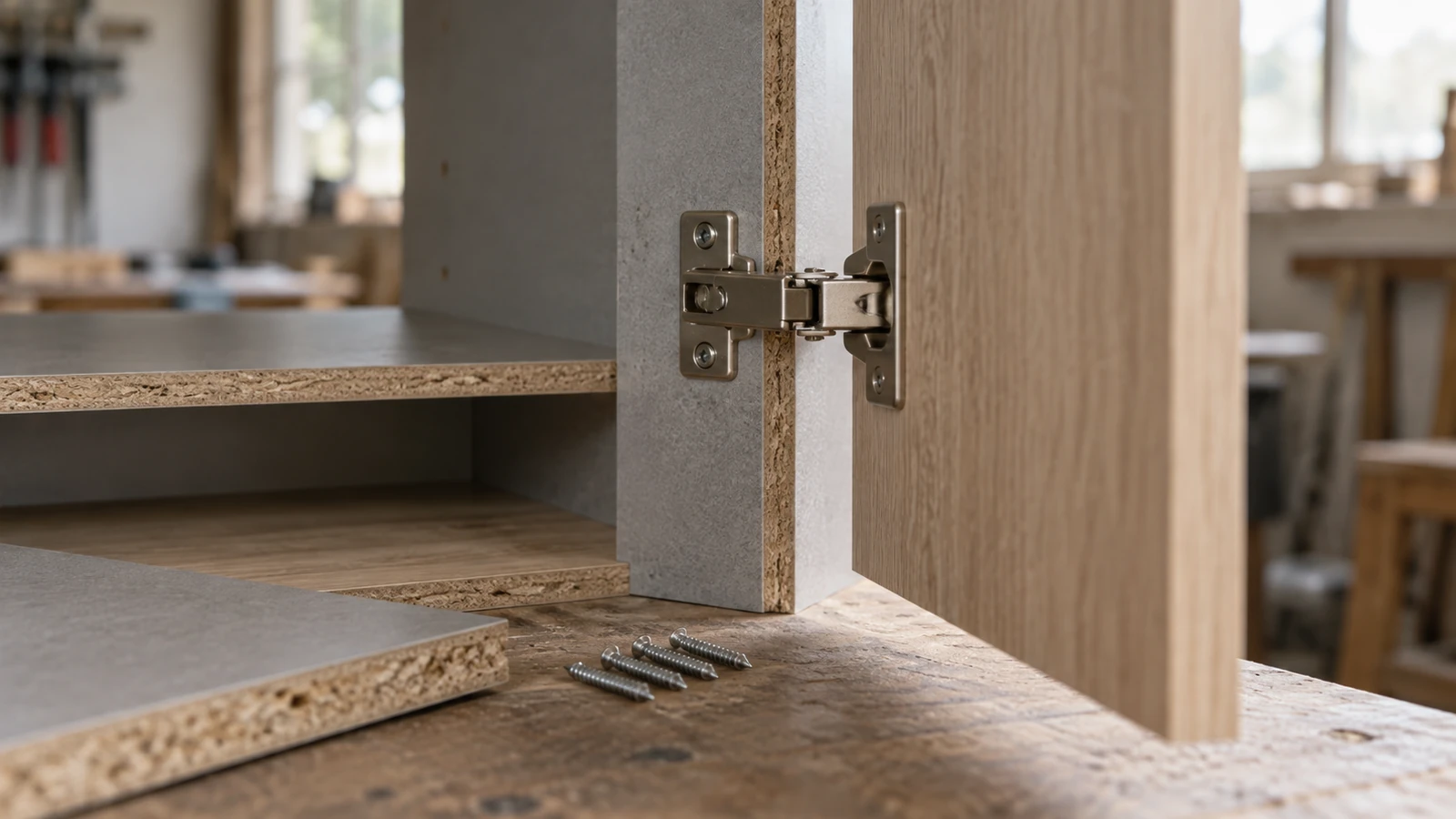

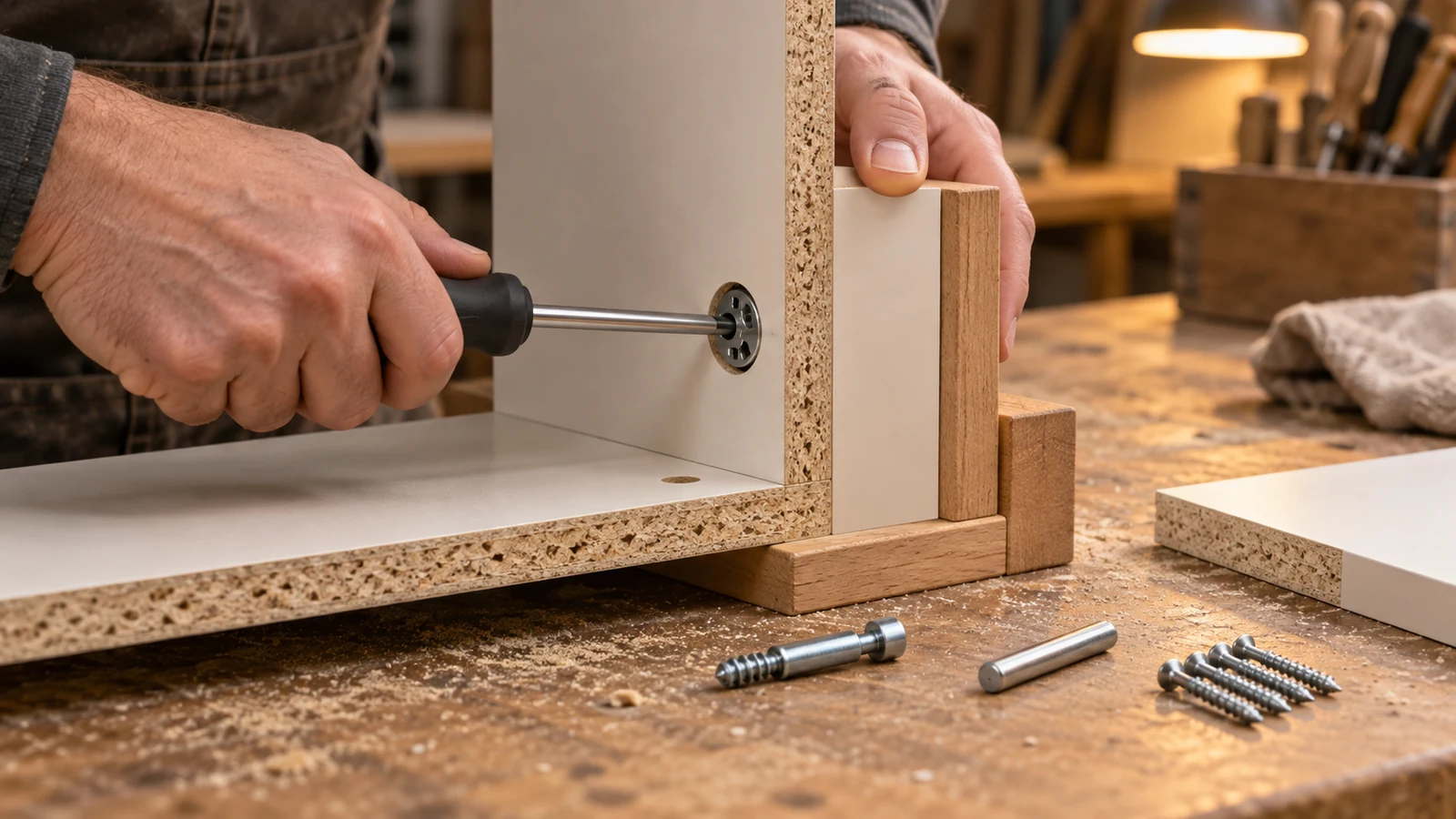
Chipboard screws for cam lock fittings are specified in flat-pack furniture more often than they are understood. The cam carries the clamping force. The screw positions the fitting or the panel, and the panel edge decides whether either of them holds.
ProAirNails supplies screws into furniture and shopfitting production, and the pattern behind most cam lock complaints is the same: a fixing that was placed by eye into the edge of a particleboard panel, tested on a finished unit rather than a trial joint, and repaired after the carton was sealed.
What chipboard screws for cam lock fittings are doing in the joint
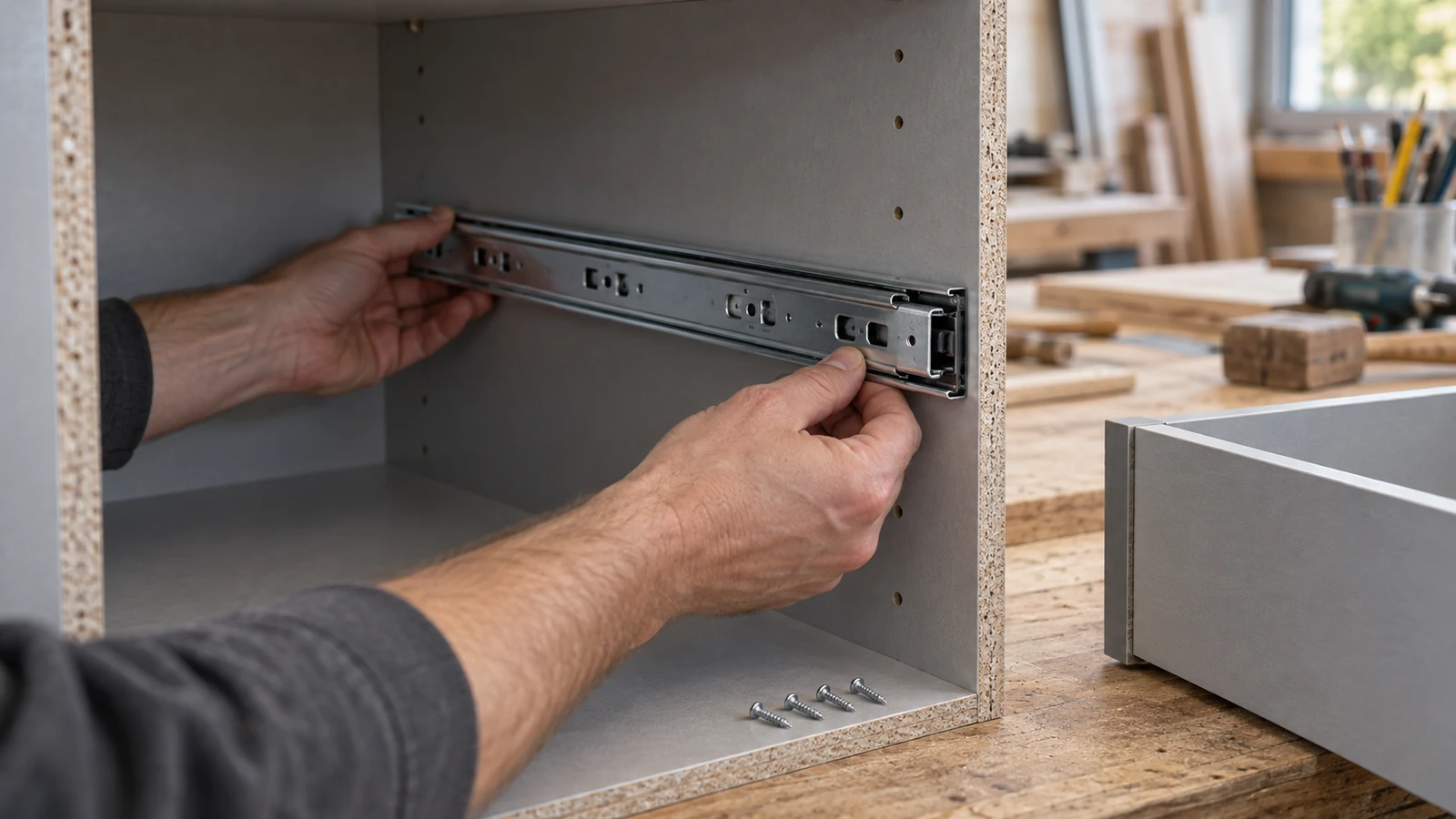
A cam and cam bolt joint is a clamping system. The bolt is screwed into the panel edge, the cam sits in the connecting panel, and turning the cam draws the two together. Nothing about that sequence depends on a screw in the panel face.
Where a screw appears around a cam lock, it is usually doing one of three other jobs: fixing the cam housing so it cannot rotate in its recess, holding a rail or bracket that the cam alone cannot position, or closing a joint that the design intends to be permanent. Naming which of the three the screw is doing is what makes the specification possible.
Cam, cam bolt and dowel: three jobs in one joint
Flat-pack joints typically combine a cam bolt, a dowel and sometimes a screw. Each has a different job, and the failure modes look alike from the outside, which is why a joint has to be tested as a system rather than as a list of parts.
| Element | Job in the joint | What fails if it is wrong |
|---|---|---|
| Cam and housing | Draws and clamps the bolt | The joint opens under load or the cam will not turn |
| Cam bolt | Anchors into the panel edge | Stripped threads in the edge, bolt pulls out |
| Dowel | Locates the panels and resists rotation | The joint rotates and the panel face misaligns |
| Screw | Positions a fitting or closes a permanent joint | Edge breakout, or a fixing that cannot be re-tightened |
Where the screw is allowed to go
In particleboard the strongest direction is into the face of the panel and the weakest is into the cut edge. A screw placed in the edge sits in the same material the cam bolt is already using, which is how a joint loses both anchors at once.
The rule is simple to state and easy to break under production pressure: keep chipboard screws for cam lock fittings out of the panel edge unless the design has nothing else to offer, and when they must go there, shorten them and move them away from the bolt.
Edge distance in particleboard
Particleboard has a dense face and a softer core. A screw that runs too close to an edge breaks out of the face; one that goes too deep into a thin panel reaches the core and holds very little. Both failures are visible after the fact, and edge distance is the variable that decides whether chipboard screws for cam lock fittings behave or not.
| Condition | Risk | What to settle |
|---|---|---|
| Screw near a panel edge | Breakout on the visible face | Edge distance and the direction of the fixing |
| Thin panel section | The screw reaches core material only | Length, thread form and whether a screw belongs at all |
| Near a cam bolt | Both anchors share the same weak material | Separation between the two fixings |
| Re-tightened after assembly | The fixing has already lost its bite | Whether the joint can be adjusted without removal |
These rows describe the decisions, not the numbers. The numbers come from a trial on the actual panel and the actual screw.
Test the joint, not the finished unit
A cam lock joint that is tested on an assembled cabinet is tested on a structure, not on a joint. By the time the unit is standing, the fixings have already been loaded, and any movement has been distributed through the whole frame.
- Build the joint as a test piece, using the panel, the edge banding and the fixing the production line will use.
- Assemble and disassemble it several times if the product is expected to be taken apart.
- Load it the way the finished unit will be loaded, not only the way it goes together.
- Keep the tested piece as the reference for the next order and the next panel supplier.
The FIRA furniture testing and standards work is a useful reference for how furniture performance is normally expressed, and the BIFMA standards programme shows the same logic applied to commercial furniture. Neither tests a joint for you, and both make the point that the joint is where the performance is decided.
Rework options and what each one costs
When a cam lock joint fails on a production line, the instinct is to add a screw. That is a repair to the geometry unless the design intended a screw in the first place, and it moves the failure to the next weakest point.
The honest options are a shorter or coarser screw in a different position, an additional dowel, or a change to the cam bolt itself. All three are cheaper to evaluate on a test piece than on a returned flat pack, and all three are easier to judge when the chipboard screws for cam lock fittings were specified against a joint rather than against a finished cabinet.
Kit quantities and the missing screw
In flat-pack production the fixing is part of a kit, and the kit is counted. A screw that exists because the joint needed it is a line on the bill of materials; a screw that exists because someone was unsure is a line that gets miscounted. Tightening the specification is also how the kit count becomes reliable.
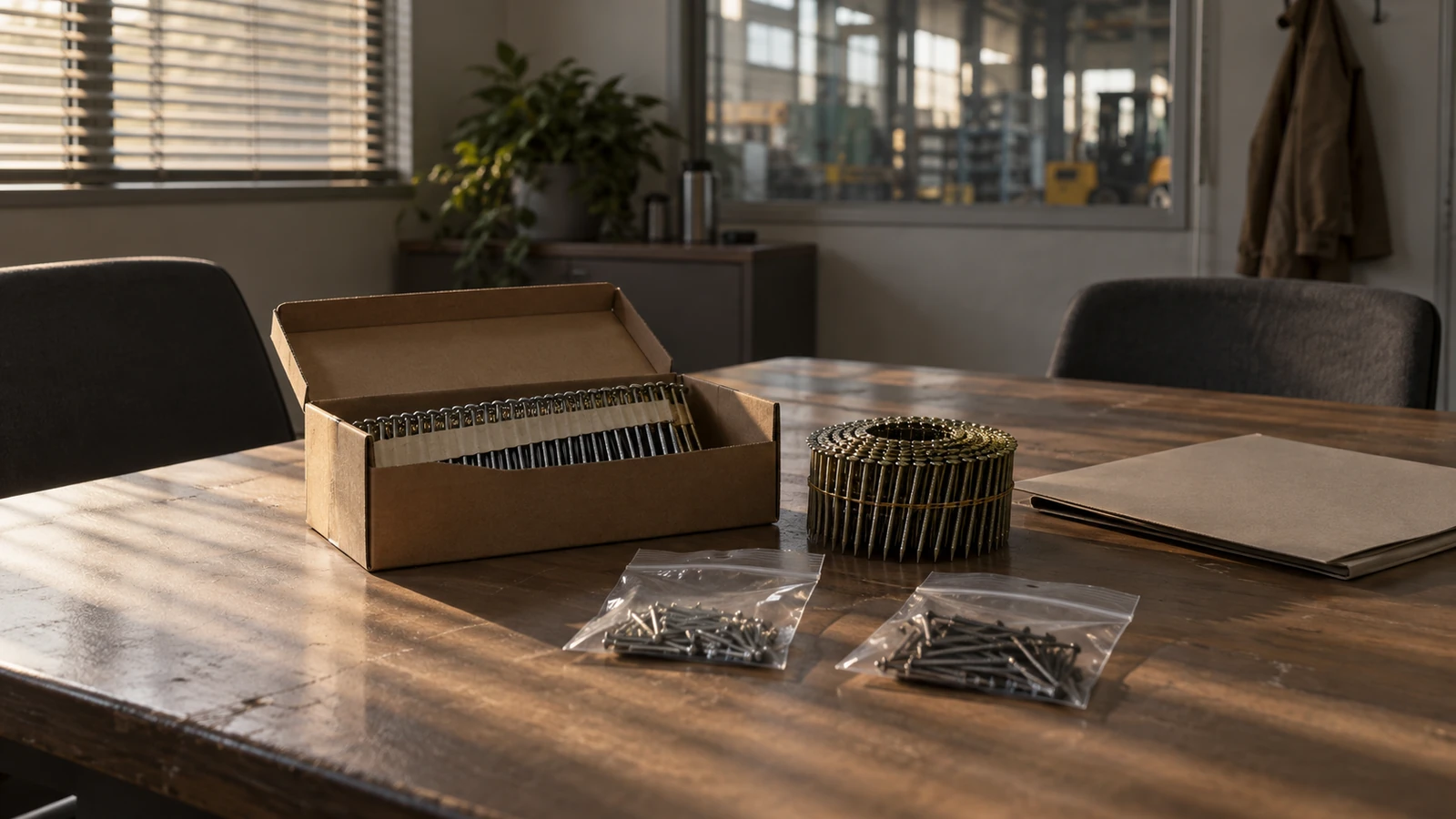
ProAirNails supplies screw products alongside pneumatic nails for furniture and shopfitting production. A kit that is specified joint by joint is a kit that can be counted, packed and reordered without a new decision each time.
Packing so the joint arrives square
A flat pack travels as panels, and its joints are assembled by someone who has never seen the production line. That makes the packing drawing part of the joint specification: which fixings go with which joint, and what the customer does if the cam will not turn.
A joint that needs a screw to hold it closed but ships without one is not a design error that shows up in the factory. It shows up as a support call.
ProAirNails supplies fixings into flat-pack and shopfitting production, and the enquiries that go smoothly are the ones that arrive with a joint detail rather than a part number. A test piece also has a limitation worth stating: it proves the joint, not the production line.
FAQ
Does a cam lock need a screw as well?
Usually not, unless the screw is fixing the cam housing or a component the cam cannot position. Adding one to a working joint moves the failure rather than removing it.
Can chipboard screws for cam lock fittings be driven into the panel edge?
They can, and the edge is the weakest direction in particleboard. Where it is unavoidable, shorten the screw and keep it away from the cam bolt.
Why does the cam turn without clamping?
Usually the cam bolt is not seated to the right depth, or the housing has rotated in its recess during assembly.
What causes breakout on the panel face?
A fixing too close to the edge, or one that was re-tightened after it had already lost its grip.
Should the joint be tested assembled or as a test piece?
As a test piece. A finished unit distributes the load through the frame and hides what the joint is doing.
How many assembly cycles should a trial cover?
As many as the product is expected to survive, plus a margin, because a joint that is never taken apart has not been tested for a product that is.
Does edge banding change the joint?
It changes the effective edge and can change how the fixing behaves, so the trial should use banded panels if production does.
What should be recorded from a trial?
Panel material and thickness, fixing type and length, edge distance, number of cycles, and photographs of the failure.
How do I stop kit quantities drifting?
Specify the fixing joint by joint, so every item in the kit has a reason that can be checked.
What should an enquiry include?
Panel material and thickness, cam lock type, the joint detail and the number of assembly cycles the product has to survive.
Specify the joint, then the screw
A cam lock joint is a system, and the screw is a decision inside it. Chipboard screws for cam lock fittings are specified joint by joint, so ProAirNails can quote the screw, the coil nails and the pneumatic fasteners around it once the joint detail is on the table. Send the panel build-up, the cam lock type and the test piece result through Contact Us, and the reply can be built around the joint rather than a part number.