
What a construction nails wholesale supplier really needs to get right
A construction nails wholesale supplier is not just moving cartons off a pallet. For contractors, lumber yards, and procurement teams, the supplier has to keep fasteners moving into the field without slowing framing crews, roofers, or carpenters who cannot afford a shortage in the middle of a build. With construction nails, the difference between a smooth job and a frustrating one often comes down to whether the right format is available at the right time: loose bulk nails for general use, or collated coil nails for pneumatic nail guns on high-volume work.
That is why buyers rarely shop nails on price alone. They are usually trying to solve a more practical problem: which supplier can support the application, keep inventory steady, and offer packaging that fits how the crew actually works.
Quick takeaways for buyers
Construction nails are basic on paper, but the buying decision is not always basic. A solid wholesale source should help you match the fastener format to the job:
- Loose nails make sense for general construction, repair work, and mixed use.
- Collated coil nails are better suited to pneumatic fastening systems and repetitive framing work.
- Bulk cartons matter when you are feeding a crew, not a workstation.
- Packaging and consistency are just as important as the nail itself when uptime matters.
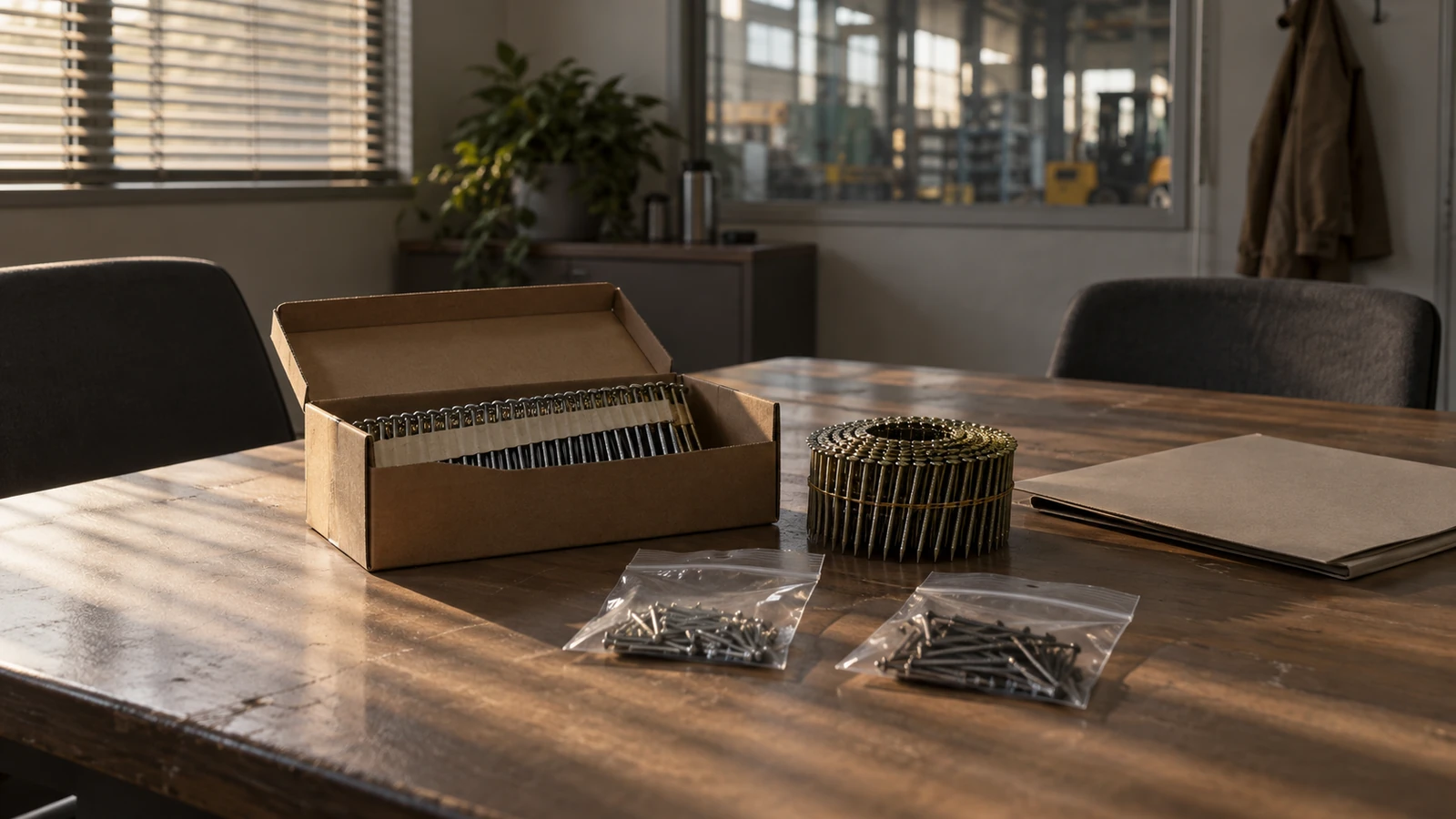
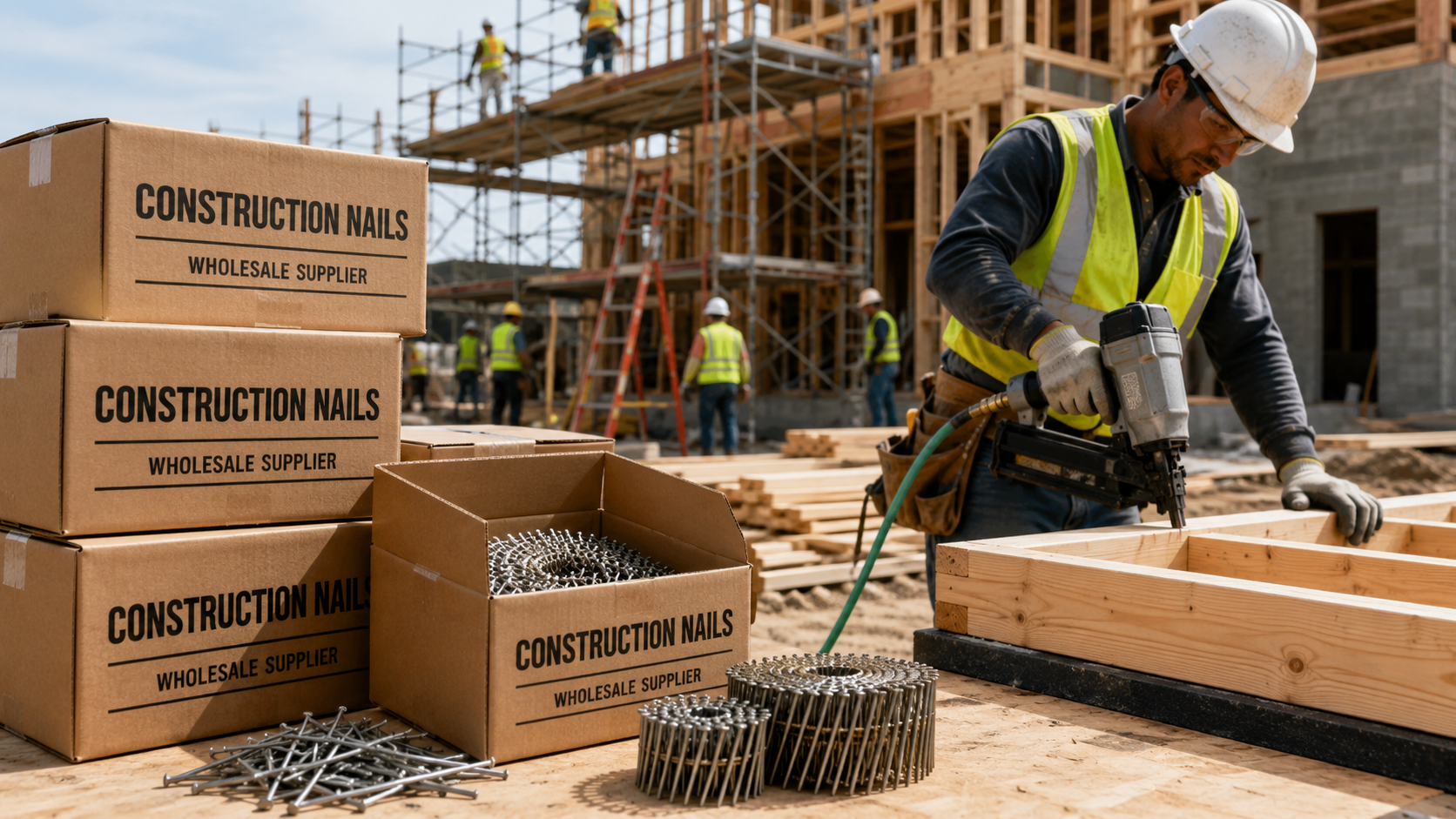
The image supplied shows exactly that split: loose nails scattered for bulk supply, coil nails bundled for nail gun use, and carton packaging positioned as wholesale inventory. That combination tells you the supply chain is built around construction throughput, not just retail sales.
Why the format matters more than people think
A lot of buyers search for nails wholesale near me hoping the closest distributor will solve the problem. Sometimes proximity helps. But the wrong nail format can create more waste than a longer delivery route ever would.
Loose bright or common steel nails are still common in wood-frame building and general construction. They are straightforward, familiar, and often appropriate where hand nailing or simple bulk stock is enough. Collated coil nails, by contrast, are made for speed. Once they are loaded into a pneumatic nail gun, the crew can fasten sheathing, framing members, decking, or subfloor assemblies much faster than by hand. That is not a small difference on a jobsite. It changes labor rhythm.
A careful buyer will ask not only “What nails do you stock?” but “What fastening workflow are these nails supporting?”
Loose bulk nails versus collated coil nails
Loose bulk nails
These are the simplest form: straight shank, pointed fasteners with flat heads, sold in bulk cartons or loose packs. They are easy to distribute and can suit a wide range of construction and carpentry tasks. The tradeoff is speed. If a crew is driving thousands of nails, loose stock is rarely the most efficient option.
Collated coil nails
Coil nails are bundled for use in nail guns, which makes them the practical choice for framing and other repetitive fastening jobs. The image suggests a machine-made fastener with secondary collating and packaging, which is typical of wholesale supply for powered tools. Exact coatings, shank patterns, and dimensions are not visible here, so those details should be confirmed before ordering. That caution matters; a small mismatch can turn into tool jams or a fastener that is simply not right for the substrate.
What sourcing managers should check before placing an order
If you are evaluating a construction nail distributor, start with the boring questions. Boring questions save money.
Confirm whether the supplier can provide both bulk and collated formats, because your customer base may need both. Ask how products are packaged and whether cartons are standardized enough for warehouse handling. Verify that the nail format matches the intended tool system, especially for pneumatic nail guns. And do not assume metallic gray or silver appearance tells you everything about finish or corrosion behavior. It usually does not.
For exterior work, roofing, or coastal environments, buyers often need more detail than a photo can provide. If the supplier cannot clearly identify coating, shank type, or dimensional data, that is a warning sign, not a minor omission.
Common buying mistakes
One common mistake is treating all construction nails as interchangeable. They are not. Another is buying only by local availability and forgetting the application. A supplier may be nearby and still not be the right fit if they cannot support the nail format your crews actually use.
Another quiet problem is mixing wholesale and retail expectations. Wholesale supply should be about consistent cartons, stable replenishment, and predictable product grouping. If a supplier cannot explain whether the boxes contain one uniform specification or mixed assortments, the buyer has a planning problem on their hands.
Practical advice for contractors and wholesalers
Contractors should align nail purchasing with job type: framing, carpentry, deck work, roof work, or general assembly. Wholesalers and supply houses should think about shelf mix and tool compatibility, not just unit volume. The best inventory is the one that keeps crews moving without forcing last-minute substitutions.
If you are building a supply relationship, ask for clear product identification, packaging details, and the intended fastening method. That short list can prevent a lot of field frustration.
Frequently asked questions
Are construction nails only for framing?
No. They are used across wood-frame building, carpentry, subfloor assembly, decking, roofing, and general construction.
Why use collated nails instead of loose nails?
Collated nails are designed for pneumatic nail guns and speed up repetitive fastening. They are better suited to high-volume work.
What should I verify before buying wholesale?
Check the nail format, packaging, tool compatibility, and any material or finish details that matter for the job.
Next step
If you are comparing suppliers, look beyond the carton label. A dependable construction nails wholesale supplier should give you the right mix of bulk and collated fasteners, clear product information, and packaging that fits real construction workflows. That is the difference between stocking nails and actually supporting a jobsite.