
What a custom fastener manufacturer really does for industrial buyers
When engineers search for a custom fastener manufacturer, they are usually not shopping for generic catalog hardware. They are trying to solve a fit problem, a repeatability problem, or a supply problem. A standard bolt may be close enough for a prototype, but production equipment has a habit of exposing every small mismatch: thread engagement, shoulder length, head height, tool clearance, or the way a part seats against a machined surface. That is where made-to-spec fasteners become less of a convenience and more of a necessity.
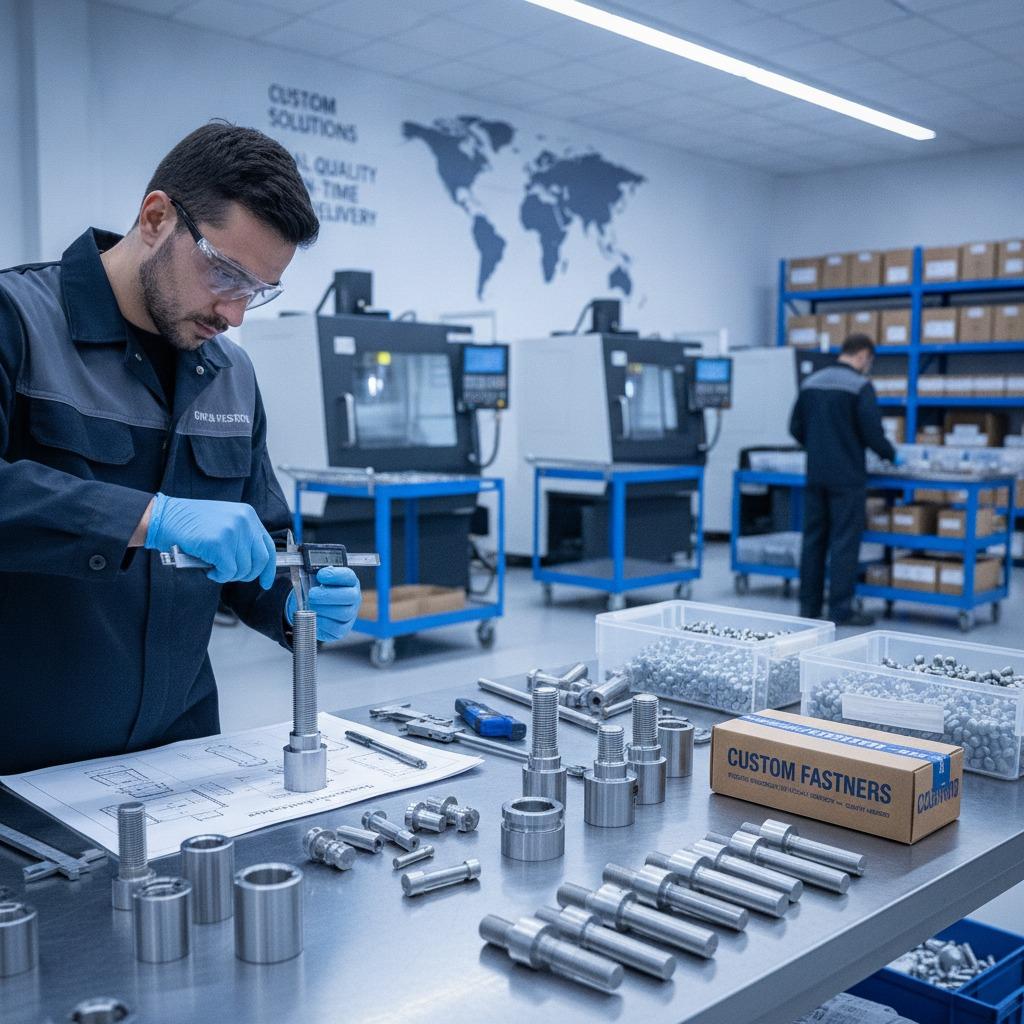
The parts shown in the supplied material point to a manufacturing environment built around custom metal fasteners and related precision machined hardware. The visual cues are straightforward: turned metal parts, threaded components, organized bins, inspection tools, and engineering drawings. In practical terms, that usually means the supplier is working with custom bolts, screws, studs, threaded spacers, standoffs, bushings, and other small turned parts used in machinery, automation equipment, fixtures, enclosures, and general industrial assemblies.
Why custom fasteners matter more than people expect
Fasteners are often treated as low-value items until one causes a stoppage. A few millimeters off on a stud, or a thread that does not match the mating part cleanly, can delay assembly, create rework, or force a field repair. That is why buyers evaluating a custom fastener manufacturer should look beyond price per piece and ask whether the supplier can hold consistency across batches, communicate clearly on drawings, and inspect parts in a way that matches the application.
For OEMs and maintenance teams, the main advantage of custom production is control. You can match the part to the assembly instead of redesigning the assembly around a stock fastener. That matters for compact equipment, unusual spacing, legacy machinery, and parts that need a specific grip length or threaded section. It also matters when the fastener needs to support positioning, not just clamping.
Common custom fastener types and where they fit
Custom nut manufacturer work
A custom nut manufacturer may be asked to produce nuts with unusual heights, wrenching features, internal thread requirements, or mating surfaces that suit a specific assembly. In many shops, these parts are part of a broader precision machining workflow rather than a standalone product line.
Custom stud manufacturer work
A custom stud manufacturer typically serves applications where one end remains fixed in a housing or component while the other end supports a nut, spacer, or secondary part. Studs are common in equipment frames, motor assemblies, and fixtures where access is tight. If the stud length or thread form is off, assembly becomes awkward quickly.
Related machined hardware
Threaded spacers, standoffs, and bushings often sit in the same procurement bucket. They may not look like fasteners at first glance, but they solve the same problem: accurate spacing, alignment, and secure assembly.
What the manufacturing and inspection workflow should tell you
The scene described in the preparation data suggests CNC equipment and a controlled inspection setup. That is a useful signal. For buyers, it usually indicates the supplier understands that custom fastener manufacturing is not only about shaping metal. It is also about managing dimensions, threads, and lot-to-lot consistency.
A well-run shop will generally rely on a mix of precision turning, thread cutting, and inspection against drawings. The exact process can vary; some parts may be machined from bar stock, while others may involve additional steps such as heat treatment or surface finishing. Those details should be confirmed directly with the supplier rather than assumed. The important point is whether the supplier can translate a drawing into a repeatable part and verify it before shipment.
A caliper check is not the whole story, of course. It is a practical sign, not a guarantee. But when it is paired with labeled inventory, engineering prints, and organized production flow, it suggests a more disciplined operation than a casual job shop.
How to choose the right supplier
The best custom fastener manufacturer for one project may be the wrong choice for another. A prototype supplier can be excellent at speed and flexibility, while a production supplier may be better suited for consistency and process control. Buyers should ask a few direct questions:
What fastener types are routinely produced in-house?
Can the shop work from drawings and revision-controlled specifications?
How does the supplier verify critical dimensions and thread fit?
What materials are commonly used for the part family, and what finishing options are available if needed?
Can the supplier support both small-batch and serial production without losing traceability?
It is also wise to be specific about the application. A fastener for an industrial enclosure does not have the same demands as one used in a moving machine assembly. The more the supplier knows about load, access, corrosion exposure, and service conditions, the fewer surprises later.
Common buyer mistakes
One common mistake is treating custom fasteners like commodity hardware with a slightly different shape. That usually leads to vague drawings and disappointing samples. Another is ignoring assembly conditions. If a part will be installed with hand tools, in a tight envelope, or next to delicate components, head style and tool access matter as much as the thread itself.
A smaller but costly mistake is over-specifying what does not matter and under-specifying what does. If a drawing omits the fit-critical thread detail or the required shoulder dimension, the supplier may produce a perfectly machined part that still does not work.
Practical next step for sourcing teams
If you are comparing suppliers, start with the drawing, then the inspection method, then the production process. That order keeps the conversation focused. The right custom fastener manufacturer should be able to discuss geometry, material choice, inspection, and batch consistency without drifting into vague promises.
For OEM sourcing teams, the simplest test is this: can the supplier explain how the part will be made, checked, and repeated on the next run? If the answer is clear, you are probably talking to a real manufacturing partner rather than a broker with a nice brochure.
If your current project involves custom nuts, studs, or other precision machined fasteners, the next move is to prepare a clean drawing package and request a process review before quoting. That small step often saves far more time than chasing a cheaper unit price later.