
Why buyers keep searching for a custom fastener manufacturer
When standard hardware does not fit the assembly, a custom fastener manufacturer becomes less of a sourcing preference and more of a production requirement. Engineers run into this problem in machinery builds, repair work, prototype programs, and any design that mixes tight spaces, unusual loads, or legacy interfaces. A fastener that is almost right is usually just another delay. It may work on the bench and fail the drawing, or it may fit the drawing and still create trouble on the line.
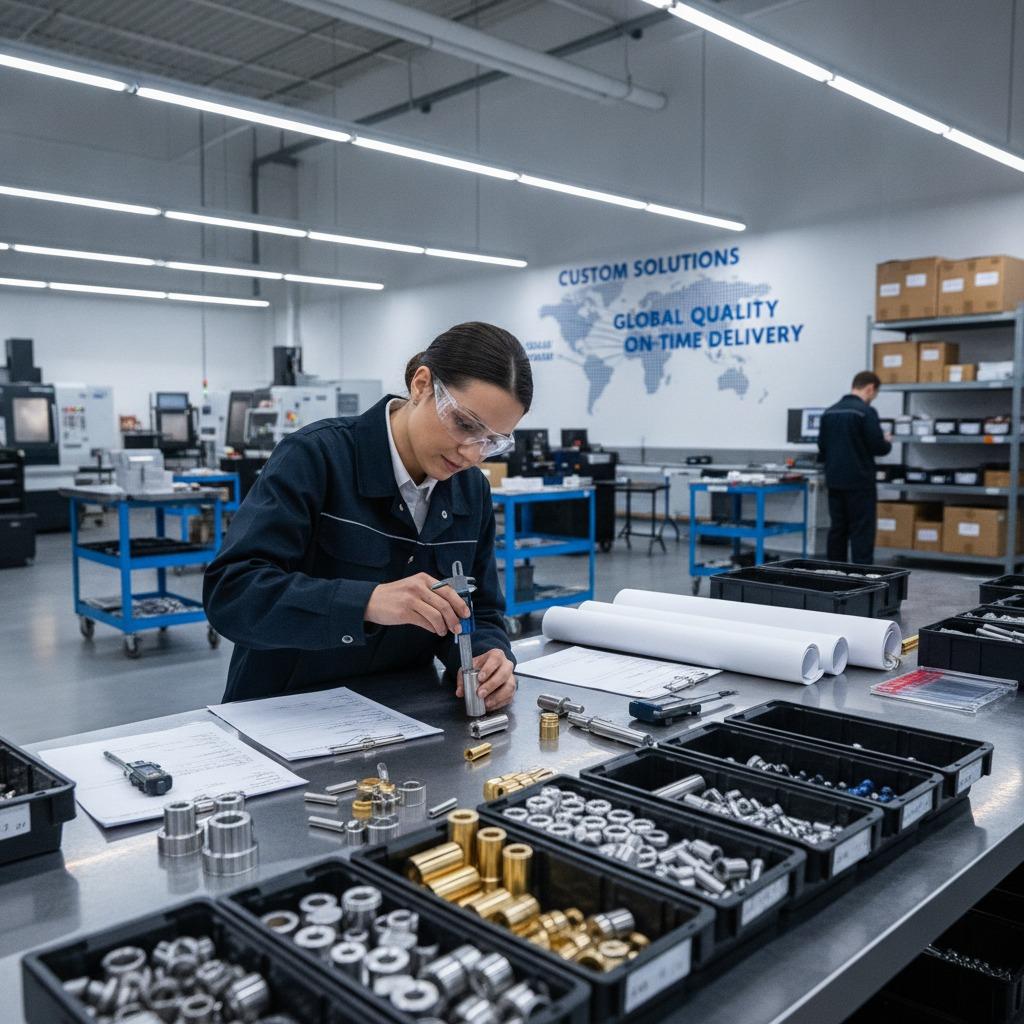
That is why the search is rarely about buying “a bolt.” It is about finding a supplier that can make custom precision fasteners and machined metal fastening components to order, then verify them before shipment. The bench-level details matter here: drawings, labeled bins, caliper checks, and orderly packing all signal a production workflow built around specification control rather than off-the-shelf convenience.
What custom fastener sourcing actually solves
Custom fasteners are not only for rare or exotic projects. They are often the practical answer when a design needs one of the following: a nonstandard length, a special shoulder, a stepped body, a different thread form, or a combined fastening-and-spacing function. In many assemblies, one custom part replaces two or three standard pieces and removes a stack-up problem at the same time.
That is also why buyers should think beyond the headline part name. A custom nut manufacturer may be asked to match an existing thread path, manage limited wrench access, or create a profile that works inside a compact housing. A custom stud manufacturer may need to support repeated service cycles, simplified assembly, or alignment in equipment where a conventional stud would project too far or interfere with adjacent components.
Common part types in custom fastener programs
The product category in question usually includes screws, bolts, studs, spacers, bushings, threaded inserts, and small turned parts. In practice, these pieces often perform more than one job. A spacer controls distance and alignment. A bushing can guide movement or reduce wear. A threaded insert can restore or strengthen a connection in a design that would otherwise strip too easily.
The parts visible in a shop setting typically suggest CNC turning and threading, especially when the components are cylindrical, stepped, hex-shaped, or shoulder-based. That does not mean every order is identical, of course. Some jobs may be simple turned parts; others may require closer inspection, sorting, or a more careful finishing workflow before packaging.
What a serious buyer should look for in a supplier
For sourcing managers, the first question is usually not “Can they make it?” but “Can they make it consistently from the drawing?” A capable supplier should be able to work from engineering documents, clarify dimensions when the print is incomplete, and flag ambiguous details before production starts. That is especially important for precision fasteners, where a small change in shoulder length or thread engagement can ripple through the whole assembly.
Inspection is another practical marker. A digital caliper on the bench does not prove full quality control by itself, but it does show that dimensional checking is part of the process. So do parts bins, drawings, and sorted packaging. Those small operational signs matter because custom fastening components are often ordered in batches that need to match one another, not just one sample piece.
Useful questions to ask before placing an order
Ask what information the manufacturer needs to quote the part accurately. At minimum, that usually means drawings, dimensions, material preference if known, and the intended application. If the part will see vibration, repeated assembly, or exposure to moisture, say so early. Even if the supplier cannot promise a specific performance outcome without full testing, that context helps avoid a poor design choice.
Also ask how they verify finished parts. A buyer does not need a laboratory lecture, but a clear answer about inspection steps is better than silence. In fastener sourcing, the difference between “custom” and “usable” is usually hidden in the details.
Selection criteria that matter more than marketing language
When comparing vendors, focus on fit-for-purpose capability. Can they machine small precision metal parts? Can they maintain repeatability across a batch? Can they package parts in a way that keeps mixed components separated and traceable enough for receiving inspection? Those are the questions that affect production flow.
Material and finish should be discussed carefully. The available information here suggests metallic parts with a silver or steel-like appearance, but exact alloy, coating, and heat treatment are not identifiable from the scene. Buyers should not assume those details. If corrosion resistance, conductivity, or strength are important, request the actual material specification rather than accepting a visual guess.
Common mistakes when ordering custom fasteners
The most common mistake is treating a custom fastener like a commodity item. It is not enough to specify a nominal thread and length if the part also has to manage spacing, alignment, or repeated disassembly. Another frequent issue is sending only a sample without a proper drawing. Samples help, but they do not replace dimensional data.
Buyers also sometimes overlook the assembly environment. A fastener that works in a clean prototype may behave differently in a vibrating machine, a high-temperature assembly, or a part that will be installed and removed many times. That is where a cautious discussion with the manufacturer pays off. It may not deliver instant answers, but it can prevent the expensive kind of surprise later.
Practical takeaway for engineering and sourcing teams
If your design depends on nonstandard hardware, a custom fastener manufacturer should be evaluated as part machining partner, part quality-control partner, and part packaging partner. The best suppliers do more than make a part look right. They help ensure the part fits, assembles cleanly, and arrives ready for the next process step.
For teams building OEM equipment, prototype assemblies, maintenance kits, or general industrial products, the real value of custom fasteners is control. Control over dimensions, control over fit, and control over the final assembly outcome.
Next step
If you are sourcing a custom fastener, start with the drawing and the application notes. Then compare suppliers on machining capability, inspection discipline, and responsiveness to technical questions. That is usually the fastest way to separate a capable manufacturer from a vendor who only handles catalog hardware.