
Drywall screw coating selection for gypsum board should begin with the exposure and finishing system, not with a color name such as black or zinc. The finish must be considered alongside screw geometry, substrate, joint layers, drive behavior, finishing compound, storage, and the project's acceptance requirements.
ProAirNails recommends documenting the service boundary, coating route, evidence, and first-lot checks before treating a finish as approved for repeat production.
Define the exposure and finish boundary
State whether the screw is for an interior dry room, conditioned space, high-humidity area, transport exposure, temporary storage, or a project with a specified coating class. Identify whether the screw will be covered by joint compound, paint, tile, sealant, or another finish. A coating selected for one wall system should not be generalized to every environment.
Compare finish decisions on one table
| Decision field | Buyer asks | Evidence to retain |
|---|---|---|
| Exposure | What moisture, storage, and service conditions apply? | Application and project boundary |
| Base screw | Are head, thread, point, and hardness unchanged? | Drawing and revision |
| Coating route | What cleaning, deposition, curing, and handling occur? | Process and lot identity |
| Surface interaction | Will compound, paint, or sealant adhere and remain clean? | Compatibility trial |
| Corrosion evidence | Which test, exposure, and acceptance apply? | Report with specimens and lot |
| Packaging | Can the finish survive transport and storage? | Carton and moisture review |
Keep the screw specification visible
The official ASTM C1002-22 page covers steel self-piercing tapping screws for specified gypsum-panel and plaster-base applications, including thread configurations and physical requirements. Use the applicable scope and project specification to select the base screw before comparing coatings. A finish cannot correct the wrong thread or point.
Separate appearance from corrosion performance
Color, gloss, texture, and visual uniformity help identify a finish, but they do not establish corrosion resistance. Record coating designation, thickness or method where specified, surface cleanliness, visible defects, storage conditions, and the test basis. Include white rust, red rust, staining, blistering, or adhesion observations when they are part of the acceptance rule.
Use salt spray for the question it can answer
The current ISO 9227:2022 page describes NSS, AASS, and CASS procedures and explains that the standard does not select product-specific exposure periods or predict long-term field life. Define specimen preparation, coating, exposure, inspection points, and interpretation in the product or project specification. Do not convert chamber hours into an unsupported service-life promise.
Run a gypsum-board compatibility trial
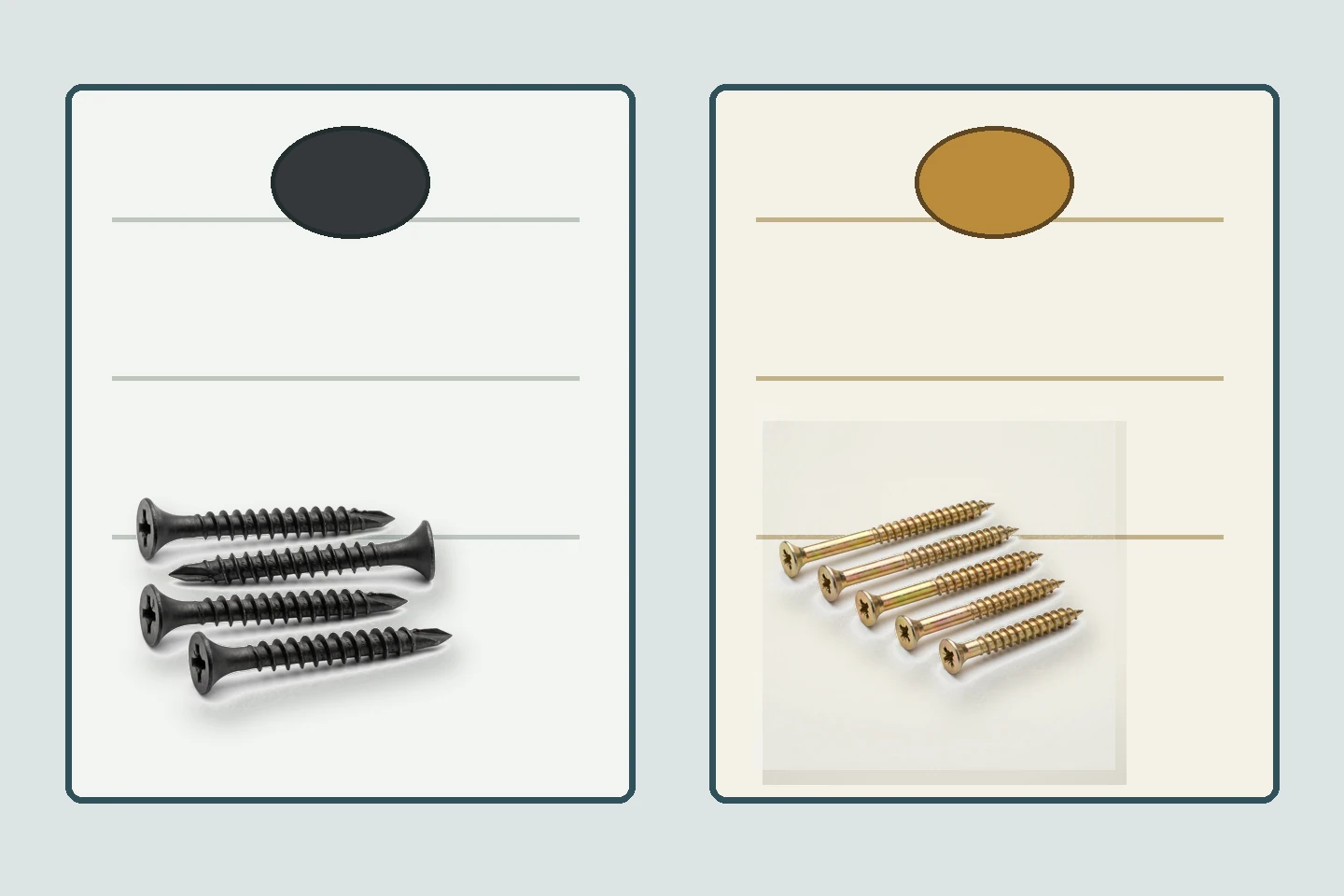
Use the approved board, support, bit, driver, speed, pressure, and depth-setting method. Check point entry, thread engagement, head seating, paper damage, proud heads, overdrive, recess condition, and the response of the compound or paint. Keep black, zinc, and other candidate finishes on separate, labeled panels so a visual or finishing difference can be traced back to the actual lot.
- Record board type, thickness, and layer count.
- Use the named bit and driver condition.
- Photograph accepted and failed seating.
- Apply the specified finishing system where relevant.
- Keep finished panels and raw screws for review.
Review finish defects by process stage
| Finding | Likely stage to review | Containment decision |
|---|---|---|
| Uneven color | Cleaning, deposition, curing, handling | Compare lot, rack, and time window |
| Rust or staining | Coating continuity, moisture, storage | Hold affected cartons and samples |
| Compound interaction | Surface chemistry or contamination | Run labeled finishing trial |
| Recess damage | Base geometry, heat route, bit, setting | Separate coating from drive cause |
| Mixed finish | Line clearance or packing | Trace and segregate cartons |
Control packaging and storage
Specify inner bag, liner, carton, label, lot, pallet, moisture barrier, and storage limits. A good coating can be compromised by wet cartons, condensation, salt contamination, or mixed products. Inspect carton corners and bottom layers after transport and record whether the defect existed before opening.
Use lot sampling before release
The official ISO 2859-1:2026 page describes AQL-indexed lot-by-lot sampling by attributes. Define identity, appearance, geometry, finish, and packaging defect classes separately. A sample result manages the stated sampling risk and does not guarantee every screw or every future finish lot.
Price the finished wall, not the screw color
Compare coating price with rust claims, touch-up, rejected boards, compound adhesion, inspection, storage, replacement freight, and project delay. A cheaper finish is not equivalent if it causes surface staining, inconsistent seating, or an unplanned hold. ProAirNails can discuss drywall screws, screw products, the product range, and technical RFQs through the inquiry page.
Keep the exact drywall screw coating selection for gypsum board decision beside the drawing and finishing specification so a purchasing shortcut does not replace the approved wall-system evidence.
Write a finish-specific RFQ
Send screw drawing, thread and point, base material, coating, exposure, gypsum board, finishing system, test method, acceptance, packaging, demand, destination, and change-notice timing. Ask the supplier to distinguish a production finish from a sample-only experiment. Keep drywall screw coating selection for gypsum board tied to the exact wall system and storage route.
Keep the conclusion inside its limits
A visual sample, salt-spray report, or one drive trial cannot approve every jurisdiction, wall assembly, exposure, or future process change. The project designer and buyer remain responsible for applicable requirements, safe installation, and final release. ProAirNails can provide evidence within the agreed specification.
Use drywall screw coating selection for gypsum board as a controlled application decision, not a universal ranking of colors or finishes.
FAQ
Should color decide the coating?
No. Exposure, finishing system, base screw, coating route, packaging, and evidence should decide.
Does ASTM C1002 choose the finish?
It provides applicable screw scope and requirements; the project and buyer define the coating decision.
What does salt spray show?
It evaluates a defined chamber procedure and coating response; it does not directly predict field life.
Why test compound interaction?
The finish may affect adhesion, staining, bleed-through, or the finished wall appearance.
What should be held after rust is found?
Hold the traceable lot and related cartons until coating, storage, moisture, and disposition are reviewed.
Can a coating fix a wrong thread?
No. Thread, point, head, and substrate selection must be correct before finish approval.
What belongs on the label?
Record SKU, screw definition, finish, lot, carton, quantity, revision, and storage or handling information.
When should coating be retested?
Retest after changes to base material, cleaning, deposition, curing, line, pack, supplier, or exposure.
How should finish quotes be compared?
Compare unit cost with inspection, storage, rework, claims, replacement freight, and project risk.
Who approves the wall system?
The buyer and project authority approve the application, requirements, installation, and final release.