
Why a drywall screw factory matters more than the box suggests
When buyers search for a drywall screw factory, they are usually not just looking for a place that puts fasteners into cartons. They are trying to reduce risk in a product that seems simple until it starts causing stripped heads, popped boards, slow installation, or rust complaints after handoff. In drywall work, the screw is small, but the consequences of a poor screw are not. A weak point in the supply chain can slow an entire crew.
For sourcing managers and engineers, the real question is not whether drywall screws exist in the market. It is how to judge the factory behind them: how consistent the screw geometry is, whether the finish holds up in ordinary interior use, and whether the supplier can deliver a product that installs cleanly in wood or light-gauge framing without creating extra rework. That is the decision this article helps narrow down.
What the product details tell you at a glance
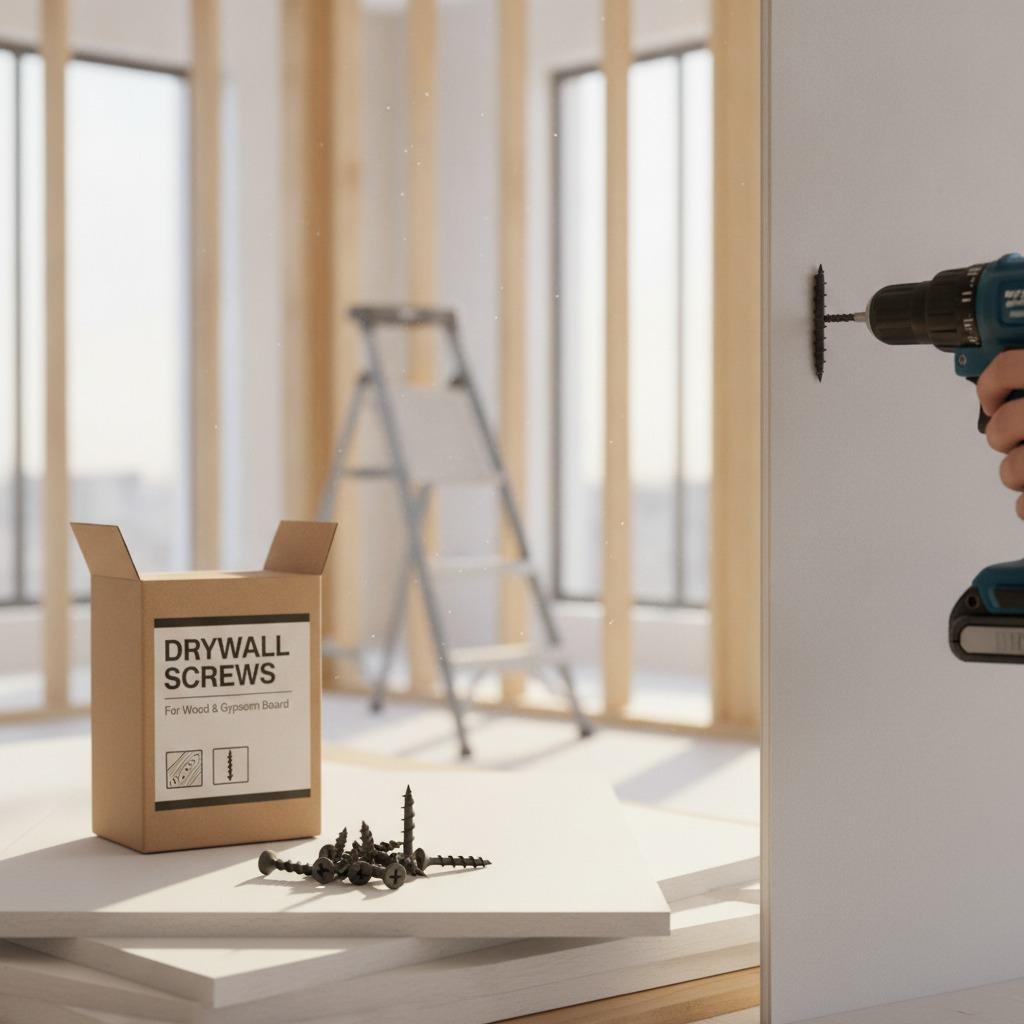
The visible product category here is a box of drywall screws marked for wood & gypsum board. The packaging also highlights high strength, sharp point, bugle head, and corrosion resistant as selling claims. Those claims are common on the shelf, but the physical features visible on the screw itself matter more to a buyer.
These screws appear to have a black coating, a coarse threaded shank, a sharp point, and a bugle head with a Phillips-style recess. That combination is typical for tool-driven fastening into drywall and wood framing. The shape is designed to pull the board down without tearing the paper face, while the coarse threads help the screw bite into wood efficiently. It is a practical design, not a decorative one.
How a drywall screw manufacturer usually builds this product
A drywall screw manufacturer normally works through a fairly standard metal fastener process: cold heading, thread rolling, point forming, and finishing. The exact base steel and coating chemistry are not visible here, so it would be wrong to pretend otherwise. But the manufacturing logic is clear enough.
Cold heading forms the head and basic body shape. Thread rolling cuts no chips and is preferred for high-volume fasteners because it creates more uniform threads than machining. Point forming gives the screw its sharp entry profile. After that, the fastener is coated or finished, often to improve appearance, handling, or corrosion resistance. In this product, the black finish suggests a coated or oxidized surface, though the exact chemistry cannot be confirmed from the image.
That sequence sounds ordinary, and in fastener manufacturing, ordinary is often what buyers want. What matters is repeatability. A screw that looks right but drives inconsistently is a production problem, not a cosmetic one.
Why the head, point, and thread profile are not minor details
Bugle head
The bugle head is one of the most important features in drywall work. It is shaped to sit down into the board surface in a controlled way, helping reduce surface damage. If the head geometry is poor, the screw may over-penetrate or tear the paper facing.
Sharp point
A sharp point matters most on faster installation jobs. It helps the screw start quickly in wood and board without excessive force. That said, not every “sharp point” claim means the same thing. Buyers should still ask how the point is formed and whether the design suits the intended substrate.
Coarse thread
Coarse threads are usually associated with better bite in wood framing and general gypsum board fastening. For a drywall screw supplier, thread consistency is a practical quality marker. If the thread shape varies too much, installation torque can become uneven, which crews notice immediately.
Selection criteria buyers should use before placing an order
A solid sourcing review should start with application. These screws are shown for wood and gypsum board, so the first check is whether that matches your construction method. If your project uses metal studs or mixed substrates, the requirement may change. That sounds obvious, but mixed framing is where many general-purpose fasteners get misapplied.
Next, ask for details that are not visible on a carton: exact dimensions, base material, coating type, packaging quantity, and whether the screw is intended for drywall-to-wood use only or broader renovation work. If a vendor cannot describe these basics clearly, that is a warning sign.
Also review drive performance. A Phillips recess is common, but not all recesses feel the same on the driver bit. Cam-out, head breakage, and inconsistent seating are the kinds of issues that make a cheap fastener expensive.
Common mistakes in drywall screw sourcing
The most common mistake is buying on appearance alone. Black-coated screws with a sharp point look neat in a carton, but surface finish is only one part of performance. Another mistake is assuming that a general drywall screw factory can automatically supply every fastening scenario. Interior drywall work is not the same as structural fastening, outdoor use, or specialty corrosion environments.
Buyers also sometimes overlook packaging clarity. A box that says “drywall screws” may still leave questions about exact application, especially when projects involve both wood and light-gauge framing. That is where a drywall screw supplier should be pressed for straightforward product documentation, even if the product itself seems simple.
Practical buyer advice
If you are comparing suppliers, use the screw’s visible features as the starting point, not the finish line. Check the head style, thread form, point, and intended substrate. Then ask for the manufacturing details that cannot be seen in a product photo. For imported or high-volume programs, consistency across lots may matter more than any single sample.
If your team is running renovation or interior build projects, a screw that feeds smoothly through a cordless drill and seats cleanly in gypsum board can save a surprising amount of labor. That is the kind of detail crews feel immediately, even if procurement only sees it later in fewer complaints.
FAQ: what buyers usually ask
Are these screws only for drywall?
The packaging indicates drywall and gypsum board use, and also mentions wood. That suggests the product is meant for common interior fastening tasks rather than specialized structural work.
Can the coating be confirmed from the image?
No. A black finish is visible, but the exact coating type is not identifiable from the image alone.
What should I request from a drywall screw factory?
Ask for dimensions, material specification, coating details, packaging quantity, and intended application. Those are the basics that separate a usable fastener from a vague listing.
Next step for sourcing teams
If you are evaluating a drywall screw manufacturer for a new order, start with sample inspection and a plain-language spec review. The right supplier should be able to explain what the screw is for, how it is made, and where it should be used without hiding behind marketing language. That is usually a better sign than a glossy carton.