
Why a drywall screw factory matters more than many buyers expect
Choosing a drywall screw factory is rarely just about finding a low price. For contractors, distributors, and procurement teams, the real question is whether the screws will drive cleanly, hold consistently, and sit flush without tearing the board. That sounds basic, but anyone who has dealt with stripped heads, broken points, or uneven batches knows how quickly a small fastening problem can slow an entire job.
In drywall work, the screw is not a background item. It affects installation speed, finish quality, and the amount of rework a crew may face later. A dependable drywall screw manufacturer should understand how the screw behaves in gypsum board and wood framing, not just how to make metal parts in bulk. That distinction matters when you are deciding between suppliers, especially if the product will be used across renovation projects, interior wall framing, or other light construction jobs.
What the product is designed to do
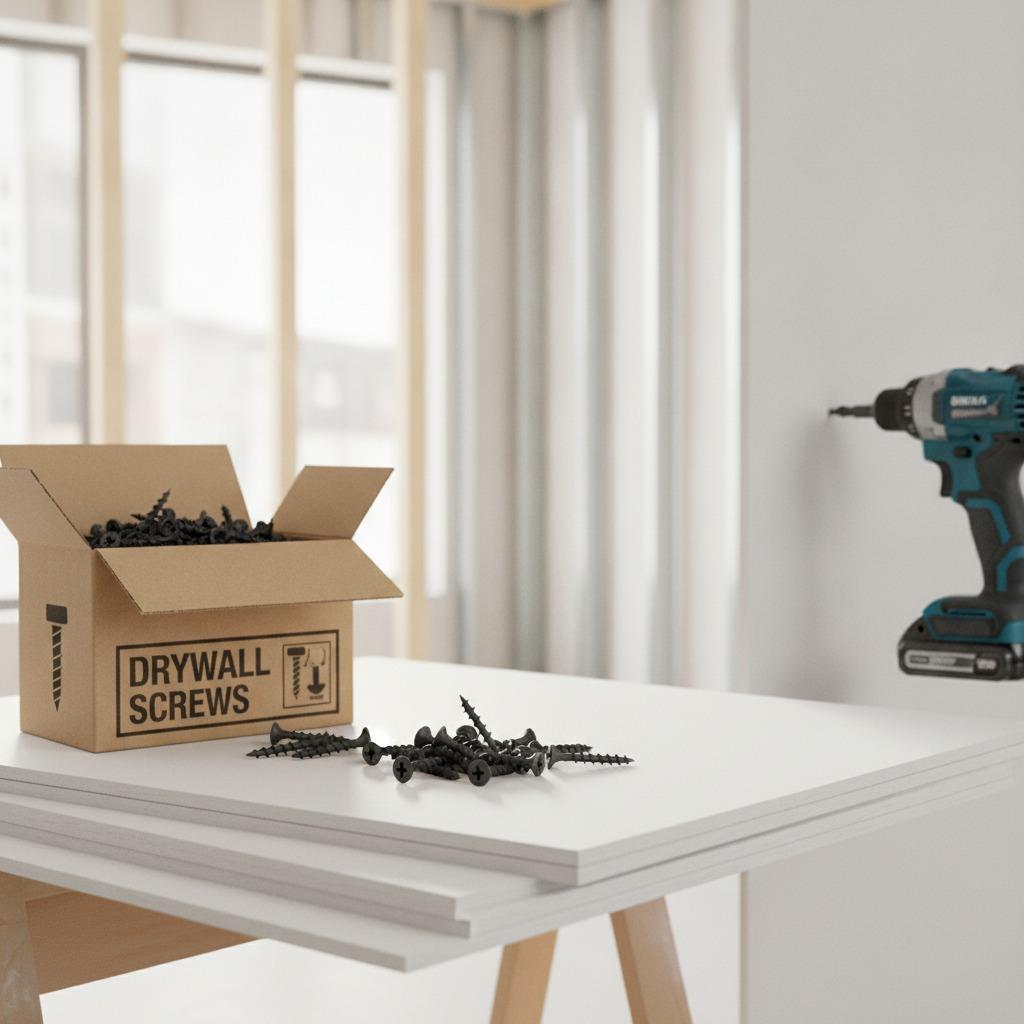
The product here is a black-coated drywall screw for fastening drywall sheets to wood or gypsum board substrates. The visible design features are practical rather than decorative: a Phillips-style cross recess head, a bugle head, a coarse threaded shank, a sharp pointed tip, and a long, slender body. Those features help the screw bite into the material and sink into the board with less surface damage.
The packaging also points to a common use case: “For Wood & Gypsum Board.” That is useful because buyers often need to separate drywall screws from other self-tapping fastening screws that may look similar but behave differently in use. A screw that works well in one board or framing setup may not perform the same way in another.
Quick reference: what buyers usually look for
When comparing a drywall screw supplier, most buyers are trying to confirm a few things quickly:
Does the screw drive smoothly without cam-out? Does the bugle head sit properly below the board surface? Is the coarse thread suitable for the intended substrate? Is the finish adequate for the storage and job-site environment? And, just as important, does the supplier explain the product clearly without hiding basic details behind vague marketing language?
The carton in this case claims “High Strength,” “Sharp Point,” “Bugle Head,” and “Corrosion Resistant.” Those are helpful starting points, but they are package claims, not a substitute for technical data. The exact steel grade, coating type, and corrosion-resistance rating are not identifiable from the image, so a buyer should ask for those specifications before placing any production order.
How these screws are typically made
While the image does not confirm the process, drywall screw manufacturing commonly involves cold heading, thread rolling, and a surface finish step such as a black coating or phosphate/oxide-type treatment. That is a practical inference, not a confirmed production record. Still, it gives buyers a useful framework for evaluating a factory’s capability.
Cold heading shapes the screw head and shank. Thread rolling forms the coarse threads without cutting away as much material, which can improve consistency. The finish matters too. A black-coated surface may support appearance and corrosion resistance, but the actual performance depends on the coating system and how it is applied. If a supplier cannot explain that clearly, it is worth slowing down the conversation.
Selection criteria that actually matter
For sourcing teams, the best comparison is rarely just price per box. A few practical questions usually reveal more:
Drive performance
A Phillips cross recess is common, but it should still engage the driver cleanly. Poor recess forming can lead to stripping, especially on faster installation lines.
Head geometry
The bugle head is there for a reason. It helps the screw settle into the board without excessive tearing. If the head profile is off, finish work becomes harder.
Thread and point design
Coarse threads and a sharp point are typical for wood framing and board fastening. They help start quickly and grab reliably. If the point is dull or inconsistent, field workers notice immediately.
Finish and storage protection
Corrosion resistance is important, but buyers should not assume every black screw offers the same protection. Ask what the finish actually is and how it is controlled.
Common buyer mistakes
One frequent mistake is treating all drywall screws as interchangeable. They are not. Another is ordering on appearance alone, especially when the outer carton looks professional but the technical documentation is thin. A third mistake is forgetting the end use. Screws for interior wall framing and gypsum board fastening may be visually similar to other self-tapping fastening screws, yet their behavior in service can differ enough to affect labor time and finish quality.
It is also easy to over-focus on the word “high strength” on the box. Stronger is not automatically better if the screw is hard to drive or prone to damaging board material. In drywall work, consistency often matters more than brute force.
Practical questions to ask a factory before you buy
If you are evaluating a drywall screw factory, ask for the basics in writing: material specification, finish specification, available sizes, drive type, and any applicable packaging details. If the product is intended for drywall installation in volume, ask how the factory controls head formation, thread accuracy, and coating uniformity. Those are the details that separate a dependable production run from a shipment that creates headaches on site.
If you need a sample, check more than one box. Look for consistency in head shape, thread appearance, and tip sharpness. Small variations can signal bigger process variation.
What to do next
If you are sourcing from a drywall screw manufacturer for the first time, start with a technical inquiry rather than a price-only request. Confirm the intended substrate, the required finish, and any packaging or labeling needs. Then compare sample performance on actual board and framing material. That one step often tells you more than a polished catalog ever will.
For buyers searching for a drywall screw supplier, the right partner should be able to explain how the screw is made, what it is designed to fasten, and where its limits are. If they can do that clearly, you are already having the right conversation.