
Why drywall screw MOQ matters more than many buyers expect
If you source drywall screw MOQ for a contractor supply line, private-label program, or project-based procurement plan, the number on the quotation is only part of the decision. Minimum order quantity affects cash tied up in inventory, carton efficiency, packaging choices, and even whether a fastener program can be launched without overcommitting storage space. For buyers of drywall screws, the real question is not just how low the MOQ can go, but whether the order structure fits the way the screws will actually be used on site.

That matters because drywall screws are rarely bought as stand-alone hardware. They move through distributors, job boxes, and sometimes kitted project packs. A screw that looks inexpensive in bulk can become awkward if the MOQ forces you into sizes, finishes, or collated packaging that do not match current work. So the better decision is usually a practical one: pick the order level that supports your installation method, replenishment rhythm, and margin, not the one that simply looks smallest on paper.
What buyers are really comparing in a drywall screw bulk order
In a drywall screw bulk order, buyers usually compare three things at once: unit cost, packaging format, and how the product will be handled downstream. A factory may be willing to quote a lower piece price at a higher quantity, but that only helps if the inventory can move. On the other hand, a lower MOQ can be useful for a new SKU, a regional test, or a seasonal job mix, even if the per-piece cost is a little higher.
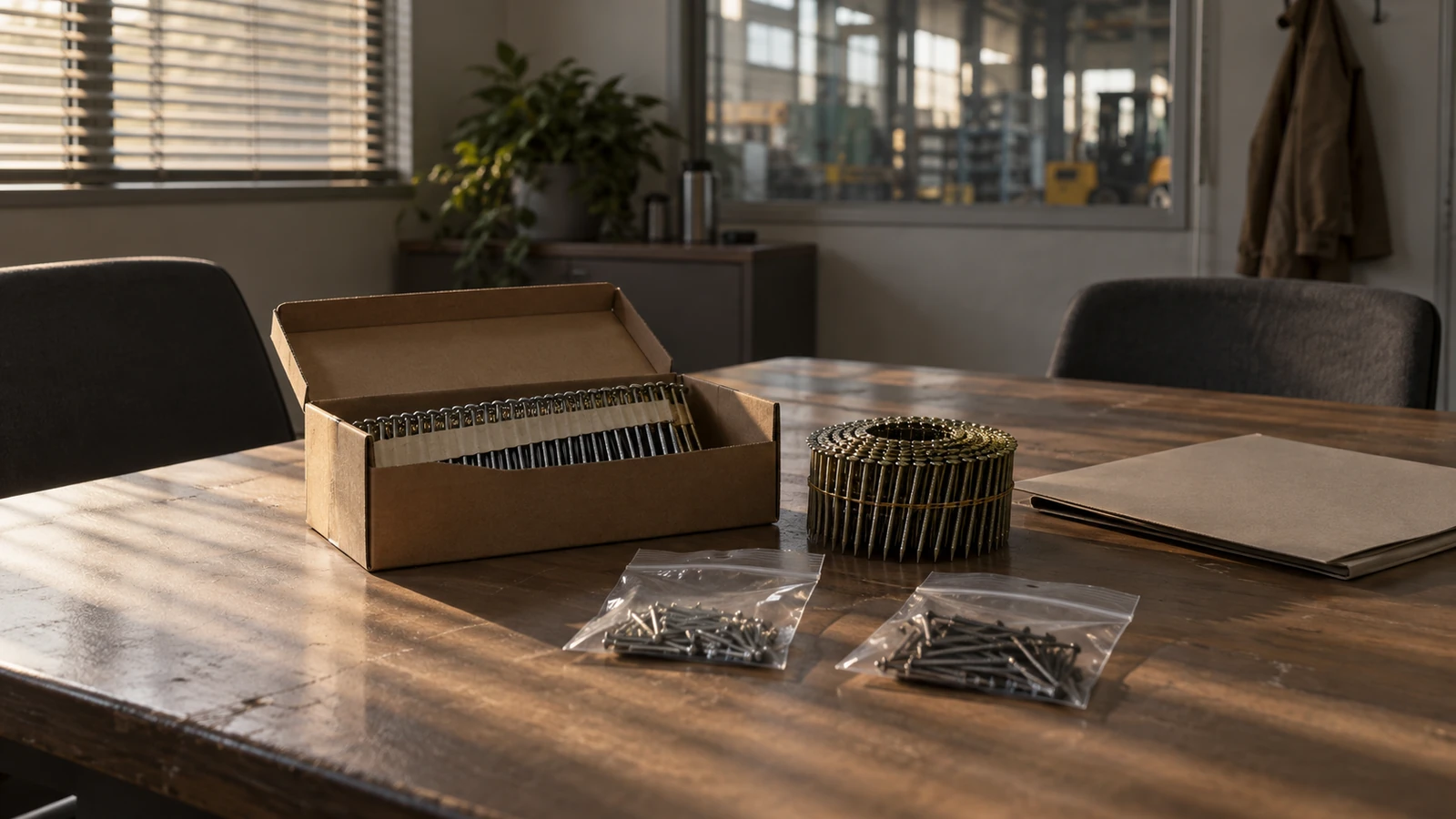
For construction fasteners, the packaging format often changes the economics. Loose screws, boxed screws, and collated strip screws serve different buying patterns. Collated strips, for example, are attractive for crews using a screw gun because they speed repeated fastening and reduce handling on ceilings and walls. That convenience can justify a different MOQ than standard carton-packed screws, especially when the job is overhead and labor time is the real cost driver.
What the product itself suggests about ordering strategy
The product described here is a typical drywall screw: a long, slender steel fastener with a dark finish, coarse-looking threads, and a bugle-style head profile associated with drywall installation. The visible use case is fastening drywall sheets to metal framing or resilient channel during interior wall and ceiling work. That points to a straightforward buyer profile: drywall contractors, interior finishing crews, remodelers, and distributors supporting those trades.
Because the screws appear in a collated strip, the factory may be set up for screw-gun feeding and repeated high-speed installation. That is useful information for sourcing, even when exact dimensions or coating specifications are not known. It tells you the product is likely optimized for productivity on site, which means your MOQ decision should be tied to how many crews actually use screw guns versus hand-driving mixed fasteners. If your customers mostly do small patch work, a large MOQ in collated format can sit too long on the shelf.
How a drywall screw factory may structure MOQ
A drywall screw factory often structures MOQ around material consumption, threading and forming runs, coating or finishing batches, and packaging setup. Even without exact plant details, the logic is familiar across metal fastener production. Changing screw length, finish, drive type, or strip packaging usually means machine setup and a new production run. That is where MOQ tends to rise.
Common drivers behind a higher minimum
Special packaging, custom labeling, and collated strip assembly can all raise the minimum. So can unusual dimensions or finishes. If the screws are standard drywall items, buyers usually have more flexibility. If they are intended for a narrower application, such as a specific metal-framing workflow, the factory may need a larger commitment before it can run efficiently.
Selection criteria that actually help reduce sourcing risk
Before negotiating on MOQ, it helps to define the commercial and technical boundaries clearly. Buyers should confirm intended substrate, installation tool, packaging preference, and whether the screws will be sold as general drywall fasteners or reserved for a defined installation method. That sounds basic, but it prevents a common mistake: placing a low MOQ order for a product that is easy to buy but hard to sell.
Ask whether the order can be split across sizes or whether one size must carry its own MOQ. Ask how the packaging is configured for screw-gun use. And ask for sample cartons or a small trial if the screws are meant for a new customer segment. Small cautions like that save larger headaches later, especially in a market where buyers often care more about availability than perfect specification language.
Practical mistakes to avoid when buying drywall screws in volume
The most common mistake is treating all drywall screws as interchangeable. They are not. Coating, geometry, strip format, and intended substrate all influence performance and downstream acceptance. Another mistake is ordering too aggressively on a low price without checking whether the packaging matches your warehouse and jobsite flow. A pallet that looks cheap can still be expensive if it is awkward to pick, repack, or distribute.
It is also wise not to assume a collated strip product will fit every screw gun or every crew preference. Tools and feeding systems vary, and the field can be less tidy than the catalog photo. That small reality often decides whether the product becomes a fast mover or a slow one.
FAQ: quick answers for procurement teams
Is lower MOQ always better?
No. Lower MOQ helps with testing and cash flow, but a slightly higher MOQ can make sense if it lowers unit cost or improves packaging efficiency.
Should collated strip screws have a different MOQ than bulk-packed screws?
Usually yes, because strip assembly and packaging setup add production complexity.
What should buyers confirm first?
Start with application, drive method, packaging format, and expected sales volume. Those four items usually determine whether the MOQ is workable.
Next step for buyers
If you are comparing drywall screw MOQ options, build the quote around real use, not just price per thousand. A sensible sourcing brief should state the screw type, packaging preference, target application, and whether you need a trial run before a larger commitment. That gives the factory something concrete to quote against and gives your team a clearer path to a usable inventory position.