
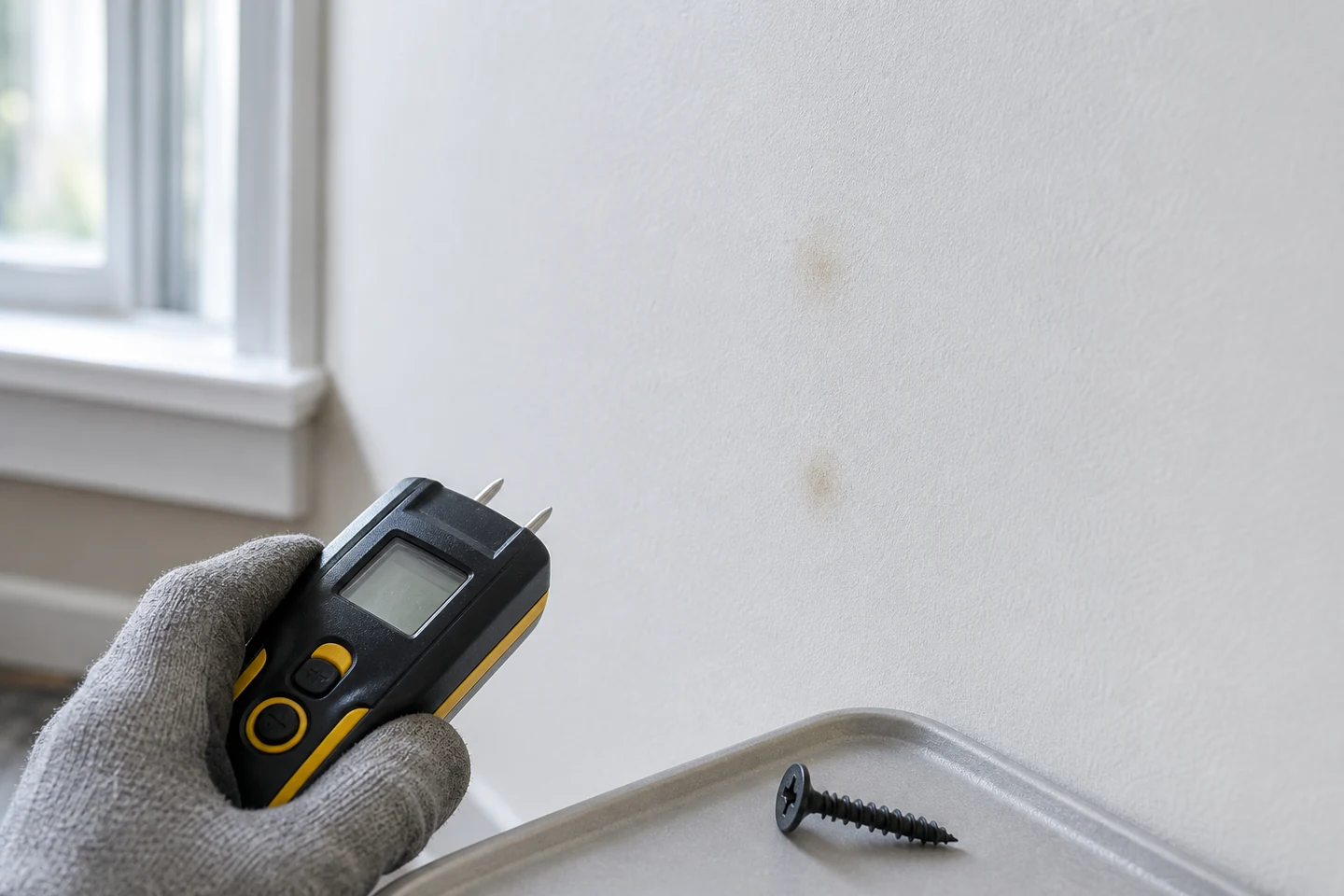
Drywall screw rust stains through paint should be treated as evidence of a source, not only as a decorating defect. A brown circle can be related to moisture reaching a fastener, condensation, a coating damaged during installation, contamination in the finishing layers, or another metal object behind the surface. The color alone cannot identify the cause.
Painting over the mark may hide it temporarily while removing the best clue: its shape, position, and relationship to other stains. Photograph and map the wall before sanding or sealing.
Create a stain map, not a list of spots
Mark each visible position on a room elevation. Note height, distance from windows or exterior corners, whether the marks follow a framing line, and whether they gather below a roof, pipe, duct, bathroom, or recently repaired area. Use side lighting to separate flat discoloration from raised screw heads or cracked compound.
Add the date first noticed and whether the marks changed after rain, heating, cooling, washing, or seasonal humidity. A row on one cold exterior wall presents a different investigation from one isolated spot in a dry internal partition.
Sort observations into four possible sources
| Evidence group | What to look for | Next question |
|---|---|---|
| Moisture path | Staining, damp readings, soft board, nearby plumbing or exterior detail | Where could water or condensation reach the assembly? |
| Fastener surface | Corrosion at the head, damaged finish, incompatible environment | Is the condition repeated on confirmed fastener positions? |
| Finishing contamination | Marks not centered on fasteners, contaminated tools or water, isolated compound discoloration | Does an opened sample actually contain a corroded screw? |
| Hidden metal | Irregular spacing, accessories or services behind the board | Could another metal component be causing the mark? |
Check moisture without making one reading the verdict
Compare the stained position with an unstained control on the same wall using the method and instrument suitable for the inspection. Record room conditions and the exact locations. A surface reading is a screening observation; it may be affected by materials, salts, metal, temperature, and instrument type.
If moisture is suspected, investigate the building source before opening multiple spots. The responsible building professional should determine whether plumbing, envelope, condensation, or another condition needs correction. Replacing screws while an active moisture path remains will not solve the assembly problem.
Open one representative mark and one control
Follow the approved repair procedure and expose only enough material to observe the fastener head, surrounding compound, face paper, and local board condition. Photograph the layers in order. Do not scrape the head clean before its original surface has been recorded.
At a nearby unstained position, confirm whether the fastener type and finishing build are comparable. The paired sample helps distinguish a local event from a repeated material or environmental condition. Preserve any removed fastener with its location and orientation identified.
Decide the correction in source order
- Stop active moisture or condensation. The repair should not close over an unresolved source.
- Assess damaged board and metal. Determine whether local materials need replacement under the wall-system requirements.
- Select the approved fastener and repair build. Coating, material, environment, board, framing, and finishing system must be considered together.
- Prime and refinish only after the source is controlled. Keep photographs and a review date so recurrence can be recognized.
The limitation is important: a stain map and opened sample cannot establish hidden moisture extent, corrosion life, structural condition, or code compliance. Those decisions require the appropriate site investigation and project authority.
Record what would trigger wider inspection
Escalation signs include increasing stain count, marks along several framing lines, damp or soft board, repeated staining after repair, visible corrosion on multiple samples, or a known environmental exposure. Define who reviews those signs and when.
For product context, review the Drywall Screw category and the ProAirNails factory overview. Send wall location, screw reference, environment, stain map, moisture observations, and opened-sample photographs through the inquiry page when investigating drywall screw rust stains through paint.
FAQ
Can rust spots on drywall be sealed and repainted?
A stain-blocking finish may cover a mark, but the moisture, metal, or contamination source should be identified first. Repainting alone can remove useful evidence and allow the stain to return.
Do brown wall spots always mean the drywall screws are rusting?
No. Finishing contamination, hidden metal, moisture paths, and other conditions can create similar marks. Confirm a representative position rather than identifying the source from color alone.
Should every marked screw be replaced?
That decision depends on the confirmed source, extent, wall system, environment, fastener condition, and project requirements. Replacing visible positions without correcting moisture or assembly conditions may not be effective.
A mapped investigation makes drywall screw rust stains through paint less likely to become a repeating paint repair.