
Drywall screws for double layer boards must be selected from the documented assembly, not by doubling a single-layer habit. The face layer changes the fastener path, total build-up, joint layout, access to framing, and what an inspector can see. Fire, sound, abuse, or other rated performance may also depend on following a tested or listed system.
ProAirNails recommends opening the drawing before opening a carton. Identify the board layers, framing, approved screw types, fastening schedule, joint offsets, and responsible authority. The fastener purchase can then match a specific system instead of a vague request for a longer drywall screw.
Approve the assembly before the screw
Start with the project specification, listed design when applicable, board manufacturer's instructions, and installation standard. Record whether the construction is a wall, ceiling, shaft, soffit, or another system; whether framing is wood or steel; and whether each layer fastens to framing or follows a different approved method.
| Assembly field | What purchasing needs | What installation needs |
|---|---|---|
| Board build-up | Layer count, type, thickness, product identity | Orientation and sequence |
| Framing | Wood or steel and declared range | Location, spacing, and access |
| Fastener schedule | Type, size, finish, quantity basis | Layer-specific placement and spacing |
| System status | Rated, tested, listed, or non-rated project detail | Approved drawing and inspection route |
If a field is unknown, mark it unresolved. A general product sample cannot close a missing system requirement.
Move drywall screws for double layer boards through two releases
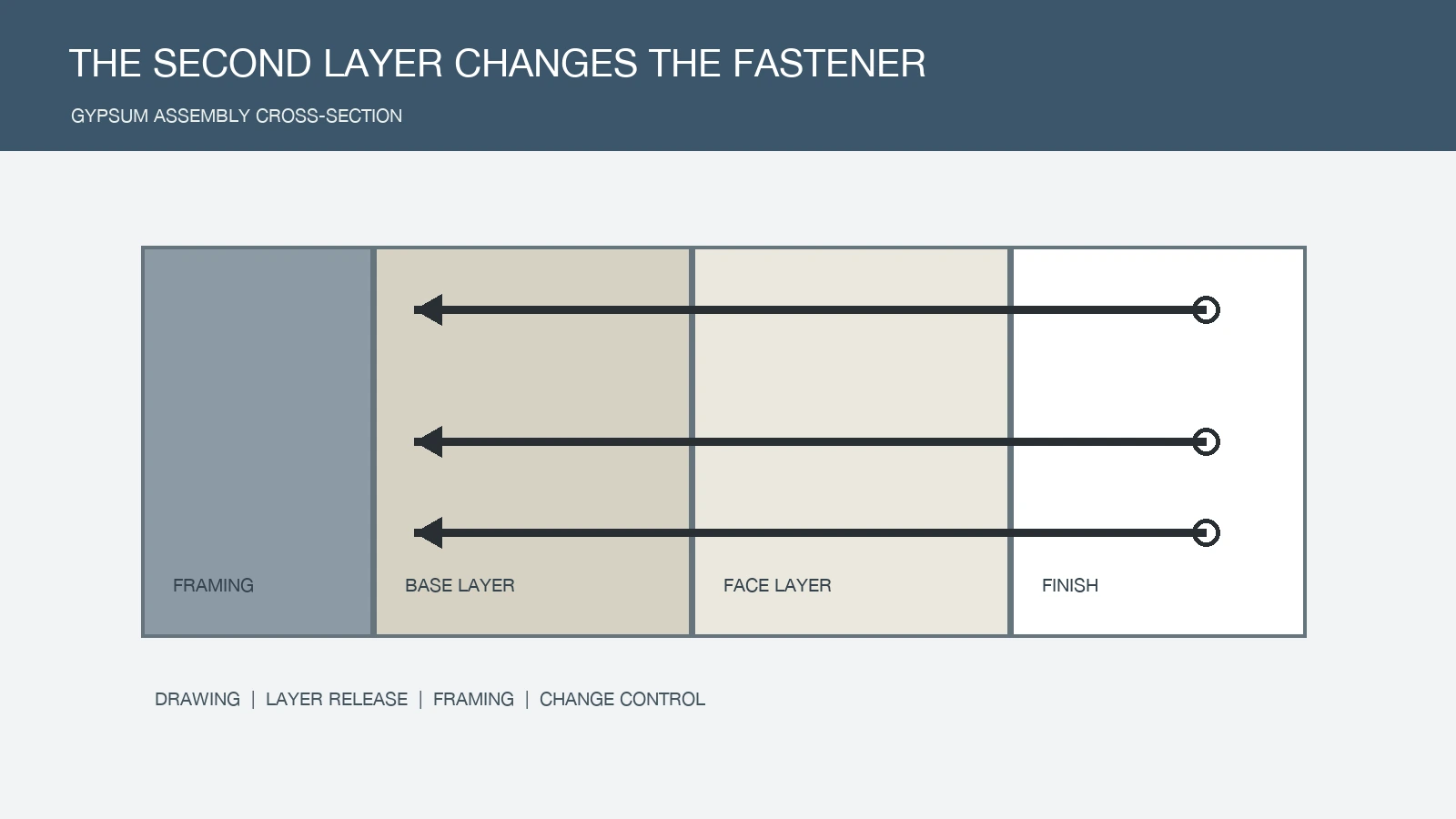
Release the base layer and face layer separately. The base-layer record confirms framing contact, screw seating, board condition, and joint arrangement before those details disappear. The face-layer record confirms the final path, head seating, paper condition, and compliance with the specified layout.
This two-release method prevents a finished surface from hiding a first-layer miss. It also gives quality teams a clear hold point when the drawing, framing, or delivered fastener does not match the approved submittal.
Photograph the base layer while evidence is visible
Before covering the first layer, capture enough context to identify the wall or ceiling area, framing direction, board edges, penetrations, openings, fastener pattern, and any approved deviations. Follow the project's inspection rules; photographs supplement, rather than replace, required inspection.
- Verify the carton and screw code against the first-layer release.
- Check driver bit fit and the tool's depth control on a sample area.
- Inspect heads for proud seating, paper tear, and breakage.
- Confirm board joints and edges follow the approved layout.
- Close the hold point before the face layer covers the work.
For drywall screws for double layer boards, a labelled section sample is useful during procurement. It shows the intended build-up and gives the supplier a concrete reference for length and thread discussions without replacing the assembly documents.
Let the second layer reopen access questions
The installer must still locate framing or follow the specific system's approved attachment route after the base layer is concealed. Do not guess from surface marks alone. Use the project's layout and control method, especially near openings, control joints, service penetrations, and changes in framing direction.
Total board build-up affects the required path, but arithmetic alone does not select the screw. Point, thread, head, steel thickness where relevant, framing material, minimum penetration or engagement, and the listed assembly all matter. Ask the responsible designer or manufacturer when the documents conflict.
Match thread type to the declared framing
The ASTM C1002 specification covers steel self-piercing tapping screws for applying gypsum panel products to wood and cold-formed steel members within its stated scope. It distinguishes thread configurations used for different substrate relationships. Use the current project requirements and framing information to choose the applicable product.
| Change found on site | Why it matters | Required response |
|---|---|---|
| Wood becomes steel framing | Thread and point relationship changes | Stop and confirm the approved screw |
| Steel member falls outside declared range | Self-piercing performance may differ | Escalate to the system authority |
| Board type or layer count changes | Build-up and listed system can change | Review drawings and submittal |
| Alternative coating arrives | Finish and compound compatibility may differ | Hold for documented approval |
Protect rated and tested-system boundaries
The Gypsum Association GA-216 page explains that the standard addresses single- and multilayer gypsum panel applications over wood and steel framing, including fastener selection and spacing topics. A project may also rely on a specific fire or sound design with its own details.
This article cannot approve a rated assembly or authorize substitutions. Do not change screw type, size, spacing, layer orientation, board product, joint treatment, framing, or other listed elements without the required design and code review. The strictest controlling document should be resolved by the responsible project team.
Make receiving part of the layer plan
Separate first-layer and face-layer items when their specifications differ. Labels should show product code, dimensions, thread or type designation, finish, quantity, lot identity, and the project reference needed by the site. Protect cartons from moisture, crushing, and mix-ups during storage.
ProAirNails can help buyers compare drywall screws, review related screws, examine the broader fastener range, and send a system-specific RFQ through Contact Us. Include assembly reference, board build-up, framing, screw schedule, quantities by layer, packaging, destination, and delivery sequence.
Close the submittal with change control
The approval for drywall screws for double layer boards should connect the quotation, technical data, sample, carton, layer schedule, and authorized assembly documents. At reorder, compare wire, dimensions, thread, point, head, recess, finish, labels, and lot information with that record.
ProAirNails treats a proposed change as a question, not an automatic equivalent. The buyer can route it to the responsible designer, installer, or compliance authority before material reaches the wall. That keeps the second layer from becoming the place where an earlier assumption disappears.
FAQ
Why are drywall screws for double layer boards a system decision?
Layer build-up, framing, attachment route, joint layout, screw schedule, and any rated design work together; one screw attribute cannot approve the system.
Can I double the single-layer screw length?
Do not use arithmetic alone. Confirm the approved assembly, framing, screw type, point, thread, head, and required engagement or penetration.
Should the base layer be inspected before covering?
Yes, follow the project's hold points and capture the required evidence while framing contact, joints, and head seating remain visible.
Do both layers always use the same screw?
Not necessarily. Use the layer-specific requirements in the project specification, listed design, board instructions, and applicable standard.
What changes when framing changes from wood to steel?
The thread and point relationship, applicable screw scope, and system requirements can change, so the substitution needs approval.
Does ASTM C1002 approve every drywall screw?
No. It has a defined scope and performance requirements; product conformity and suitability for the specific assembly still need evidence.
Can a supplier approve a fire-rated wall change?
No. Changes to a rated assembly require review by the responsible design, code, listing, and project authorities.
What should appear on the carton label?
Include the controlled product code, dimensions, thread or type, finish, quantity, lot identity, and project reference where required.
What belongs in the RFQ?
Send the assembly reference, layer build-up, board products, framing, screw schedule, quantities, pack format, destination, and delivery stages.
When should a reorder trigger review?
Review any change to material, dimensions, thread, point, head, recess, finish, packaging, label, manufacturing route, or inspection evidence.