
Moisture resistant board is the most misunderstood sheet on a wet room job. It resists moisture in the air. It does not survive being soaked, and it will not make a badly detailed bathroom waterproof.
Contractors ask ProAirNails about drywall screws for moisture resistant board expecting a single recommendation, and the honest answer starts with the board itself and the sequence it is fixed in. The screw is the last decision, not the first.
What moisture resistant board is, and what it is not
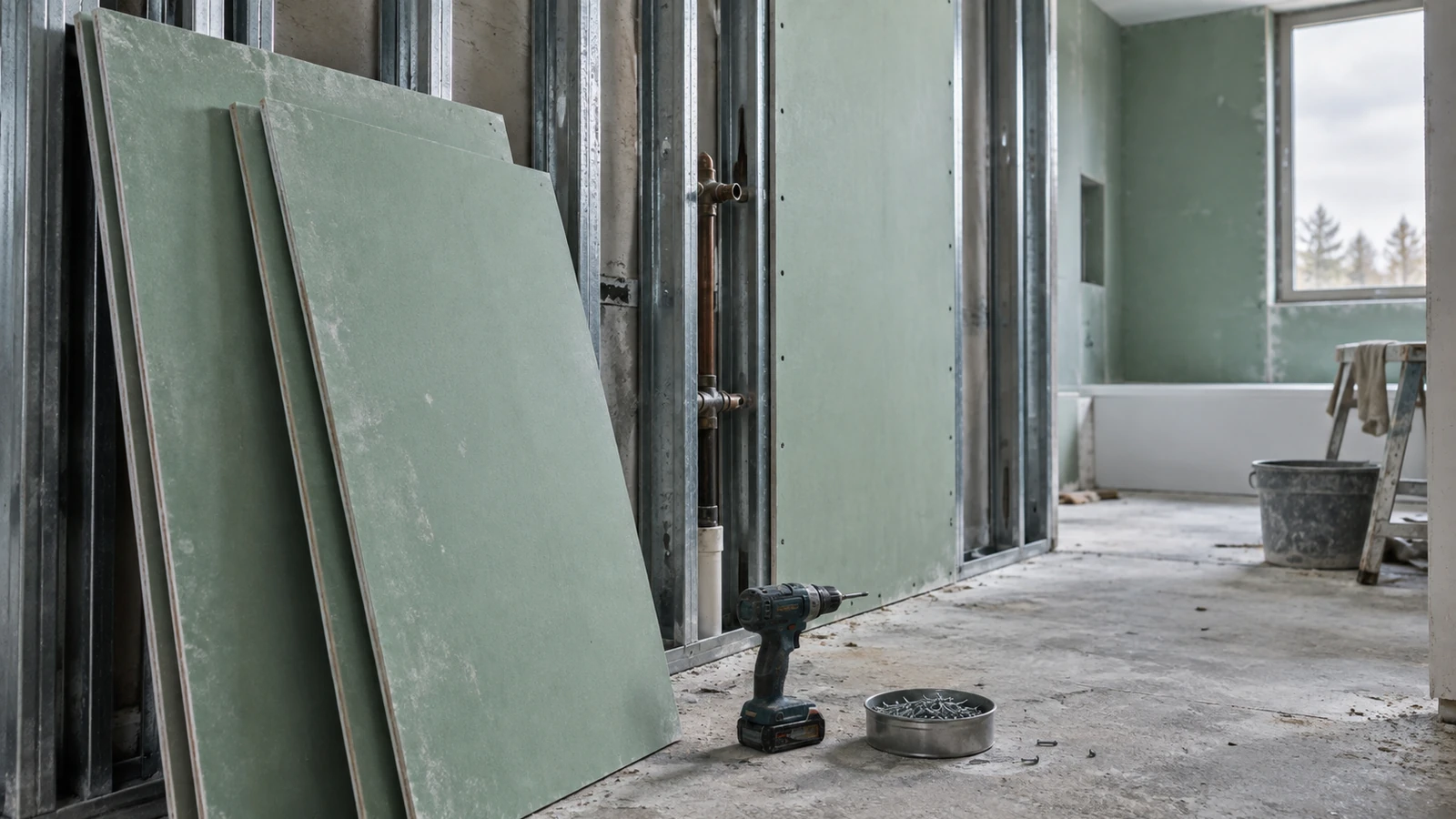
The board has a water-repellent additive in its core and a green face paper, which slows the rate at which moisture gets in and reduces the chance of the board swelling at a cut edge in a humid room. The fixing then has to be selected for that same room rather than for the rest of the house.
It is not a waterproof board and it is not a substitute for a tanked or tiled wet zone. Where water is going to sit, run or splash continuously, the protection comes from the tanking or the tile substrate behind the finish, and that is a different specification from the board. Drywall screws for moisture resistant board are chosen for a room that is humid, not for a room that is wet.
Drywall screws for moisture resistant board: coating and length
In a humid room, a screw is the first thing to show corrosion. A black phosphate screw that is perfectly adequate in a dry partition will leave a rust mark through a painted surface in a bathroom, so the coating decision follows the room rather than the budget.
Length is set by the board and by what is behind it. A screw has to pass through the board and into the stud or channel with enough thread to hold, and the same depth control that keeps a head flush in a dry lining keeps the paper intact here, where a crushed face takes on moisture differently to a clean one. This is where drywall screws for moisture resistant board part company with the same fixing used in a dry partition.
| Decision | What it depends on | What to avoid |
|---|---|---|
| Screw coating | Humidity of the finished room | Black phosphate in a bathroom or shower room |
| Screw length | Board thickness plus substrate | Thread that stops short of the stud |
| Head seating depth | Depth control on the driver | Heads crushed through the face paper |
| Spacing | Board thickness, stud centres and any tile load | Wider spacing on walls that will carry tiles |
The screw spacing that keeps a wet wall flat
Water vapour and tile loads both push a wet room wall harder than a dry one, so the fixing pattern is usually tightened rather than relaxed. Closer spacing at board edges matters more than in the field, because the edge is where the board takes on moisture first and where the joint is finished.
Where heavy tiles or a stone finish are going on, spacing is part of a specification that has to account for the weight, not a habit carried over from a bedroom ceiling. Drywall screws for moisture resistant board are therefore counted per board edge and per support rather than ordered to a rule of thumb. The ASTM C840 specification for the application and finishing of gypsum board is the reference for how the fixing pattern is normally described, and it is the language a specifier will recognise.
Joints, edges and the sequence in a wet room
Cut edges of moisture resistant board are the most vulnerable part of the sheet, and they are also where two boards meet. Seal them as the work proceeds rather than after the room is boarded, because a cut edge in a shower area will always be exposed to more vapour than the face around it.
Hang the board with the long edge across the supports where the layout allows, keep fixings back from the cut edge by the distance the board manufacturer specifies, and finish the joints before any tanking or tiling begins. A joint that was filled late will not look or behave like one that was filled as part of the sequence.
Sealing: the part that decides whether the board was worth buying
The board only performs as intended if the detailing around it performs first. Penetrations, tile trim, shower fixings and the junction with the floor all need sealing with something designed for the purpose, and opening a board again later to add a fixing undoes that detail.
Which is why access panels and tile-safe fixings belong in the plan. Every unplanned hole in a wet wall is a place where vapour reaches a cut edge and where a screw head is exposed, and the ASTM C1047 accessories specification for gypsum board covers the beads and trims that finish those junctions properly.
Services, fixings and future access
Servicing runs through a wet room wall, and every one of them is an opportunity to weaken the assembly if it is not set out before boarding. Pipework and cable runs should be positioned so that fixings can land on framing rather than on a service.
Agree the positions of any future fixings with the client before the boards go up, since that is the moment when extra noggings and backing plates cost nothing. Adding a fixing under a tile after the fact is the most expensive way there is to hang a towel rail, and it puts a fresh hole through a wall that was lined with drywall screws for moisture resistant board precisely to avoid that exposure.
What fails first in a wet room
| What you see | What it usually means | What to check |
|---|---|---|
| Rust marks in a painted finish | Screw coating chosen for a dry room | Coating against the humidity of the finished room |
| Soft or swollen board at a cut edge | Unsealed edge in a wet zone | Whether the edge was sealed as the work progressed |
| Tile cracking along a board joint | Joint movement, or spacing too wide for the tile load | The fixing pattern around that joint |
| Head popping months later | Depth control, or a fixing that never reached the stud | Driver setting and screw length against the substrate |
Checks before the tiler arrives
- Confirm the room's wet zones and the tanking specification before any board is fixed.
- Check the screw coating against the expected humidity, not the same order as the dry areas.
- Set the driver for depth and prove it on a spare piece of the actual board.
- Seal cut edges as each board goes up rather than at the end of the day.
- Photograph every wall before tiling, so a future fixing has a chance of finding framing.
- Agree the positions of towel rails, screens and cabinets, and fit backing before closing the walls.
What a screw cannot correct
A screw cannot keep water out of a room that was never tanked, and it cannot repair a board whose cut edge has already taken on water. ProAirNails supplies the fixing rather than the wet zone design, and the design is where a wet room succeeds or fails.
Stated plainly, moisture resistant board manages humidity. It does not manage water, and it does not replace the membrane, the tile backing or the sealing detail that make a shower area work.
FAQ
Which screws suit moisture resistant board?
A coated screw chosen for the humidity of the finished room rather than the same specification used in the dry areas. That is the whole of the drywall screws for moisture resistant board question that genuinely changes a specification.
Is moisture resistant board waterproof?
No. It resists moisture in the air and slows the effect of humidity. It is not a substitute for tanking.
Can standard black screws be used in a bathroom?
They can, and they will usually rust. In a humid room the coating is the part of the screw you will see fail first.
How far apart should fixings be?
Closer than in dry construction, tighter at board edges than in the field, and set by the tile or finish load where one is being carried.
Should cut edges be sealed?
Yes, as the work proceeds. A cut edge is the most vulnerable part of the sheet and often sits where two boards meet.
Does the board need a special joint treatment?
The joint is finished the same way as any gypsum joint; what changes is the attention paid to edges in the wet zones.
Can I fix a towel rail later?
Only into framing or a fitted backing. Fixing blind into a boarded wall risks a service and opens a hole in a sealed zone.
What about a shower cubicle?
The board behind it is part of a tanked assembly. The board and its fixings are chosen to suit that specification rather than instead of it.
Do ceiling fixings differ in a wet room?
Slightly. Humidity rises, so coating choice matters on the ceiling as much as on the walls.
What should a wet area enquiry include?
Board type and thickness, substrate, room use, tile or finish load, the fixing pattern specified and the tool in use.
What to send with a wet area enquiry
Send the room and the build-up: board type and thickness, substrate and centres, the tile or finish being carried, the fixing pattern specified and the tool on site. ProAirNails supplies drywall screws, pneumatic staplers and pneumatic nails into interior board work, and a photograph of the build-up with a rule across the board and substrate answers more than a description. Start at Contact Us.