
Why buying from a furniture staples bulk supplier is more than a simple purchasing task
If you buy fasteners for upholstery, assembly, or repair work, the choice of a furniture staples bulk supplier can affect far more than unit cost. It touches production uptime, how often operators stop to reload, whether a stapling line runs smoothly, and how much scrap ends up in the bin. For shops that handle repeated fastening jobs, especially with pneumatic staple guns, bulk packaging is not just convenient; it is part of the workflow.
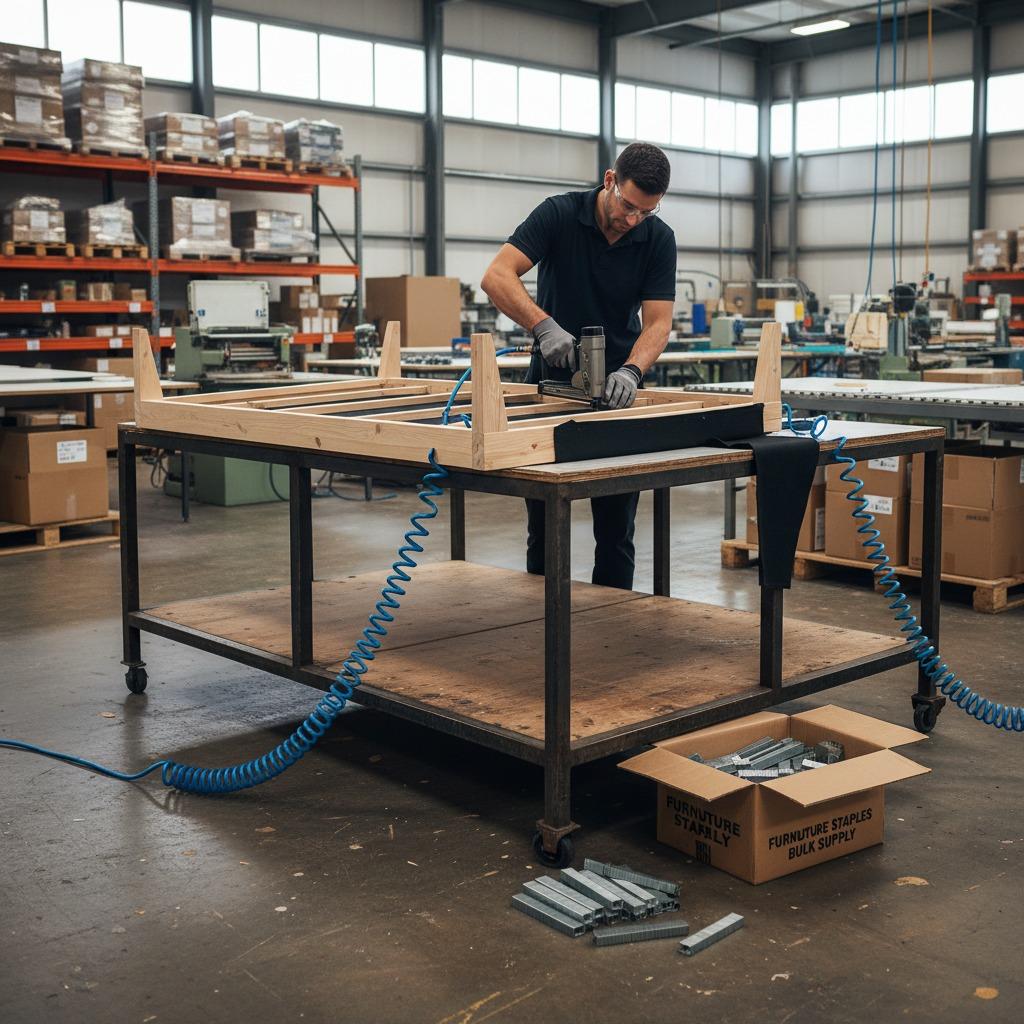
The cartons labeled as bulk supply make the point plainly. These are not specialty fasteners bought one box at a time for occasional use. They are consumables meant to feed ongoing production: upholstery shops, furniture factories, repair benches, woodworking operations, and other light industrial fastening environments. That distinction matters when a buyer is deciding whether to prioritize price, packaging, or consistency.
What bulk staple supply is really solving
Upholstery and furniture assembly rarely fail because a staple was dramatic. They fail because the fastener was slightly wrong, the strip fed poorly, or the supply ran out at the wrong moment. That is why upholstery staples bulk buying tends to be judged on practical details rather than catalog language. Operators want strips that feed cleanly into pneumatic stapling tools, and buyers want cartons that arrive intact, stored sensibly, and easy to issue to the floor.
The visible product format here suggests collated U-shaped staples arranged in rectangular strips. That is the standard kind of consumable used for fastening fabric, webbing, backing material, and light panels to wooden furniture frames. The finish appears metallic and silver-gray, possibly steel with a protective coating, although the exact coating is not confirmed. A cautious buyer should treat that as a clue, not a specification.
Quick reference: what buyers usually compare
1. Compatibility with the stapling gun
This is the first filter. Even a well-made staple is useless if the crown width, leg length, or wire size does not match the tool. Unfortunately, those dimensions are not visible in the supplied information, which is a reminder to verify them before placing volume orders.
2. Feed reliability
In real production, a staple that jams once in a while becomes expensive. Downtime costs more than the fastener itself. Bulk buyers should ask whether strips are consistently collated and whether the packaging protects them from bending in transit.
3. Surface finish and corrosion risk
Because upholstery and furniture work often involves indoor use, corrosion resistance may not need to be extreme. Still, a staple that rusts in storage or after installation creates avoidable complaints. If the coating is zinc-like or galvanized, confirm that with the supplier instead of assuming.
4. Pack format
Large cartons are useful when the shop consumes staples steadily. For smaller repair teams, however, oversized packaging can be awkward. The right bulk format depends on inventory turnover, storage space, and how often different staple sizes are used on the floor.
Where bulk upholstery staples earn their keep
In furniture manufacturing, bulk staples are part of the hidden discipline of throughput. They hold dust covers, secure fabric edges, fasten webbing, and support repeatable assembly steps. In upholstery repair, they help technicians work quickly without giving up holding power. The same goes for packaging or light industrial fastening where a compact U-shaped fastener is needed in quantity.
There is a reason sourcing managers pay attention to this commodity even when the spend looks modest. A cheap fastener that causes misfeeds can stall a line. A decent one, supplied reliably, becomes invisible. In manufacturing, invisible is often exactly what you want.
Common mistakes when sourcing furniture staples wholesale
The first mistake is assuming all staples of the same general shape behave the same way. They do not. Small differences in geometry can change how a staple drives into softwood or harder frame members, and they certainly affect tool compatibility. The second mistake is buying only on unit price and overlooking packaging quality. Bent strips, crushed cartons, or mixed lots turn into waste quickly.
A third mistake is overbuying without checking demand patterns. Bulk supply is valuable, but only when the shop can actually move the inventory. Fasteners are not glamorous stock, and they should not sit long enough to become a storage problem.
Buyer advice for practical purchasing
If you are evaluating a supplier, ask for the staple dimensions, the intended stapling tool range, and the packaging count per carton. If those details are not immediately available, press for them before approving volume orders. For trade buyers, that is not nitpicking; it is standard risk control.
It also helps to compare how the supplier handles repeat supply. A good bulk supplier is not just a source of boxes. They are a predictable replenishment point, which matters when upholstery lines run on scheduled jobs and repair shops cannot afford interruptions. Many buyers also prefer to keep one or two alternate staple sizes in reserve, though that only works if the tools are known to accept them.
FAQ buyers usually ask
Are these staples only for furniture?
No. Furniture and upholstery are the main use cases here, but similar bulk staples can also appear in woodworking and some light industrial fastening jobs.
Can I assume the staples are galvanized?
No. The silver-gray appearance suggests a coated metal finish, but the exact coating is not confirmed in the provided information.
What should I confirm before ordering in volume?
Staple dimensions, tool compatibility, packaging count, and any finish or coating details you need for storage or service conditions.
A sensible next step for sourcing teams
If your operation uses stapling as a routine production step, start with a sample review rather than a blind pallet order. Check how the strips feed, how the cartons arrive, and whether the product matches the tool chain already on the floor. For teams comparing upholstery staples wholesale options, that small trial often reveals more than a catalog page ever will.
The best supplier is not always the cheapest one. In fastener sourcing, the better choice is usually the one that keeps operators moving, keeps inventory clean, and avoids surprises. That is the real job of a furniture staples bulk supplier.