
Why furniture buyers care about staple supply before they care about price
If you’re sourcing from a furniture staples bulk supplier, you already know this is not a glamorous line item. It is, however, one of those quiet inputs that can slow a production floor down when it is wrong. Staples that feed poorly, bend on impact, or arrive in the wrong pack format waste time at the stapler and create avoidable rework on upholstery, backing panels, webbing, and other frame assemblies.
That is why the decision is less about chasing the lowest carton price and more about making sure the staple format matches the job. For workshops, distributors, and production teams, the practical question is simple: can these staples be loaded reliably, driven cleanly, and supplied in the quantities the operation actually consumes?
What bulk furniture staples are typically used for
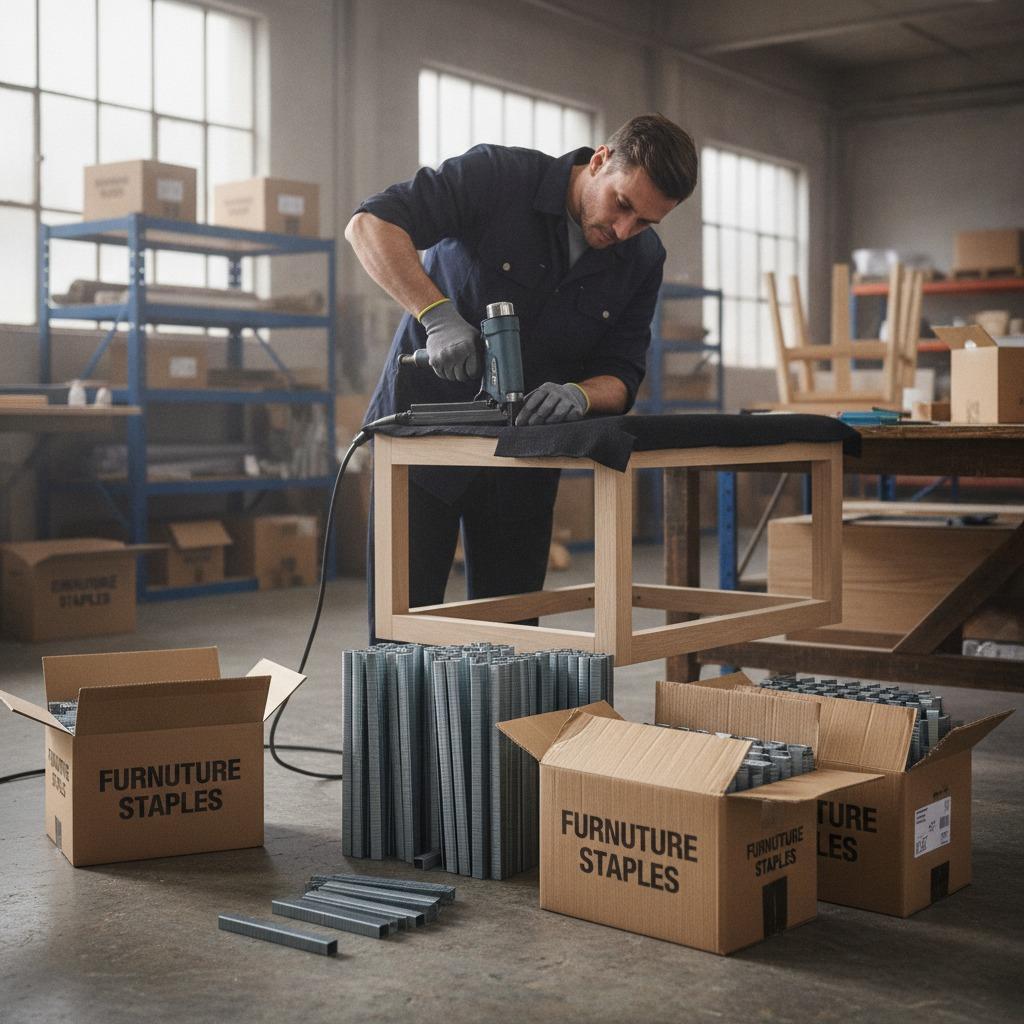
Furniture staples are metal U-shaped fasteners supplied in stacked strips and used to attach upholstery fabric, backing material, padding, felt, and similar components to wooden frames. In many shops they also support reupholstery and repair work, where speed matters but the finish still has to look tidy once the piece is turned over or reassembled.
The product shown is packaged in bulk cartons and appears to have a silver or gray finish, likely zinc-coated or galvanized in appearance. That is not a guarantee of a specific corrosion spec, but it does suggest a common industrial staple format rather than a specialty decorative fastener. In a working environment, that is usually what buyers want: predictable feed, consistent strip quality, and enough inventory on hand to avoid constant reordering.
Quick buyer takeaways
For sourcing teams comparing upholstery staples bulk options, the most useful filter is application fit. A staple that works in one stapler or one fabric stack may be a poor choice in another. The carton may look generic, but the details hidden inside matter: crown width, leg length, wire gauge, strip consistency, and compatibility with pneumatic staplers all influence performance.
It is also worth separating “bulk” from “good value.” Bulk packaging helps lower handling costs and simplifies replenishment, but only if the staple quality is steady enough for repeated use on the line. In practice, a shop that saves a little on purchase price but loses time to jams usually pays more in the end.
What to ask a supplier before placing an order
1. Staple size and tool compatibility
Do not assume the staple will fit every gun or every job. Confirm the size format your stapler requires and check whether the staple is intended for furniture assembly, upholstery work, or a broader industrial fastening application. If the supplier cannot clearly specify compatibility, that is a warning sign.
2. Packaging format
Bulk cartons sound straightforward, but there is a difference between loose-packed product, neatly banded strips, and carton counts that are easy to handle on the floor. For high-volume shops, packaging that feeds into storage and production workflows cleanly can matter almost as much as the staple itself.
3. Finish and storage expectations
The visible silver-gray finish suggests a coated metal staple, but buyers should still ask how the product should be stored and whether the finish is intended to support ordinary workshop conditions or something harsher. I would not overstate corrosion resistance unless it is documented; that sort of assumption can become expensive later.
Common mistakes when buying staples in volume
One common mistake is buying by habit instead of by spec. A production manager may have used a certain staple for years, but if the stapler model, substrate, or upholstery stack changes, the old choice may no longer be the best fit. Another frequent problem is underestimating how much variation in feed quality can affect throughput. Staples that are slightly inconsistent may still look acceptable in the box, but they can misalign in the magazine and interrupt work at the worst possible moment.
There is also a tendency to treat all upholstery staples wholesale offers as interchangeable. They are not. Some are better suited to furniture manufacturing, others to repair work, and some may be more appropriate for cabinet backing or light assembly. The more specific the application, the more specific the sourcing conversation should be.
How to evaluate a furniture staples bulk supplier
A serious supplier should be able to explain the product in practical terms: how it is packaged, what tool family it supports, and what applications it is meant to serve. Look for signs that the supplier understands workshop realities, not just carton movement. Bulk supply is most useful when it arrives organized, consistent, and easy to replenish.
For distributors, the value proposition is a little different. You need a staple product that can sit in inventory without becoming a liability, and that means clear labeling, stable packaging, and a format customers can identify quickly. For production users, the real test is simpler: does the staple drive cleanly and keep the job moving?
Practical next step for buyers
If you are comparing furniture staples bulk supplier options, ask for the exact staple specification, pack configuration, and intended application before you commit to a large order. If the supplier can provide those details clearly, the rest becomes much easier. If they cannot, keep looking. Staples may be a small component, but in furniture work, small components have a habit of revealing poor sourcing discipline very quickly.
FAQ
Are upholstery staples bulk and upholstery staples wholesale the same thing?
Usually the terms overlap in practice. The difference is more about buying channel and order size than about a distinct product category.
Can furniture staples be used for reupholstery?
Yes, that is one of their core uses, provided the staple size and tool compatibility match the job.
Should I choose coated staples over plain metal?
That depends on the environment and the application. A coated or plated appearance may be useful, but buyers should verify the actual finish and not rely on appearance alone.