
Why buyers keep coming back to furniture staples in bulk
If you’re sourcing from a furniture staples bulk supplier, the real question is rarely whether staples are simple. It’s whether the supply is dependable enough to keep upholstery lines, repair benches, and shop assembly moving without stoppage. In furniture work, a small fastener can become a production risk very quickly. A box that arrives damaged, inconsistent, or poorly packed can slow down an entire week’s output.
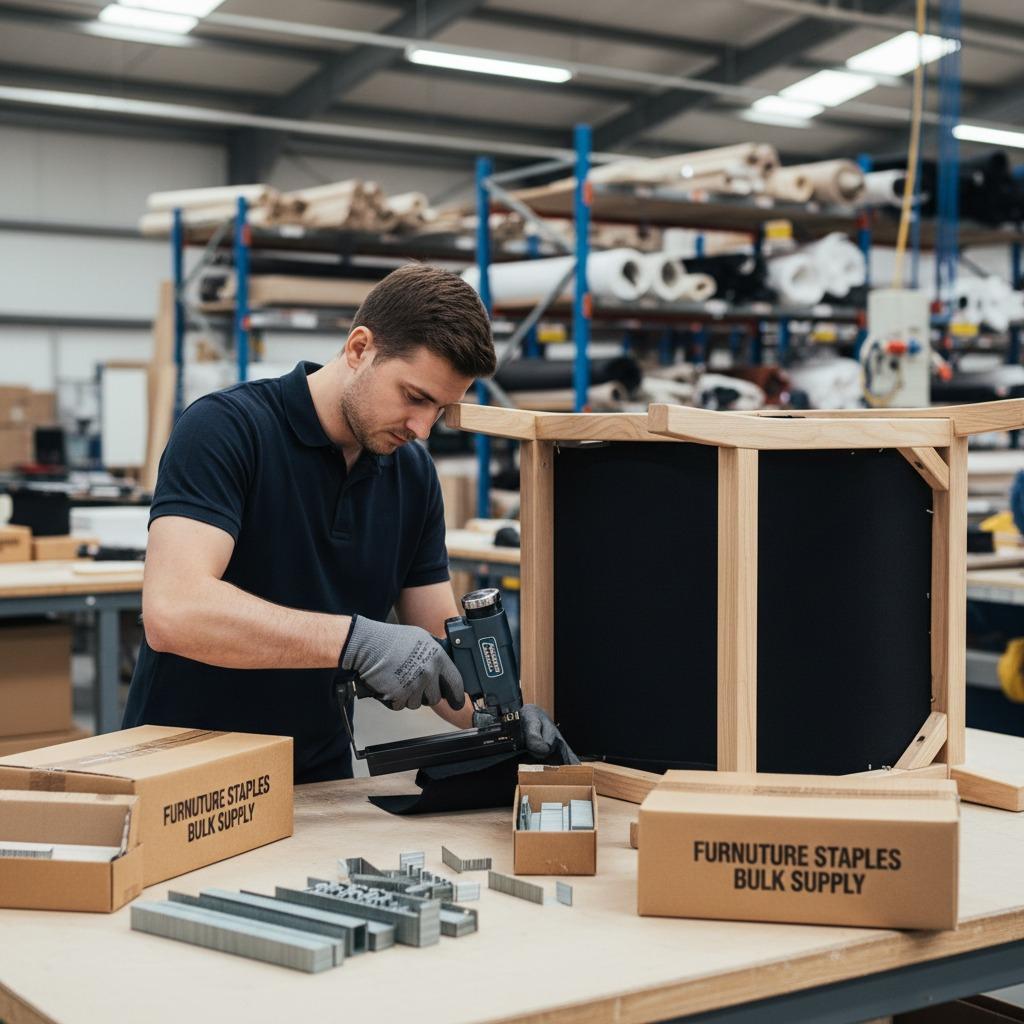
That is why bulk-packaged furniture staples remain a practical procurement item rather than a commodity to be ignored. The format shown here is straightforward: silver-gray metal staples bundled in strips and packed into cartons labeled for furniture staples. For buyers, that tells you something important even before dimensions or coatings enter the discussion. It suggests a consumable meant for volume use, not a niche specialty item.
What these staples are doing on the shop floor
Furniture staples are used to fasten fabric, webbing, backing materials, and some light-to-medium wood components during upholstery and assembly. In day-to-day production, that usually means pneumatic staple guns or upholstery staplers, where speed and repeatability matter more than elegance. A good staple does its job quietly. It drives cleanly, holds the material in place, and doesn’t create avoidable rework.
For upholstery operations, that makes the choice less about the fastener itself and more about fit-for-purpose supply. Upholstery staples bulk ordering is often driven by consumption rate, not by one-off project needs. Once a shop is running multiple stations or supporting repair work, buying small retail packs becomes a false economy. The labor cost of running short is usually higher than the difference in unit price.
Quick take: what bulk buyers should look for
Before placing any order, procurement teams usually want a short checklist, even if the final decision is made by production staff.
First, confirm the staple format matches the tool used on the line. Second, verify the packaging quality, because loose or bent strips create feeding problems. Third, ask for the key dimensions and material details in writing instead of assuming them from appearance. The image suggests a bright, galvanized, or zinc-coated finish, but that should be treated as a visual impression unless the supplier states it plainly.
It’s also worth checking whether the supplier can support recurring replenishment. Bulk supply only helps if the cartons arrive consistently and the product description remains stable from order to order. A slightly different crown width or leg length can be enough to disrupt a production routine, even when the staples look similar in a photo.
Comparing bulk packaging to smaller purchase formats
Bulk cartons
Bulk cartons are usually the right fit for manufacturers, upholstery shops, cabinet shops, and warehouse supply teams. They reduce handling overhead and simplify inventory planning. The downside is that they demand more confidence in product consistency. If the supplier is not clear on gauge, crown width, or leg length, a bulk order can become a costly test shipment.
Retail-style packs
Smaller packs can be useful for prototyping, maintenance, or low-volume repair work. They limit exposure if the staple specification is still being validated. But they are not the natural choice for a production environment where staples are consumed all day long.
Common buying mistakes with upholstery staples wholesale orders
One common mistake is focusing on price alone. That usually shows up later as feed issues, wasted labor, or mixed inventory. Another is assuming all furniture staples are interchangeable because the boxes look alike. They are not. Small differences in staple dimensions can affect tool compatibility and fastening performance.
Buyers also sometimes overlook packaging integrity. The image shows organized bundles inside cartons, which is a good sign for bulk handling, but logistics matter just as much as the staple itself. If cartons crush in transit, the product may arrive technically correct and practically troublesome.
A final caution: do not infer corrosion resistance from a shiny surface alone. Bright metal may be suitable for many indoor furniture jobs, but actual coating type and protection level should be confirmed when the application calls for durability or storage exposure.
How to evaluate a supplier without overcomplicating it
A reliable furniture staples bulk supplier should be able to answer basic technical and supply questions clearly. Can they identify the staple type by application? Can they provide carton consistency? Do they support repeat orders without changing the specification quietly? Those are the questions that matter most to engineers and sourcing managers.
For product teams, the practical decision is often whether the staple is being bought as a standardized production consumable or as a flexible maintenance item. That distinction shapes everything from order quantity to inspection expectations. In high-volume furniture assembly, standardization is worth more than a small unit-cost saving.
Practical next step for buyers
If you’re shortlisting suppliers, start with the specification sheet rather than the catalog photo. Ask for staple dimensions, coating details, box count, and tool compatibility before you place a production order. If the supplier cannot provide those basics cleanly, that is useful information too.
For upholstery shops and furniture manufacturers, the best bulk purchase is the one that disappears into daily work without causing attention. That is the real measure of a fastening consumable: not how impressive it looks in a carton, but how predictably it supports the line once the staplers start running.
FAQ
Are bulk furniture staples only for large factories?
No. Smaller upholstery shops, cabinet builders, and repair operations often buy bulk as well, especially if usage is steady.
Can the same staples be used across all staplers?
Not safely assumed. Compatibility depends on the tool and on the staple dimensions, which should always be verified.
Why is packaging important?
Because even a correct staple can become a problem if strips are bent, loose, or damaged during shipping and storage.