
Why buyers look for galvanized staples in wholesale quantities

Galvanized staples wholesale searches usually come from the same practical problem: a fastening line needs steady supply, and small-pack purchasing starts to waste time, money, and storage space. When a plant, workshop, or packaging operation consumes staples every day, the buyer is not just comparing unit price. They are trying to avoid stoppages, compatibility issues, and the kind of inventory gaps that show up at the worst moment.
That is why galvanized staples bulk purchasing tends to matter most to engineers, sourcing managers, and production teams. The staple itself is a small part, but the downstream effect is not small at all. If the fastener does not feed cleanly, if the strip geometry is inconsistent, or if the finish does not suit the working environment, the result can be jams, wasted labor, and rework. Bulk buying should solve those problems, not create new ones.
What the product appears to be, and why that matters
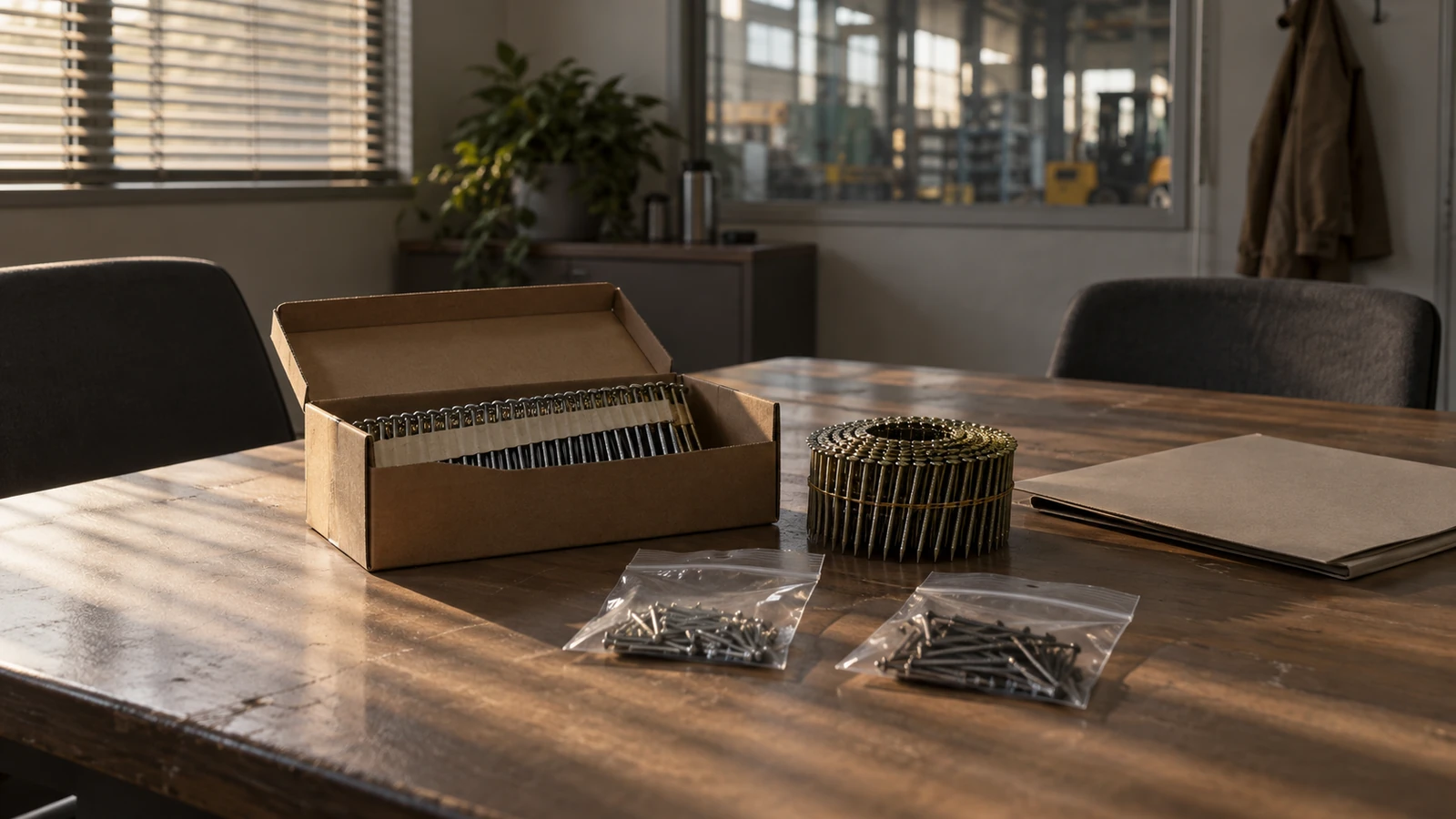
From the supplied product information, the item appears to be a stack of thin, uniform staple strips packed in a carton and clear tray. The visible clues point to a mass-produced metal fastening product, likely formed and cut from steel and finished in a silver-gray, matte-to-satin look. The exact grade, coating, and dimensions are not given, so it is better to treat the product as a general industrial staple strip rather than assume a specific nailer or stapler standard.
That caution matters. Buyers often make the mistake of ordering on appearance alone. A staple that looks standard can still differ in crown width, leg length, strip count, adhesive bonding, or feed angle. In industrial fastening, a few millimeters can decide whether a tool runs smoothly or turns into a maintenance issue.
Quick buyer takeaway: what wholesale sourcing should optimize
Wholesale galvanized staples should be evaluated on four simple questions:
Will they feed consistently in the intended stapling or packaging system?
Do the bundled strips stay aligned during shipping and handling?
Is the finish suitable for the working environment, especially where humidity or storage exposure is a concern?
Can the supplier keep the same format across repeat orders?
Those questions sound basic, but they are where most purchasing mistakes start.
Why galvanized finish is often chosen for industrial use
In general industry terms, galvanizing is used to improve corrosion resistance compared with plain steel. That does not make a staple rust-proof, and it does not replace proper storage, but it can be a sensible choice when the fastener may face damp warehouses, long shelf life, or general handling exposure.
For sourcing teams, the practical point is not to over-specify the finish without need. Some applications only require clean, reliable feeding and moderate protection. Others, such as certain furniture assembly or packaging operations, may value longer storage life. The right finish depends on the actual use case, not on a blanket assumption that shinier means better.
Common applications for wholesale galvanized staples
The likely use cases include industrial staplers, packaging, carton sealing, furniture assembly, woodworking, and other high-volume fastening operations. These are all environments where repeat-feed handling matters. If staples are supplied in aligned strips, operators can load faster and reduce interruptions, which is one reason bulk packaging is so useful.
A buyer should still verify the intended material being fastened. Wood, cardboard, foam, and other substrates place different demands on staple geometry. A staple that performs well in carton work may not be the right choice for assembly tasks that need a different leg shape or holding behavior.
Packaging and handling details to check
The supplied product is shown in a cardboard box and a clear plastic tray. That is a useful sign for bulk handling because it suggests organized storage and easier inspection. Still, the real issue is whether the packaging protects alignment during transit. A cheap-looking carton can hide a very good product, and a neat outer pack can still contain bent strips. Buyers should ask for internal pack details if feed consistency is critical.
How to compare wholesale galvanized staples before placing an order
Start with compatibility. Confirm the staple format matches the tool or line. Then look at uniformity. The provided product information emphasizes identical, narrow strips, which is encouraging, but buyers should request dimensional details before locking in a purchase.
After that, assess finish and storage needs. Galvanized staples wholesale options are often chosen because buyers want a balance of cost and corrosion resistance, not the highest possible spec. That is a reasonable approach, as long as the environment is understood.
Finally, consider supply stability. A bulk fastener is only economical if it can be reordered in the same form. Changing strip dimensions or coating type midstream can create avoidable tool adjustment work.
Practical mistakes buyers still make
The most common mistake is treating all staples as interchangeable. They are not. Another is buying purely on low unit cost and discovering that strip breakage, jam rates, or inconsistent feed wipes out the savings. A third mistake is underestimating storage. Bulk fasteners need dry, orderly handling just like any other steel-based consumable.
A smaller but real issue: some teams forget to align procurement language with production reality. If operators say the line needs repeat-feed staples for a specific tool, the purchasing record should reflect that, not a generic description that leaves room for substitution.
What a sensible sourcing decision looks like
If your operation uses staples at volume, wholesale galvanized staples can be a straightforward way to reduce replenishment noise and keep the line moving. The decision should rest on fit, finish, packaging integrity, and repeatability, not just price pressure. That is especially true for industrial users who cannot afford tool jams or last-minute substitutions.
A good next step is to request the exact strip dimensions, coating details, pack count, and compatibility information from the supplier before committing to a large order. If the application is critical, ask for a sample pack first and run it in the actual tool, not a similar one in the corner of the shop.
FAQ
Are galvanized staples always the best choice?
No. They are useful when some corrosion resistance and bulk handling make sense, but the right choice depends on the substrate, environment, and fastening tool.
Can I assume all wholesale galvanized staples are the same?
No. Strip format, dimensions, and packaging can differ enough to affect feed performance.
What should I ask a supplier first?
Ask for dimensions, finish details, pack configuration, and tool compatibility before placing a volume order.