
How to Evaluate a Coil Nails Manufacturer for Pneumatic Fastening
Choosing a coil nails manufacturer is not simply a matter of comparing carton prices. The fastener must match the nailer, magazine, material, and production method, while the supplier must be able to provide consistent collation and dependable dimensional control. This guide explains what buyers should verify before placing an order, especially when the available product information shows pneumatic nail guns and collated nails but does not confirm the exact nail format.
Start with the Nail Format, Not the Application Name
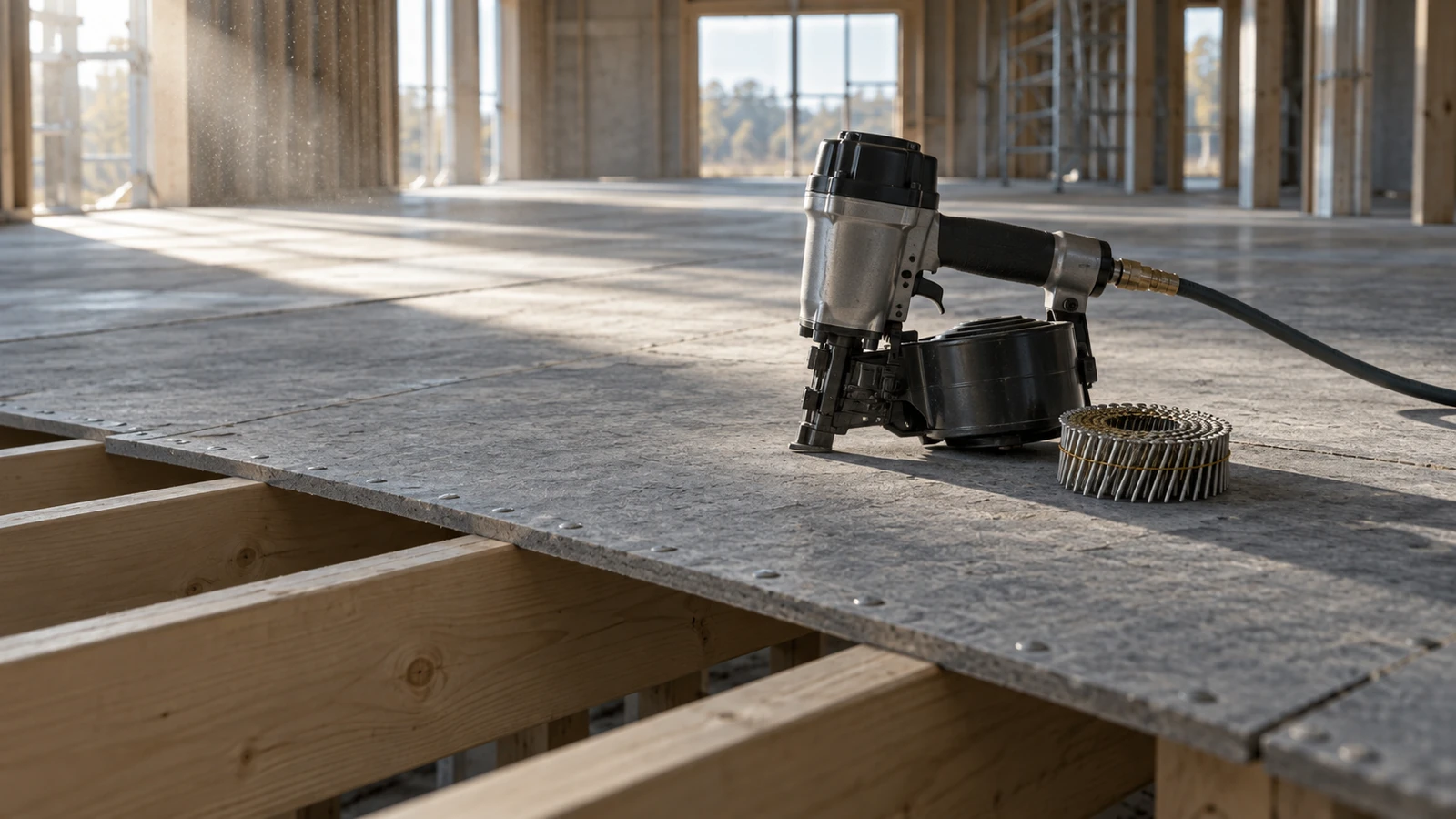
The word “coil” is often used loosely in purchasing conversations. True coil nails are joined into a circular or near-circular coil and are loaded into a coil-style pneumatic nailer. Straight-collated nails, by contrast, are arranged in strips or sticks and normally use a different magazine and feed system.
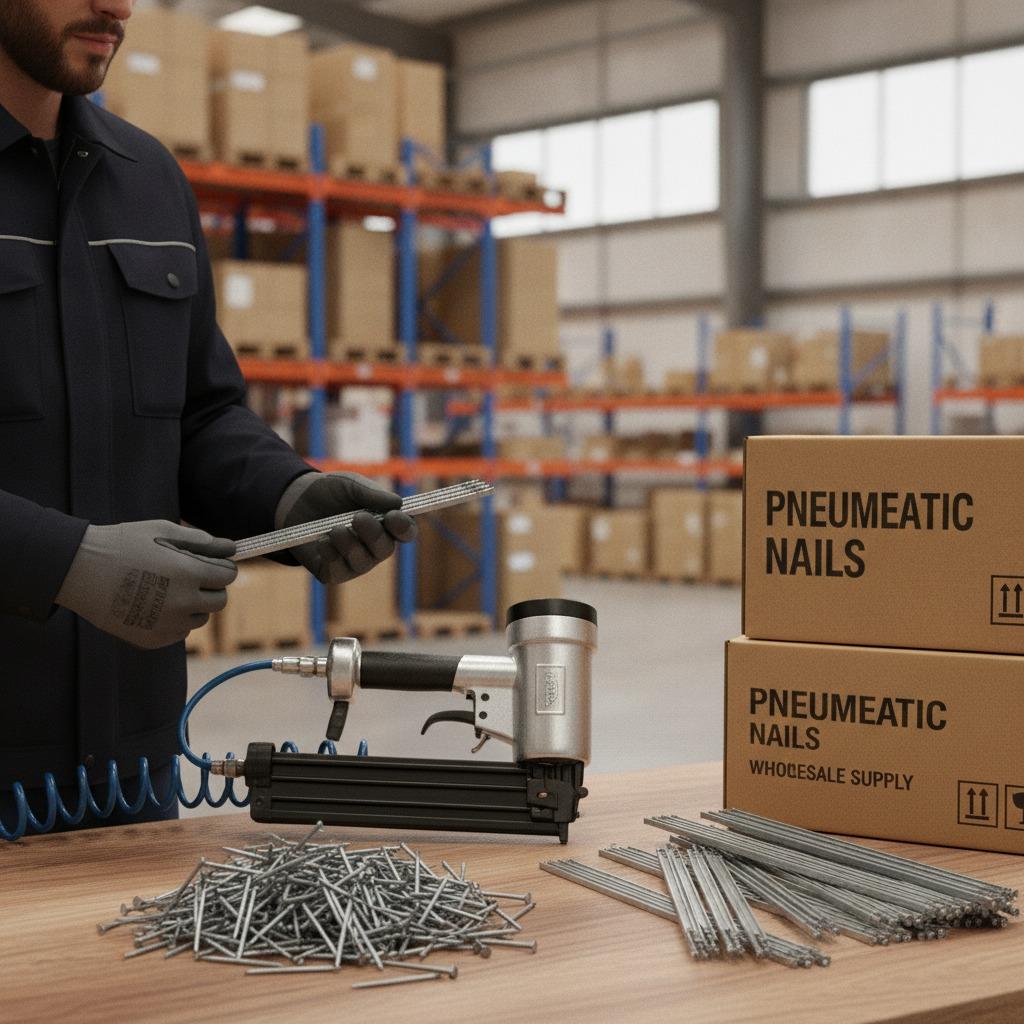
The products shown in the available information include a pneumatic fastener driver with a long magazine and nails arranged in straight collated strips. That suggests a stick-collated format, although the exact product specification is not confirmed. A buyer should therefore avoid assuming that the pictured fasteners are roofing coil nails or any other specific coil format without checking the supplier’s technical data.
This distinction affects more than packaging. Collation angle, wire or plastic joining method, nail-head clearance, shank diameter, nail length, and magazine geometry all influence whether a fastener feeds correctly. A mismatch can produce misfeeds, jams, poor seating, or damage to the tool.
Quick Buyer Checklist
- Confirm whether the fasteners are coil-collated or straight-collated.
- Specify nail length, diameter or gauge, head form, point style, and shank profile.
- Identify the nailer model or at least the required magazine and collation format.
- Ask what steel grade and surface finish are available; do not infer them from a gray metallic appearance.
- Request packaging details, including quantity per carton and how the fasteners are protected during transport.
- Clarify inspection procedures for dimensions, collation strength, surface condition, and feeding performance.
- Separate confirmed specifications from options that require quotation or technical review.
What a Capable Manufacturer Should Be Able to Explain
Wire, forming, and nail geometry
Collated nails are generally produced from drawn steel wire, then cut and formed into a finished fastener. The manufacturing route may include pointing, head forming, surface treatment, and collation. The precise process depends on the nail design and the supplier’s equipment, so buyers should ask for a product drawing rather than relying on a general catalogue description.
Important details include the shank diameter, overall length, head diameter, point style, and whether the shank is smooth or profiled. These features influence holding behavior and compatibility with the driver. For applications involving timber assemblies, pallet or crate production, furniture components, or general construction, the correct geometry matters as much as the nominal length.
Collation and feeding consistency
Collation is a production detail that is easy to underestimate. Nails must remain connected during handling but separate cleanly in the tool. Poorly aligned strips or weak joining can interrupt production. A supplier should be prepared to discuss the collation material, strip or coil configuration, allowable tool compatibility, and how feeding consistency is checked.
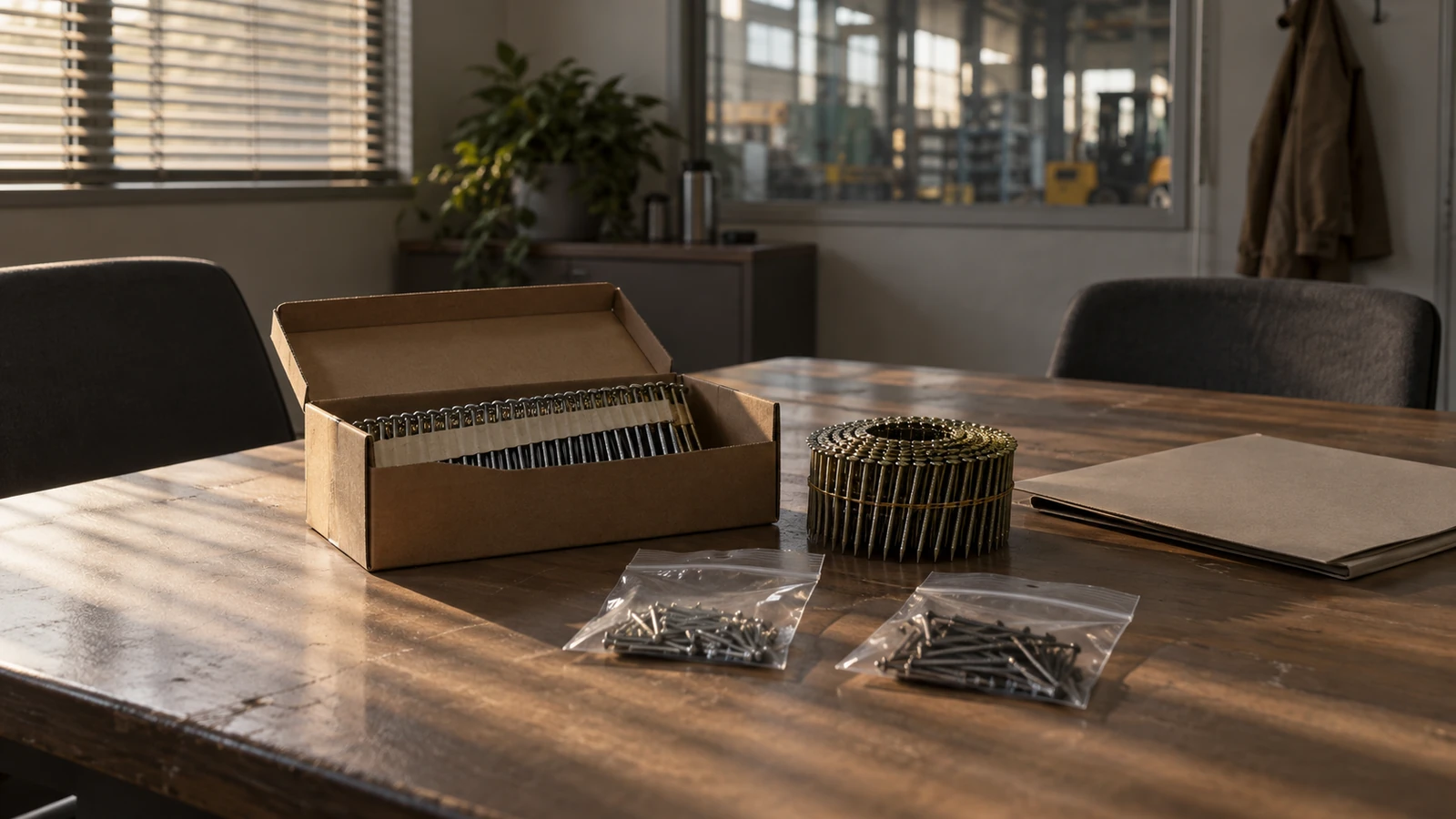
The visible product information shows fasteners in loose form and in straight strips, packed in brown corrugated cartons labeled “PNEUMATIC NAILS” and “WHOLESALE SUPPLY.” This indicates bulk or wholesale-oriented supply, but it does not establish carton quantity, packaging protection, or a particular quality grade. Those points should be confirmed in the purchase specification.
Finish and corrosion requirements
The fasteners appear gray or metallic, but an image cannot confirm the steel grade, coating type, coating thickness, or corrosion resistance. For indoor woodworking or pallet assembly, a basic finish may be acceptable. Exterior construction, exposed timber, or damp storage conditions may require a more specific surface treatment.
Do not accept “corrosion resistant” as a sufficient description. Ask which finish is offered, where it is intended to be used, and whether the supplier can provide a written specification. If the application is sensitive to staining or premature corrosion, sample evaluation may be sensible before approving a larger order.
Matching Fasteners to the Pneumatic Tool
The pictured tool has a silver-colored metal nose and upper housing, a black cylindrical grip, a long black magazine, and a blue coiled air hose connected to the compressed-air inlet. Visible components include the trigger area, fastener channel, and front nose assembly. These features identify the equipment broadly as a pneumatic nail gun, but they do not reveal the required nail dimensions or air-pressure range.
Before sourcing, record the tool’s manufacturer and model if available. Then compare the nail supplier’s data with the tool manual. Check the magazine format, fastener length range, shank size, head dimensions, and collation arrangement. The tool may be used for framing, pallet work, furniture production, trim work, or another task, but the image alone does not confirm a specific application.
Framing coil nails are a useful search term for heavier construction fastening, while roofing coil nails normally refer to a more specialized group of fasteners used with compatible coil nailers. Neither term should replace a dimensional specification. Application labels help narrow the search; they are not a substitute for tool compatibility.
Common Sourcing Mistakes
- Ordering by photograph: Similar-looking nails can differ in length, gauge, head size, and collation.
- Confusing sticks with coils: A long magazine does not prove that the tool accepts coil-collated fasteners.
- Ignoring the finish: A metallic appearance does not identify the coating or corrosion performance.
- Requesting only a carton price: Packaging quantity, inspection scope, and compatibility can change the real purchasing cost.
- Skipping a production trial: A nail that looks correct may still feed poorly in the intended equipment.
Practical Advice When Comparing Suppliers
Send the manufacturer a concise technical request. Include the nail format, dimensions, application, tool model, expected order quantity, packaging preference, and any finish requirement. Ask the supplier to identify which points are standard and which are custom or subject to confirmation.
For a first order, a controlled sample run is often more informative than a broad performance promise. Observe loading, feeding, driving depth, head seating, and the frequency of misfeeds under normal operating conditions. Keep the sample and its packaging connected to the quotation so that the approved specification is not lost during purchasing.
A supplier showing pneumatic nail guns, collated fasteners, and wholesale cartons may be positioned to serve contractors, pallet manufacturers, woodworking shops, furniture factories, maintenance departments, tool distributors, or fastener wholesalers. Still, brand, country of manufacture, certifications, warranty, service life, and exact production capability remain unconfirmed unless the supplier provides them directly.
Frequently Asked Questions
Are the shown nails definitely coil nails?
No. The available information describes nails in straight collated strips or sticks. The format should be verified before treating them as coil nails.
Can these nails be used for framing or roofing?
Possibly, depending on their dimensions, finish, collation, and the nailer. The available information does not confirm a framing or roofing specification.
What should I request from a coil nails manufacturer?
Request a product drawing, dimensional data, steel and finish information, collation details, compatible tool requirements, packaging information, and the supplier’s inspection or sampling process.
Next Step for Buyers
Before requesting a quotation, define the fastener format and record the nailer requirements. Then ask the manufacturer to confirm every dimension and application assumption in writing. That simple step reduces the risk of buying a visually similar product that cannot feed reliably or deliver the required fastening result.