
Case Study: Choosing an Industrial Nails Exporter for High-Volume Pallet Assembly
When a pallet or crate line starts missing production targets, the problem is often not the wood. It is the fastener supply. An industrial nails exporter is expected to do more than ship boxes of product; the right supplier keeps pneumatic tools fed, supports repeatable fastening, and avoids the kind of packaging-line interruptions that cost real money. In this case study, the focus is on bulk coil nails used with a pneumatic coil nailer in woodworking and packaging operations, especially pallet and slat assembly.
For sourcing managers and plant engineers, the decision is usually straightforward in principle and messy in practice: which supplier can consistently deliver the right industrial fasteners exporter service level, with the right coil format, for the right application? That sounds simple until the line is running two shifts and the wrong nail coil, or even the wrong coating, starts creating jams, weak joints, or handling issues.
The application: speed matters more than romance
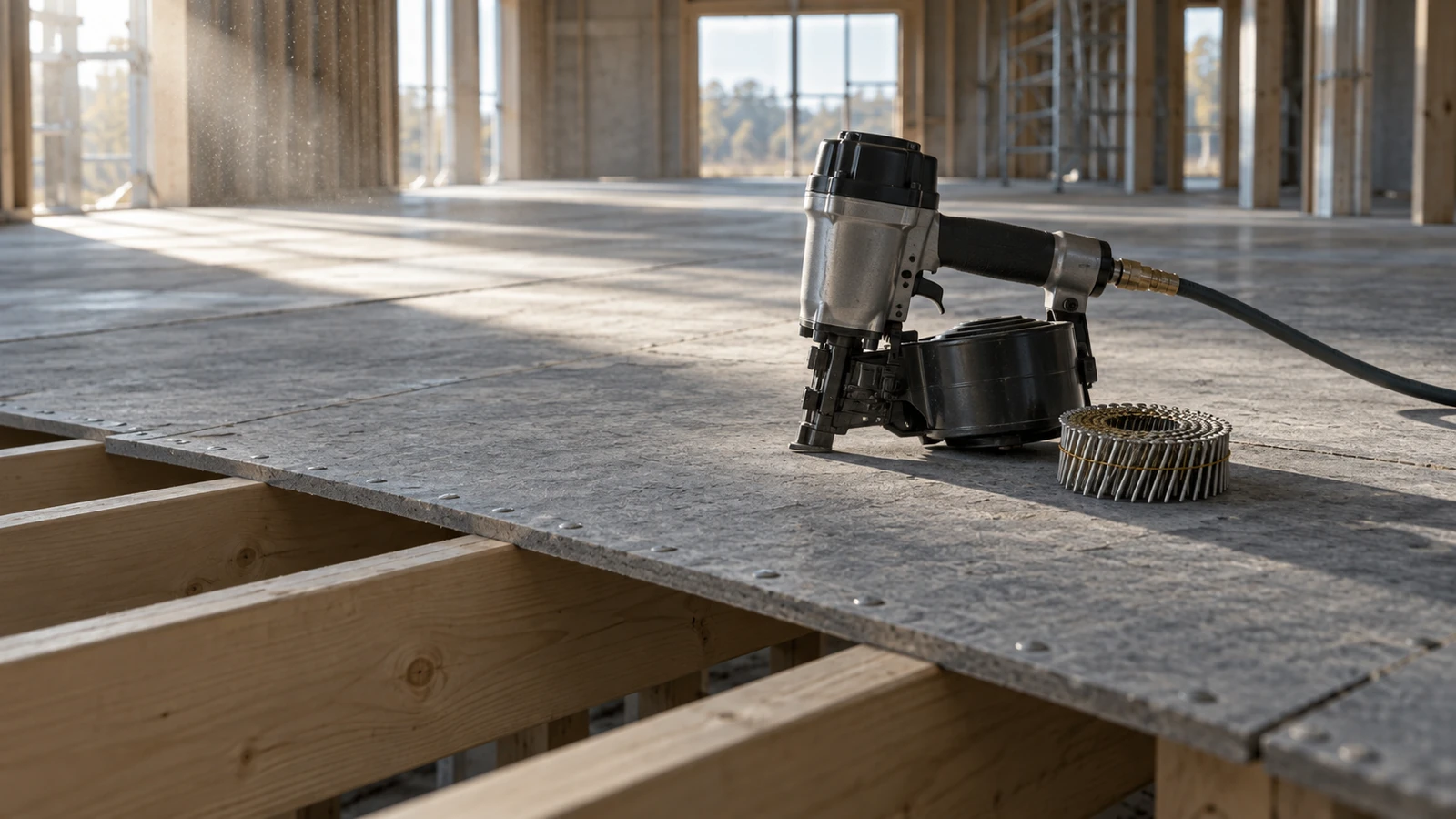
The product in view is a wire-collated coil nail format designed for feed-through nail guns. That matters because coil nails support high-volume fastening where the operator cannot afford to reload constantly. In pallet manufacturing, crate building, shipping container assembly, and general timber fastening, the value is not just the nail itself. It is the rhythm of production.
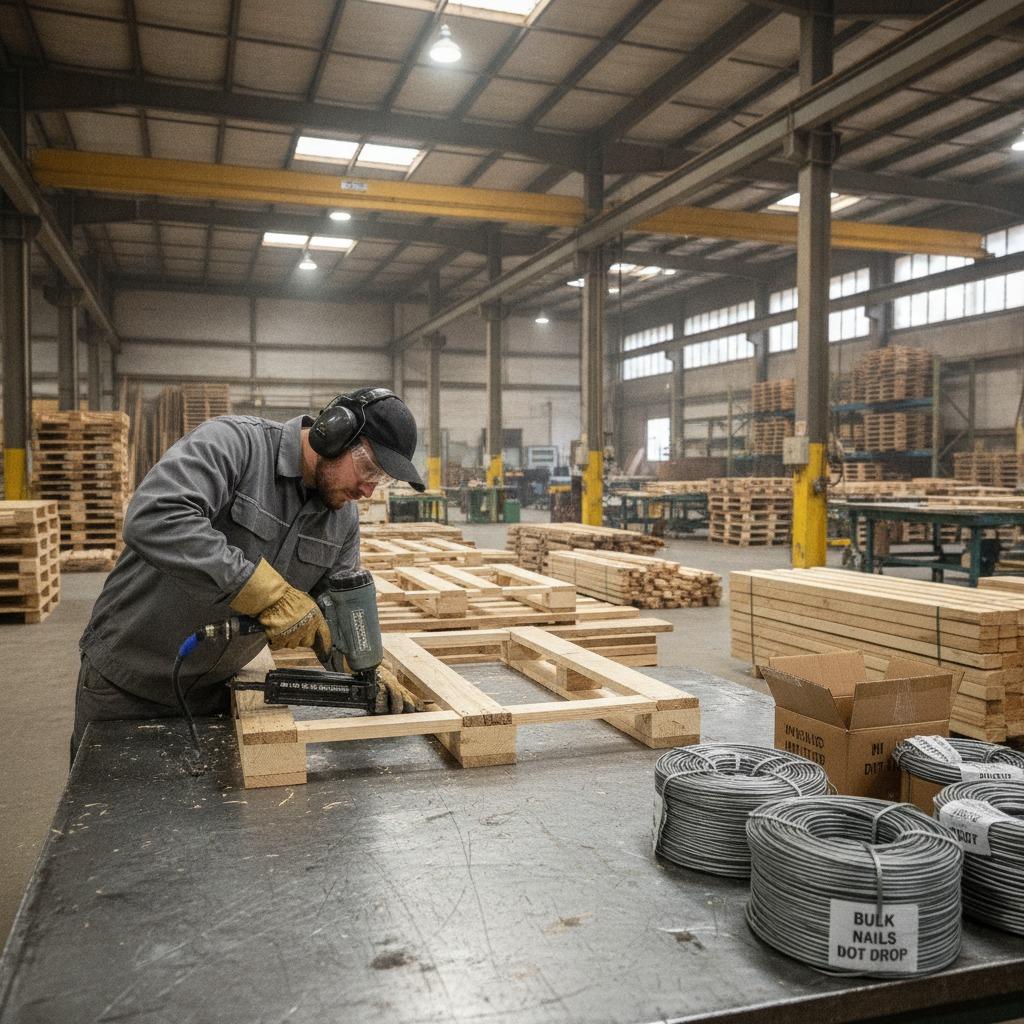
The image shows a worker fastening wooden pallet or slat components, which is a good reminder that the end use is industrial, not decorative. These nails are consumables, but they sit inside a system: compressor, pneumatic coil nailer, line speed, wood density, and the operator’s tolerance for misfeeds. A supplier who understands that system usually makes a better export partner than one who only sells by box count.
What the visible product tells a buyer
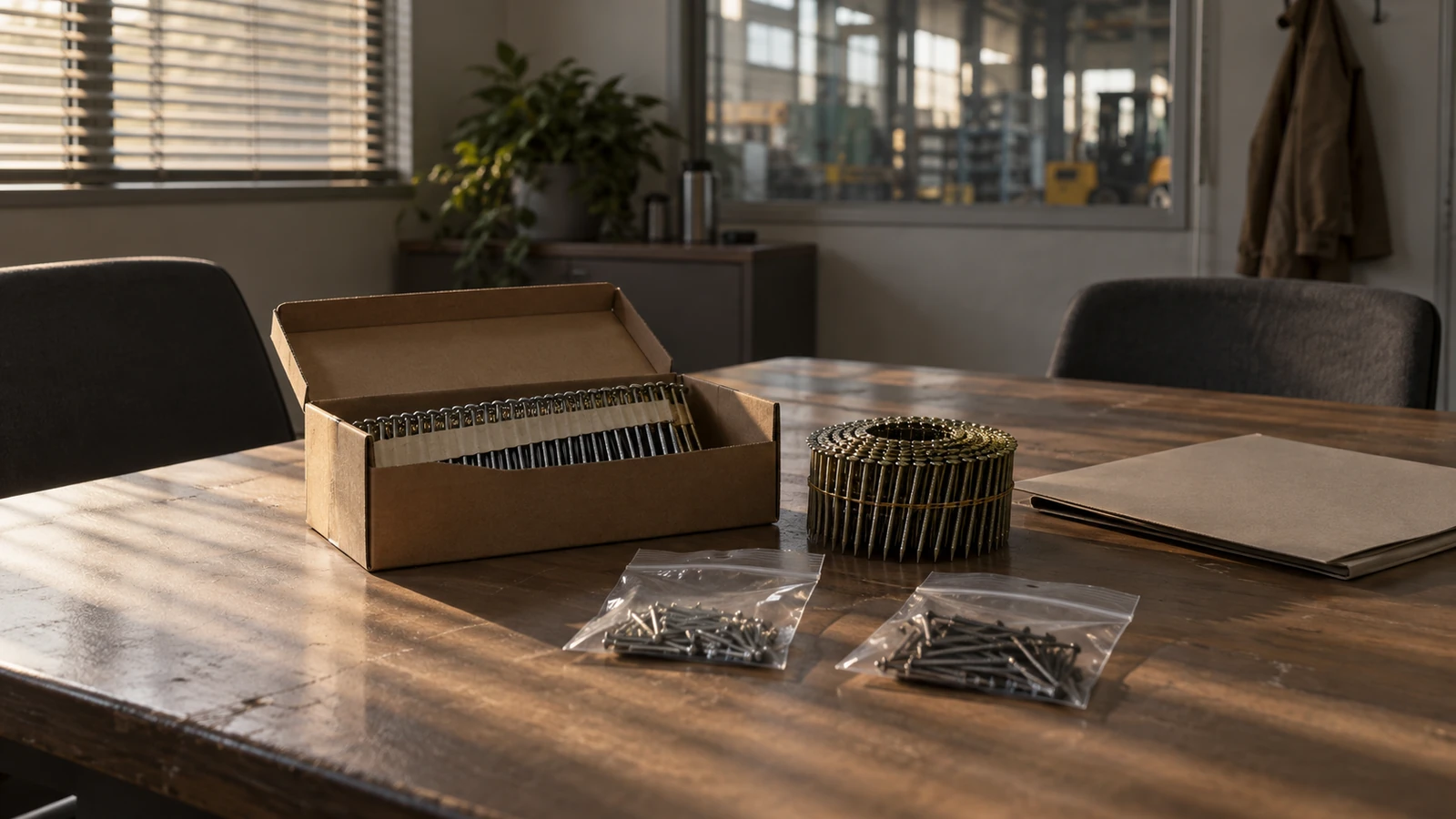
Several practical details are visible. The nails are formed into tight circular coils for automated feeding. Some coils appear in dark gray or black finishes, while others look gold or yellow, suggesting different coatings or plating types. Cardboard box packaging is also visible, which is typical for bulk industrial supply.
What cannot be confirmed from the image is just as important. The exact nail length, diameter, shank style, point type, coating chemistry, corrosion performance, and tool compatibility are not readable and should not be assumed. That caution is worth stating plainly, because a fastener that looks close enough on a screen can still fail on the line.
Quick buyer takeaway: what to verify before placing an order
If you are evaluating an industrial nails exporter for this type of product, the first questions should be practical:
Feed performance
Will the coil feed cleanly through your pneumatic coil nailer without frequent jams or deformation?
Coating and environment
Are the nails meant for dry indoor assembly, or do you need a finish that better suits transport, storage, or exposure conditions? The visible finishes suggest more than one option, but the chemistry must be confirmed.
Collation format
Does the coil geometry match your tool and workflow? A strong product can still be the wrong product if the collation pattern does not suit the nail gun.
Production consistency
Can the exporter hold the same format across repeat shipments? That is often the difference between a useful partner and a one-time vendor.
Why exporters matter in fastener sourcing
There is a tendency to treat nails as commodity items, but anyone who has supplied a packaging plant knows better. An industrial fasteners exporter is not only handling transit; they are also protecting the consistency of a consumable that has to perform under speed and pressure. If the coils arrive damaged, inconsistent, or poorly packed, the buyer absorbs the downtime.
That is why export buyers often value packaging quality, communication on product specification, and the ability to supply multiple variants without confusion. In this category, even a small documentation mistake can create a bigger problem downstream than the fastener cost itself.
Common sourcing mistakes
One frequent mistake is over-relying on appearance. A black-coated coil and a gold-finished coil may look like simple variants, but they can behave differently in storage and use. Another mistake is assuming all coil nails fit all pneumatic tools. They do not. A third is ignoring the application. Pallet assembly, crate building, and framing sound related, but they do not always demand the same fastening behavior.
A practical buyer also watches for packaging details. Bulk boxes are normal, but they need to survive export handling. Loose or crushed collations can create sorting and feeding problems before the first nail is driven.
What a sensible sourcing decision looks like
The best purchase decision is usually the one that starts with the line, not the catalog. Define the tool, the wood, the expected production rate, and the storage conditions. Then ask the exporter for product information that matches those conditions. If the supplier can speak clearly about coil format, finish options, and packaging, that is a good sign. If not, keep looking.
For this product category, the right industrial nails exporter helps buyers reduce rework, protect tool uptime, and keep assembly moving. That is the real value, and it is usually more important than the lowest quoted price.
Next step for buyers
Before you commit, request a full specification sheet and confirm tool compatibility against your actual pneumatic coil nailer. If you are sourcing for pallets, crates, or other high-volume wood assemblies, ask for the exact coil format, finish, and packaging details you need rather than assuming the visible sample tells the whole story. A short verification step now can save a long shift later.