
Industrial staple buyers rarely arrive with one universal product. A furniture supplier may need a fine-wire range for visible work, while a packaging customer wants a wider crown and a tougher carton. A distributor may already have three tool families in the market and simply needs staples that customers can identify and reorder.
This guide builds an industrial staple compatibility chart for those B2B programs. Its staple range includes different gauges and series for woodworking, furniture, packaging, and related pneumatic applications. The exact item should be matched to the buyer's current tool, sample, and market requirement.
Updated July 22, 2026. This guide is based on the current ProAirNails catalog and a buyer RFQ workflow; final product and packing details require written confirmation.
Direct answer: A usable compatibility chart must connect the stapler model to staple gauge, crown, leg length, wire dimensions, strip format, and the material being fastened. A series name by itself is not enough.
Industrial Staple Compatibility Fields
| Field | What to record | Failure prevented |
|---|---|---|
| Tool | Brand, model, magazine label, and stated range | Loading a similar-looking but incompatible staple |
| Staple | Gauge, crown, leg, wire width and thickness | Feed, bending, or penetration problems |
| Collation | Strip length, orientation, and condition | Broken strips and double feeds |
| Application | Board, timber, fabric, foam, or carton | Approving a staple on the wrong material |
Begin with the application customers are paying for
The useful starting point is not a long list of crown widths. It is the work being done: sofa frames, cabinet backs, light wood assembly, carton closure, insulation, or another repeat application. That context narrows the product conversation quickly.
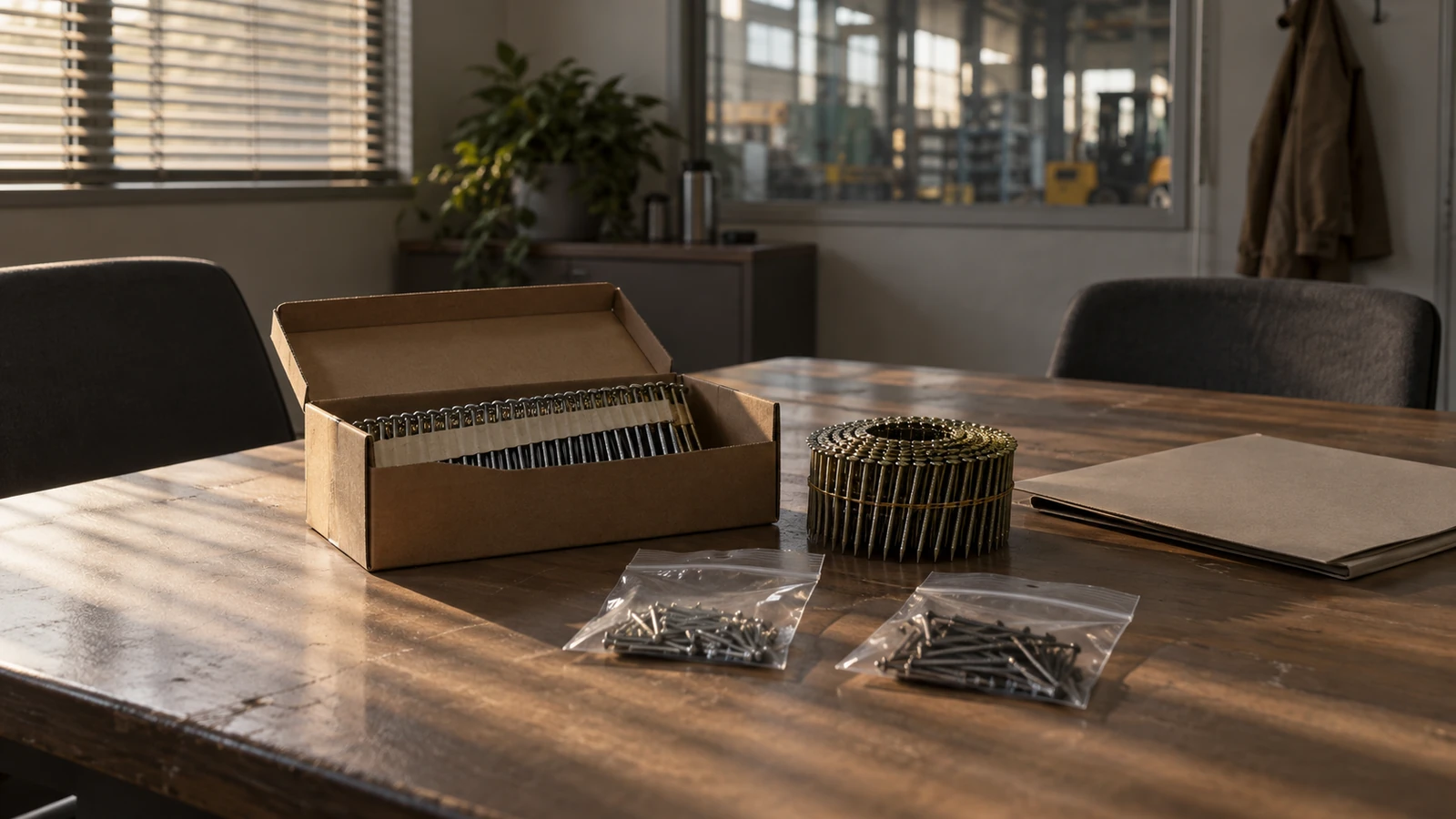
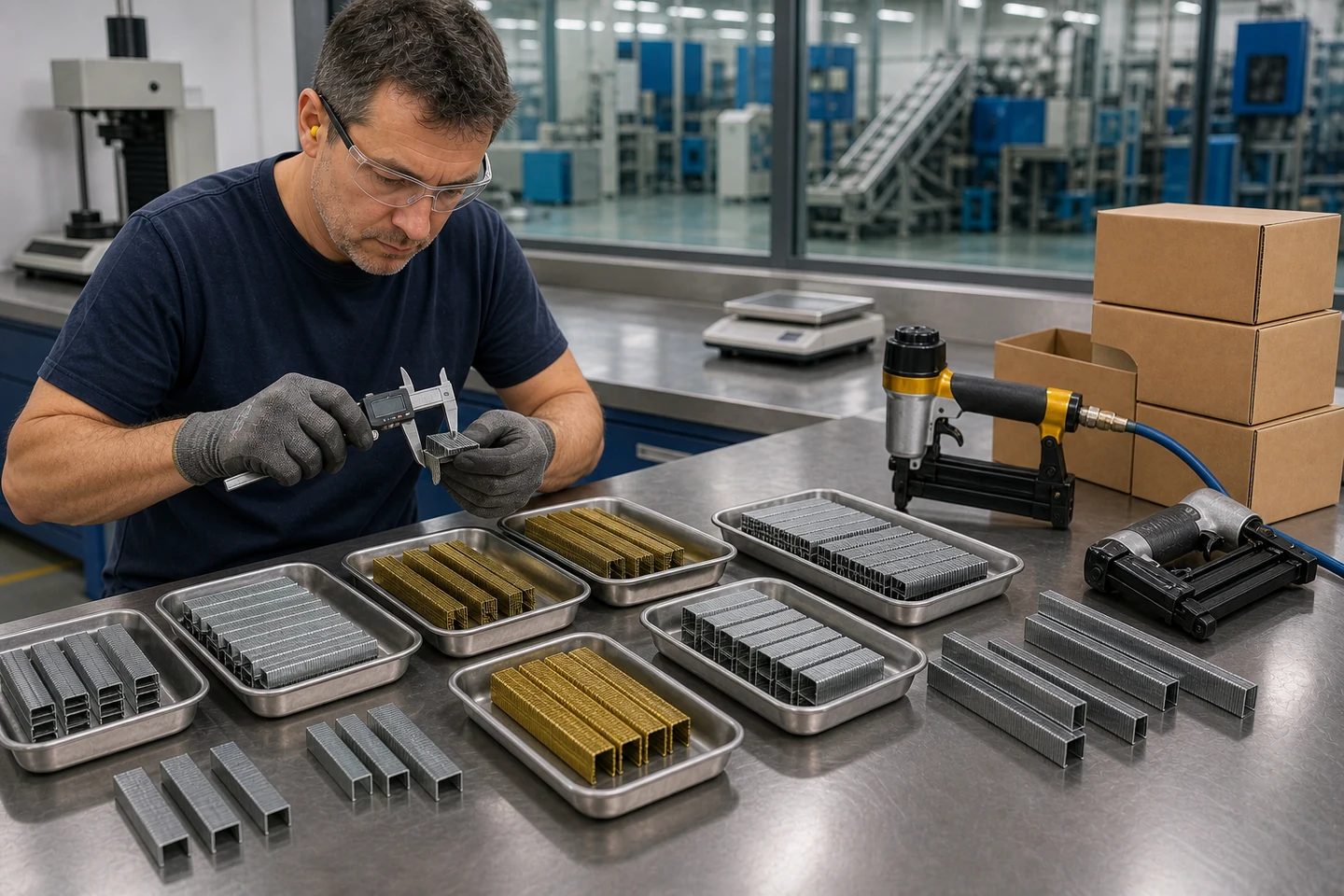
Buyers can send the tool model, existing strip, current carton, target lengths, finish, and monthly volume. When an old supply has a problem, show that too. Broken strips, unclear labels, bent legs, or crushed boxes are better evidence than a generic request for “better quality.”
Explore the current Air Staple Pin range and related Pneumatic Nails.
A saleable range needs a naming system
Staple series can become confusing when the sales team, warehouse, and customer use different names for the same product. The box should make the important facts easy to find: series, gauge, crown, leg length, quantity, finish, and compatible tool family where appropriate.
This matters even more in private-label orders. A barcode or artwork revision copied from the wrong length can create a warehouse problem before anyone opens the box. Buyers should approve the product and the label as one item, then keep that reference for replenishment.
The carton protects the collation
Staples depend on straight, stable strips. Packing should support them through export handling, mixed-container loading, and warehouse stacking. Inner-box fit, master-carton weight, moisture protection, labels, and pallet arrangement deserve attention because a deformed strip cannot be repaired by a polished outer box.
For a mixed order, heavy products should not be allowed to crush fine-wire staples. The loading plan can also separate similar-looking series so receiving teams do not spend hours reopening cartons.
Product approval and process control stay connected
A sample gives the buyer something real to run, inspect, and compare. A production order then needs to remain tied to that approved item and packing version. ISO provides an overview of the ISO 9000 quality-management family, which explains the role of controlled processes. It does not replace a buyer's product approval or application testing.
ProAirNails is backed by Huajian, established in 1997 and supplying multiple fastener categories to international markets. The broader company background is available at About ProAirNails.
One staple program can open a wider account
A distributor that begins with furniture staples may later need brad nails, pins, coils, screws, or air tools for the same customer network. ProAirNails can discuss those related product families as the range grows.
The first order should still stay focused. Choose the series and lengths that customers already use, confirm samples and packing, then expand from actual sales. That is how a controlled industrial staple range becomes part of a repeat supply program instead of a one-time quotation exercise.
Share the current staple, tool, application, and target packing through the ProAirNails inquiry page.
Implementation Checklist, Cost, and Limits
- Photograph the tool label and current staple beside a scale.
- List every leg length required for the opening range.
- Test the sample on the actual material and normal tool setting.
- Use a distinct SKU and label for staples that look similar.
Cost and value: Compatibility errors create tool downtime, damaged material, opened cartons, and support calls. The chart costs little to maintain and gives sales and warehouse teams a shared reference for repeat orders.
Limit: Series names vary between markets and brands. The chart must be validated against the real stapler and staple dimensions; it is not a substitute for the tool manual or a physical sample test.
FAQ
What buyers does ProAirNails serve with industrial staples?
The range is suited to importers, distributors, furniture and woodworking suppliers, packaging buyers, brand owners, and other repeat-order B2B customers.
Can an existing staple strip be used for matching?
Yes. Send the strip with the tool model, application, required lengths, finish, quantity, and packing details so the item can be reviewed as a complete order.
Can industrial staples carry private-label packaging?
Private-label requirements such as artwork, barcode, languages, quantities, and carton marks can be discussed with the product and packing specification.
Contact ProAirNails to discuss compatible staple series and sample requirements.