
Choosing an industrial staples manufacturer is not just a purchasing decision; it affects line speed, tool uptime, and the quality of the finished assembly. In furniture and upholstery work, the staple may be small, but the failure points are easy to see: loose fabric, split wood, bent crowns, and operators stopping to clear jams. For buyers comparing suppliers, the real question is not simply who can sell the cheapest strip of staples, but who can provide consistent collated fasteners that feed cleanly in a pneumatic staple gun and hold up in production.
What these staples are used for
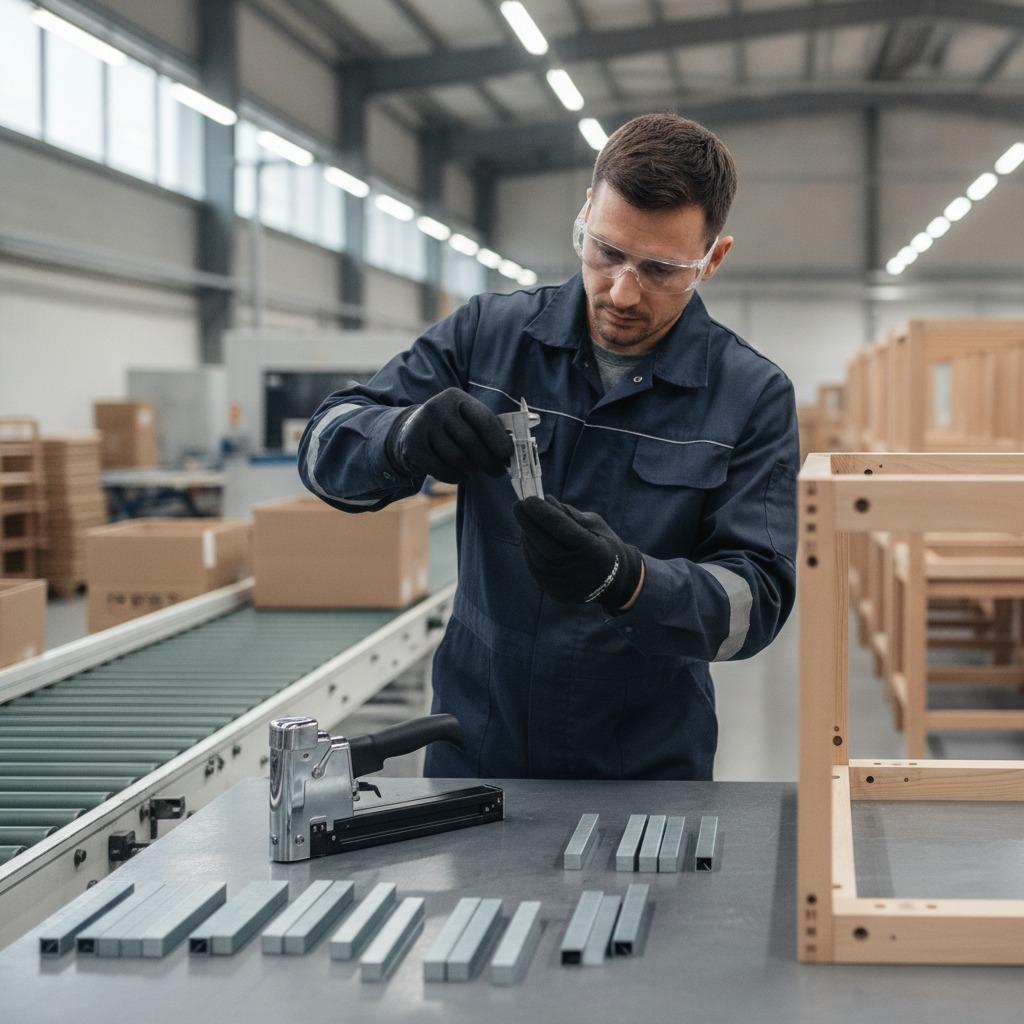
The product here is a collated metal upholstery staple, supplied in strip form for feeding through an air-powered stapler or industrial stapler. The visible shape is the familiar U-form with two sharp legs, made for fastening fabric, foam, webbing, and similar materials to wood frames. That makes it a practical fit for upholstered furniture assembly, chair and sofa framing, light wood fastening, and other workshop or factory applications where speed matters.
These are not decorative fasteners. They are working parts of a production process. When a staple strip is formed and collated correctly, the tool can fire repeatedly without much interruption. When it is not, operators notice immediately. That is why an industrial staple supplier is often judged as much on consistency as on price.
Why strip consistency matters
In high-volume assembly, the staple itself has to cooperate with the tool. The strip must feed straight, break cleanly at the point of use, and maintain enough uniformity that the stapler does not misfire or jam. The image suggests a bright silver or galvanized-looking finish, though the exact coating cannot be confirmed from appearance alone. Even so, surface condition matters because it affects handling, storage behavior, and the smoothness of feeding through the magazine.
Buyers looking at heavy duty staples should pay attention to the whole package: wire quality, forming accuracy, collation method, and how the product is packed for transit. A staple may look standard on paper, but if the strips are inconsistent, production operators feel the cost long before procurement does.
What to evaluate when sourcing
For purchasing teams comparing an upholstery staples wholesale offer, the practical checklist is usually straightforward, though it is easy to skip a step when pricing is attractive.
- Compatibility with the stapling equipment in use, especially pneumatic staple guns and industrial staplers.
- Uniform strip formation so the staples feed smoothly through the tool.
- Wire material and finish, especially if the application involves repeated handling or storage before use.
- Dimensional fit for the intended frame, substrate, and upholstery build.
- Packaging that protects the strips from bending or damage in transit.
One practical caution: buyers sometimes ask for “standard” staples and assume all staples of the same general shape will run the same way. In practice, small differences in crown width, leg length, gauge, and collation can change tool performance. Those details are not always visible in a sample image, so the specification sheet matters more than the photo.
How an industrial staples manufacturer should be assessed
A good staples manufacturer should be able to speak clearly about the production method, not hide behind vague labels. For this product category, the likely route is wire forming and collation, with the possibility of galvanizing or zinc-type treatment after forming, though that cannot be confirmed here. What matters to the buyer is whether the supplier controls the forming process tightly enough to keep the strips uniform from batch to batch.
Questions worth asking before ordering
What wire material is used? Are the staples suited to the intended staple gun or stapler model? Are the strips collated for continuous feeding? How are the staples packed to protect them during shipping and storage? These are not glamorous questions, but they prevent most purchasing mistakes.
If the application is furniture assembly, it is also wise to ask how the staple behaves in wood of different densities. Soft wood, hardwood, and mixed-frame constructions do not always respond the same way. A staple that works well in one build can leave proud legs or inconsistent penetration in another.
Common buyer mistakes
The most common mistake is shopping only by headline price. Cheap staples can become expensive if they create downtime, scrap, or rework. Another common issue is buying without checking tool compatibility. An industrial staple supplier may offer several related sizes or collations, and the wrong choice can cause feeding problems that look like tool trouble until the consumable is examined more closely.
A second mistake is assuming all bright-finish staples are coated the same way. They may not be. If corrosion resistance is important for storage, shipping, or the final environment, that question should be settled before the order is placed. It is better to be slightly cautious than to discover after delivery that the product does not suit the production environment.
What matters most in real production
For most buyers, the best supplier is the one that reduces friction. That means staples that arrive in uniform strips, run cleanly in air-powered tools, and match the intended upholstery or frame-assembly task without constant adjustment. In other words, the ideal industrial staples manufacturer is not just a seller of metal fasteners; it is part of the production system.
That perspective is especially useful for factories, workshops, and sourcing teams that buy upholstery staples wholesale. Once annual usage volumes rise, small quality differences become visible in labor time and tool maintenance. The cheapest option is not always the least expensive one over a full production cycle.
FAQ: quick answers for buyers
Are these staples only for furniture? No. Upholstery is the most visible use, but similar collated staples are also used for light wood fastening and other fastening tasks where a stapling tool is appropriate.
Can the finish be identified from the image alone? Not precisely. The staples appear bright silver or galvanized-looking, but the exact coating should be confirmed from product specification.
Why does collation matter? Because strip consistency supports smooth feeding in a pneumatic stapler and helps avoid jams, which are costly in production settings.
A practical next step
If you are comparing an industrial staples manufacturer for a new line or a replacement source, start with the basics: tool compatibility, strip consistency, and the intended application. Ask for the exact staple specification rather than relying on a photo or a generic catalog description. That extra step usually separates a workable supply arrangement from one that creates avoidable production trouble.
For sourcing managers and product teams, that is the real decision: not whether a staple looks acceptable, but whether it will keep a production line moving without drama.