
Why pallet buyers care about the nailing process
If you are sourcing a wooden pallet for freight, storage, or export packaging, the conversation usually starts with dimensions and load needs. It should also include how the pallet is built. That is where an OEM pneumatic nails supplier becomes relevant, because the fastening method has a direct effect on pallet consistency, throughput, and field performance.
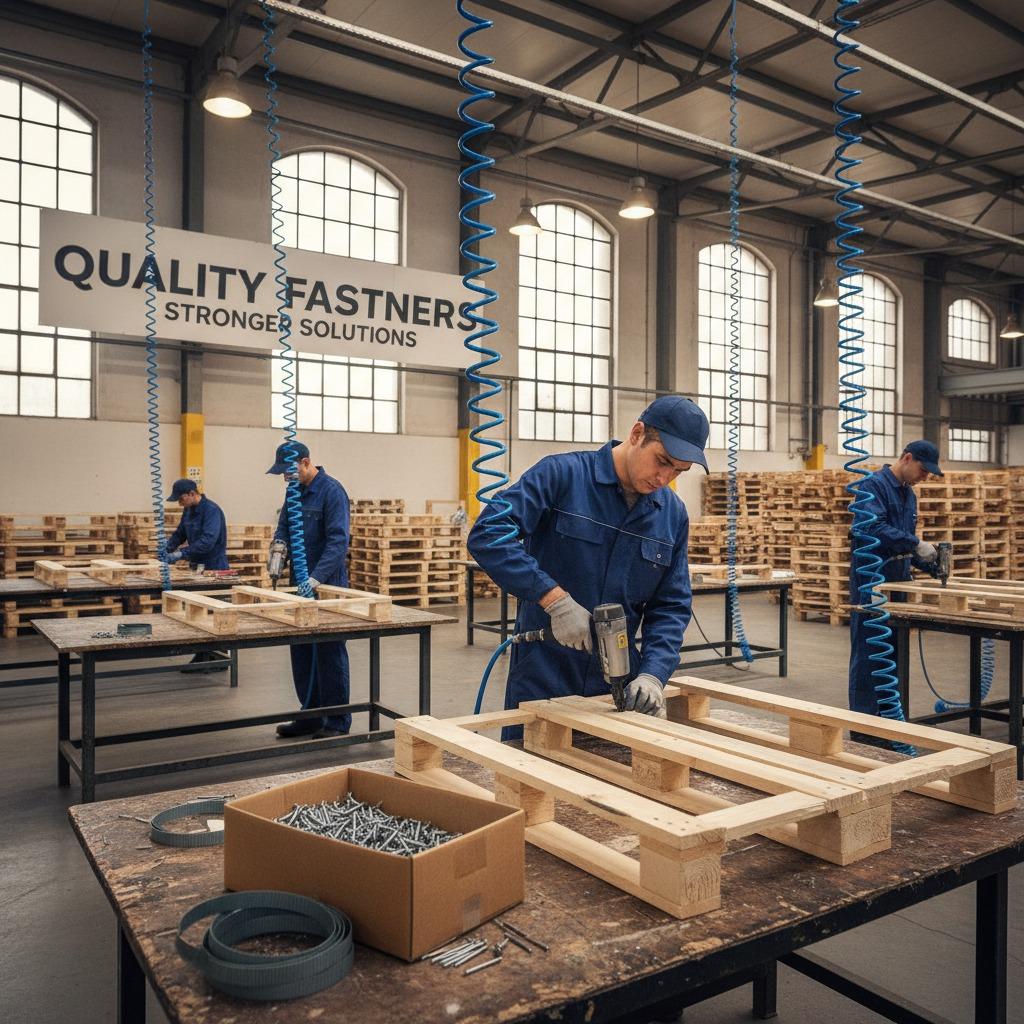
A pallet is not just a stack of boards. It is a load-bearing base that has to survive forklift impacts, warehouse racking, conveyor movement, and the rougher parts of shipping. In a busy pallet assembly line, pneumatic nailers are often the practical tool of choice for fastening deck boards to stringers or blocks. The process is fast, repeatable, and well suited to high-volume production, though it still depends heavily on operator discipline and fixture quality.
What the assembly line tells you about the product
The visible setup in this kind of production floor is usually straightforward: unfinished softwood lumber, metal nails, air nail guns, and compressed-air hoses. Pallets are assembled in flat rectangular frames, often with open slats so forklifts can enter and air can circulate during storage. Stacked pallets in the background are a simple but useful sign that the operation is organized for repeat output rather than one-off carpentry.
That matters to buyers because pallet quality is often judged after the fact, when a shipment has already moved. A board that sits slightly loose, a fastener that misses the intended line, or a stringer that splits under load can create headaches in a warehouse or on a container floor. The cheapest quote is not always the cheapest pallet if it drives damage, rework, or handling delays.
Pneumatic nailing versus slower joining methods
For pallet manufacturing, pneumatic nailing has a clear advantage in speed. It is also easier to standardize than hand nailing, especially when the line is set up around jigs or repeatable fixtures. A pneumatic nails manufacturer or air nail supplier can support this workflow by supplying fasteners matched to the nail guns and the wood used in production.
That said, faster is not automatically better. The real question is whether the assembly process produces pallets that hold together under the conditions your goods will actually see. Softwood lumber, for example, is common in pallet production because it is practical and available, but wood variability still affects driving force, split risk, and the finished feel of the pallet. Buyers should ask whether the supplier’s process is designed for consistent fastening rather than simply high output.
What to evaluate when choosing a supplier
When comparing an OEM pneumatic nails supplier, most sourcing teams should look beyond the sales language and into the production reality.
1. Compatibility with the pallet build
The nail specification has to match the lumber thickness, joint design, and nailing equipment. If the fastener is wrong for the material, you get more split boards or weaker joints.
2. Process control on the line
Look for signs of controlled assembly: consistent placement, stable workstations, and organized inventory. Those are better indicators than a polished brochure.
3. Ability to support your use case
A pallet for warehouse staging is not always the same as one for export packaging or bulk freight transport. Load path, handling frequency, and storage environment all influence what kind of pallet construction makes sense.
4. Practical communication
An air nail supplier that understands pallet manufacturing will usually ask the right questions: wood species, joint geometry, nailer type, and the end-use environment. If those questions never come up, be cautious.
Common mistakes buyers make
One common mistake is treating all wooden pallets as interchangeable. Another is assuming that a visual inspection of the finished pallet tells the whole story. It does not. A pallet can look fine on the rack and still be vulnerable to fastener issues or inconsistent assembly.
Another buyer-side blind spot is over-specifying what does not matter and under-specifying what does. Exact decorative appearance rarely matters in freight handling. Fastener performance, repeatability, and suitability for the intended load do.
A buyer-facing checklist that actually helps
Before you place an order, ask for clarity on the pallet type, the wood used, the fastening process, and the intended application. If the pallet is being built for storage and transport of industrial goods, make sure the supplier understands whether the priority is durability, cost control, stackability, or one-way shipping efficiency.
If you are sourcing at scale, it is worth visiting the assembly floor or requesting process photos. A good OEM pneumatic nails supplier should be able to show how pallets move through the line and how consistency is maintained. Even a brief look at the workstations can reveal whether the operation is set up for disciplined production or improvised output.
FAQ: quick sourcing questions
Are pneumatic nails only for high-volume pallet plants?
Not necessarily, but they are most useful where repeatable fastening and speed matter.
Do all wooden pallets use the same nail type?
No. Nail choice depends on lumber, joint design, and the nailing equipment.
Why does pallet construction matter so much?
Because the pallet is part of the packaging system. If the base fails, the shipment suffers.
Next step for sourcing teams
If you are comparing pallet suppliers or fastener partners, start with the build process, not just the catalog photo. Ask how the pallet is assembled, what air nail equipment is used, and whether the supplier can support the specific handling environment your goods will face. That is usually where the useful differences show up.