
Why buyers still care about a pneumatic fasteners supplier
If you buy for a woodworking line, cabinet shop, or trim crew, a pneumatic fasteners supplier is not just a place to restock consumables. It is part of the uptime equation. When compressed-air fastening tools work well, assembly moves fast, joints stay consistent, and operators spend less time fighting jams or searching for the right nails. When the supply is poor, even a good production cell starts to feel clumsy.
That is why sourcing decisions around air powered fasteners tend to be more practical than promotional. Engineers want fit and reliability. Sourcing managers want availability and predictable specifications. Product teams want the fastener and tool combination to behave the same way on Monday morning as it did on the pilot run. This article looks at what matters when you are choosing a supplier for pneumatic fastening work, especially in woodworking, cabinet assembly, and light-duty shop production.
What the tool picture tells us about the application
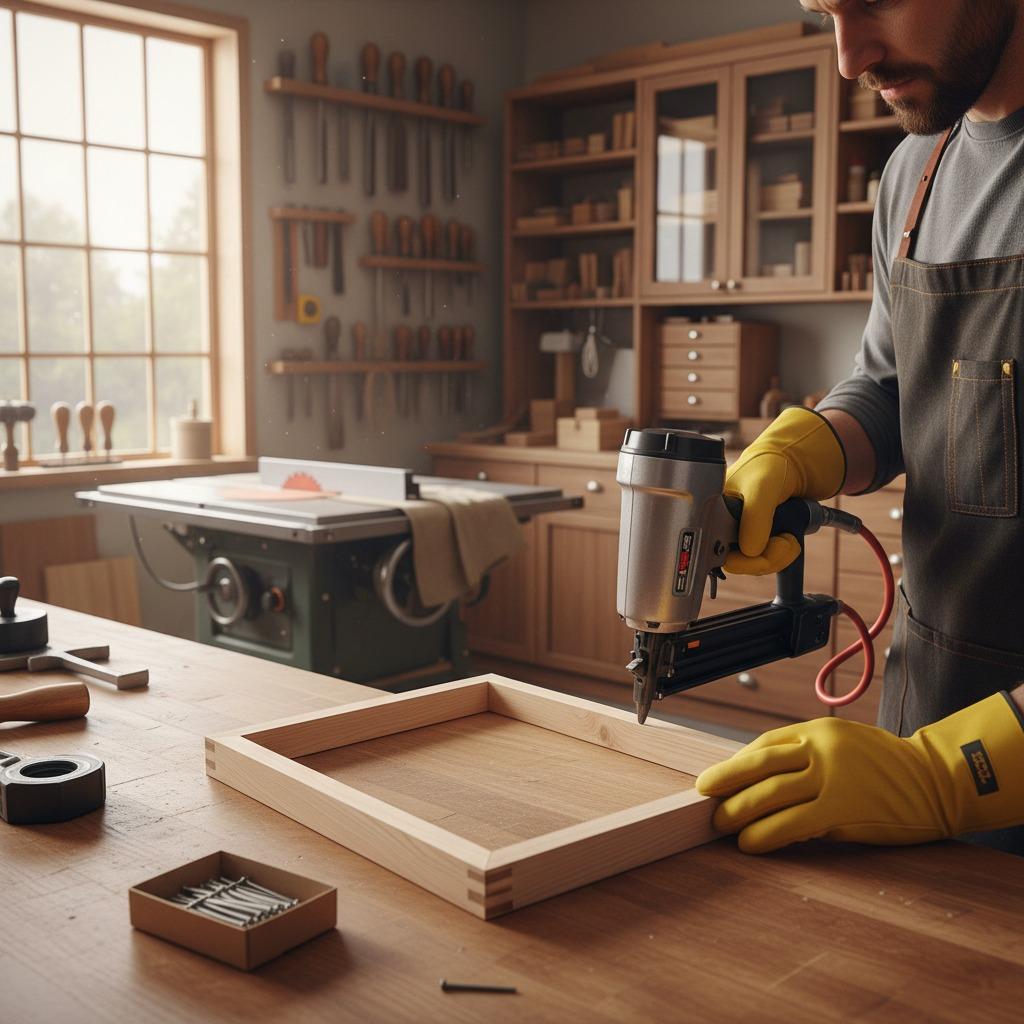
The visible setup is a handheld pneumatic nail gun or brad nailer used on a light-colored wood frame or panel. The black and silver tool body, pistol grip, and red coiled air hose point to a compressed-air fastening system rather than a cordless one. That matters because air-powered fastening usually favors repeatability and shop throughput over complete mobility.
In practice, tools like this are used for narrow wood strips, trim, cabinet parts, frames, jigs, and similar joinery where a small fastener does the job without splitting the material. The work is often done with yellow gloves on a bench, which suggests a controlled assembly environment rather than rough construction. That distinction matters when you are evaluating a pneumatic fasteners manufacturer, because shop-grade fastening and jobsite fastening do not always call for the same product mix.
Quick buyer takeaways
If you are shortlisting suppliers, start with three questions: does the supplier understand the fastening process, can they support the specific fastener format you use, and do they help reduce downtime? Those sound obvious, but many buyers still separate the tool from the consumable and then wonder why performance varies from batch to batch.
One practical caution: a supplier that looks strong on price alone may be weaker on consistency, packaging, or technical support. For pneumatic systems, small variations in fastener dimensions or finish can show up as misfires, poor seating, or visible surface damage. In woodworking, that is more than a nuisance; it can affect rework rates and the final appearance of the product.
Where pneumatic fastening makes the most sense
Cabinet and furniture assembly
Assembly teams use air-powered fasteners because they are quick, compact, and easy to repeat along a joint line. For frames, panels, and narrow strips, the right fastener helps hold parts in position while glue cures or permanent joinery is completed.
Trim and light finish work
Trim installation often demands a fastening method that leaves a small visual footprint. That is why buyers look closely at the tool type, the fastener size, and the way the supplier describes the product family. A broad label is not enough.
Shop fixtures and jigs
For internal shop use, speed and convenience usually matter more than appearance. Still, a poor-fit fastener can waste time and create unreliable jigs, which is the opposite of what the shop needs.
What to compare when evaluating suppliers
A serious pneumatic fasteners supplier should make it easier to answer a few unglamorous but important questions. Are the fasteners compatible with the tools already in use? Is the packaging clear enough for operators on the floor? Can the supplier explain where one fastening family ends and another begins?
For buyers, the safest approach is to compare by application first, not by catalog size. A pneumatic fasteners manufacturer that can speak clearly about woodworking, cabinetry, and light assembly is usually more useful than one that simply lists a large assortment. In this category, breadth matters less than clarity and repeatability.
Common mistakes buyers make
The first mistake is assuming every air powered fastener behaves the same. It does not. Even small differences in length, head style, coating, or collation can change how a tool feeds and how the wood surface looks after firing.
The second mistake is treating the supplier as interchangeable once a nail size is chosen. In real production, that can backfire. If the supplier changes packaging, lot consistency, or technical documentation without warning, the line may absorb the cost before anyone notices.
The third mistake is ignoring the tool-and-hose setup. A coiled air hose, handheld tool, and bench workflow can be highly efficient, but only if the system is matched to the actual task. A compact tool designed for edge fastening is useful; forcing it into the wrong job is not.
Buyer-facing questions worth asking
Ask what wood applications the supplier supports most often. Ask how they distinguish brad-style fastening from other fastener families, if they do. Ask what information is available on compatibility, finish, and handling. And ask how they handle supply continuity when one fastener format becomes hard to source.
It is also worth asking whether the supplier can support prototype runs as well as production volumes. Many teams discover too late that a product that works in the sample room is difficult to source consistently once purchasing takes over.
FAQ
Is a pneumatic system still relevant in a mixed-tool shop?
Yes. In many woodworking and cabinet operations, pneumatic fastening remains attractive because of its speed, light tool feel, and established workflow.
Why not just switch everything to cordless?
Because not every task needs portability. In a fixed assembly area, compressed air can still be a very efficient choice, especially for repetitive fastening.
What should I expect from a supplier relationship?
Clear product definitions, consistent supply, and support that helps operators avoid mismatches. The best suppliers reduce friction instead of adding another layer of guesswork.
Next step for sourcing teams
If you are reviewing a pneumatic fasteners supplier for woodworking or cabinet assembly, start with the actual joint, the actual tool, and the actual fastener family used on the floor. That simple check prevents a lot of expensive confusion later. A good source should help you keep fastening fast, neat, and repeatable without turning procurement into a guessing game.