
Why buyers still ask for a pneumatic fasteners supplier
A lot of sourcing decisions in woodworking and light fabrication still come down to one practical question: who can supply pneumatic fasteners that work reliably in production, not just in a demo? If your shop uses a pneumatic nail gun or brad nailer for frames, cabinet parts, trim, or small panel assemblies, the supplier relationship matters more than most people admit. A missed feed, inconsistent holding power, or poor tool-to-fastener match slows the line and turns a simple fastening step into a quality problem.
That is why the search for a pneumatic fasteners supplier is not just about price. It is about consistency, fit, and whether the fasteners are suited to the tool and the job. In workshops that use air powered fasteners, a small mismatch can show up as jams, surface marks, or weak joints. For anyone buying for production, the decision is less glamorous than machine selection, but often more important day to day.
What the shop-floor setup tells you
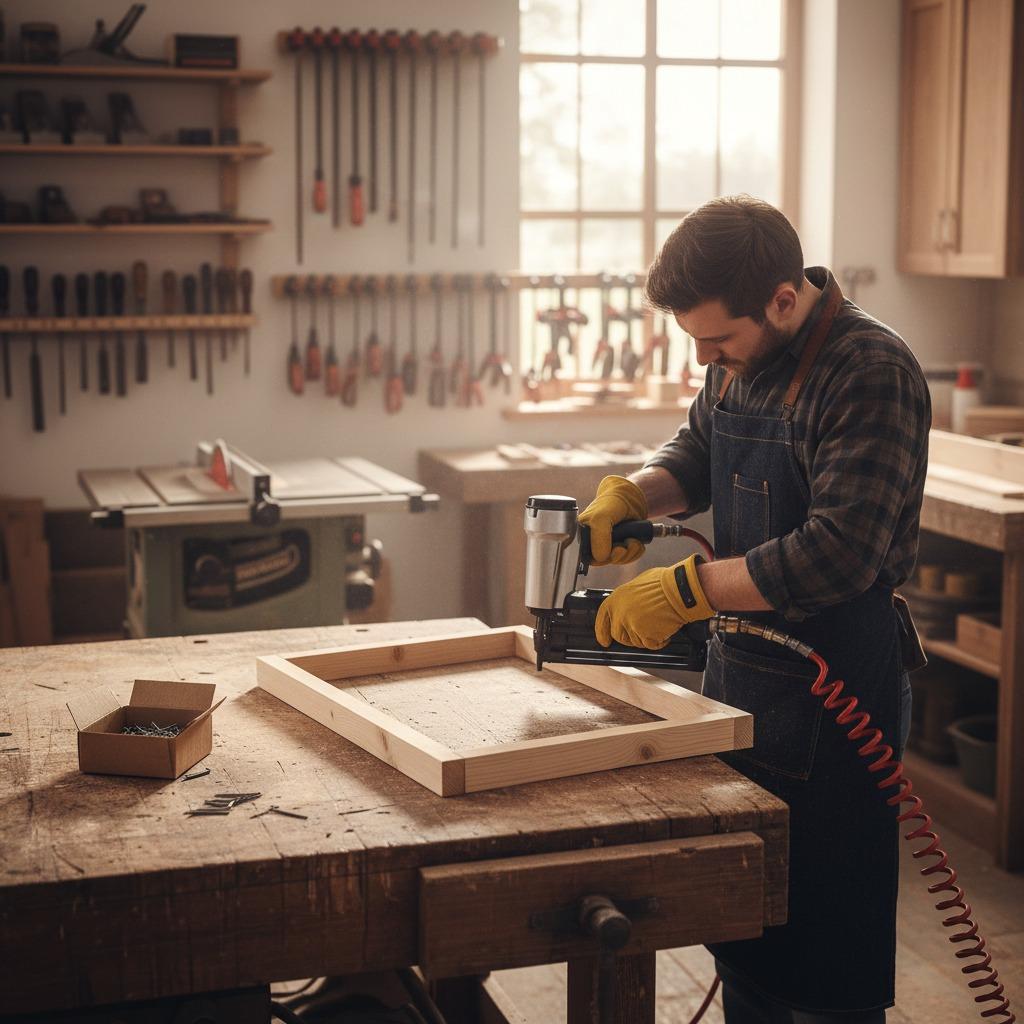
The scene is familiar in many woodworking shops: a handheld nailer, dark metal housing, silver nose assembly, and a red coiled air hose feeding the tool. The operator holds a light-colored wooden frame or panel in place and fastens it one-handed. That simple arrangement says a lot about how these systems are actually used.
They are valued because they speed repetitive assembly while leaving one hand free to control the workpiece. That matters in small-frame construction, cabinet and furniture fabrication, and trim work where alignment is more important than brute fastening force. The fastener itself is usually meant to disappear into the joint or remain unobtrusive. In other words, the tool is doing precision work, not heavy structural anchoring.
What to compare when choosing a supplier
A good supplier should help you match the fastening system to the application, not just ship cartons. Buyers usually want three things: compatibility, repeatability, and practical support.
Compatibility with the tool
Pneumatic fasteners have to suit the nailer or brad nailer you are using. That includes size, profile, and the way the fasteners are collated. If the supply is off even slightly, you may see feeding problems or inconsistent placement. Shops often underestimate how much time is lost to these small annoyances.
Consistency from batch to batch
For production work, consistency matters more than an occasional bargain. If your team relies on repeatable fastening in frame assembly or cabinet parts, variation in finish, shank behavior, or strip quality can affect both throughput and appearance. A supplier should be able to speak plainly about how they manage that consistency, even if they do not dress it up in marketing language.
Use-case fit
Not every fastening task is the same. Picture frames, box construction, trim pieces, and light panel assemblies may all use similar tools, but they do not always want the same fastener style. This is where a pneumatic fasteners manufacturer may be useful if you need more application-specific guidance, while a distributor-focused pneumatic fasteners supplier may be better for recurring procurement and stock continuity.
Where air powered fasteners make sense
Air powered fasteners are still widely used because they balance speed, control, and shop practicality. In light-duty wood joinery, they help reduce clamping time and keep parts aligned while adhesive sets or subsequent assembly steps continue. That is particularly useful in small box construction, decorative frames, and furniture subassemblies.
The caution, of course, is that pneumatic fastening is not a cure-all. If the joint design is poor, a fastener will not save it. Some buyers focus so tightly on tool speed that they forget substrate quality, glue strategy, and part fit. In woodworking, those details still do the real work.
Common buying mistakes
One frequent mistake is treating all fasteners as interchangeable because the tool is “just a nailer.” It is not that simple. Another is buying on short-term availability alone and then discovering the fasteners do not run cleanly in production. Shops also get into trouble when they choose the wrong fastening profile for visible surfaces, especially on light-colored wood where marks show quickly.
It is also worth asking whether the supplier understands your actual use case. A seller who only talks about catalog breadth may not be very helpful when you need a steady supply for woodworking assembly and finish nailing. A better supplier asks about the tool, the material, and the expected joint behavior.
Practical buyer advice
Before placing a recurring order, confirm the tool model family, the fastener format, and the intended workpiece thickness range with your internal team. Keep a sample pack in the shop and have the operators test it on real parts, not scrap that behaves differently. If the fasteners are for visible assemblies, check surface marking under the same lighting your customers will see.
For sourcing managers, the best supplier is usually the one that reduces surprises. That may mean holding stable inventory, providing clear product descriptions, and understanding the difference between rough construction work and cleaner cabinet or furniture fabrication.
FAQ
Is a pneumatic fasteners supplier the same as a tool supplier?
Not necessarily. Some suppliers focus on the fasteners themselves, while others bundle tooling, service, and consumables. For production buyers, that distinction matters.
Are air powered fasteners only for heavy industry?
No. They are common in woodworking, trim assembly, and light manufacturing because they offer controlled, repeatable fastening.
What should I ask before I switch suppliers?
Ask about compatibility, fastener consistency, packaging, and whether the supplier can support your specific application rather than only a general product category.
Next step
If you are reviewing suppliers for a woodworking shop, cabinet line, or small assembly operation, start with the tool you already use and work backward from there. A reliable pneumatic fasteners supplier should make the fastening step quieter from a procurement standpoint, not louder. The right partner is the one that keeps the line moving and the joints looking the way your customers expect.