
A minimum order quantity is a production figure before it is a sales condition, and the wire gauge is the first thing that moves it. Buyers who treat pneumatic nail MOQ by gauge as a number to negotiate usually find the conversation goes in circles, because the number is set by how long the line takes to make the order, not by how much the seller would like to sell.
Understanding where the minimum comes from makes it something a buyer can influence. Change the gauge, the finish or the collation and the minimum moves, because each of those decisions changes what has to be set up, run and packed.
MOQ is a production quantity, not a sales rule
Every order on a collated nail line carries a fixed cost that does not scale with size: setting the dies and the collation head, establishing the drawing or forming setup, verifying the first strips, and packing at a different carton weight. That fixed block is what the minimum has to absorb.
A small order is not refused because it is unprofitable in principle. It is refused because the setup cost per thousand would be so high that the buyer would not accept the price, and both sides know it.
What changes on the line when the gauge changes
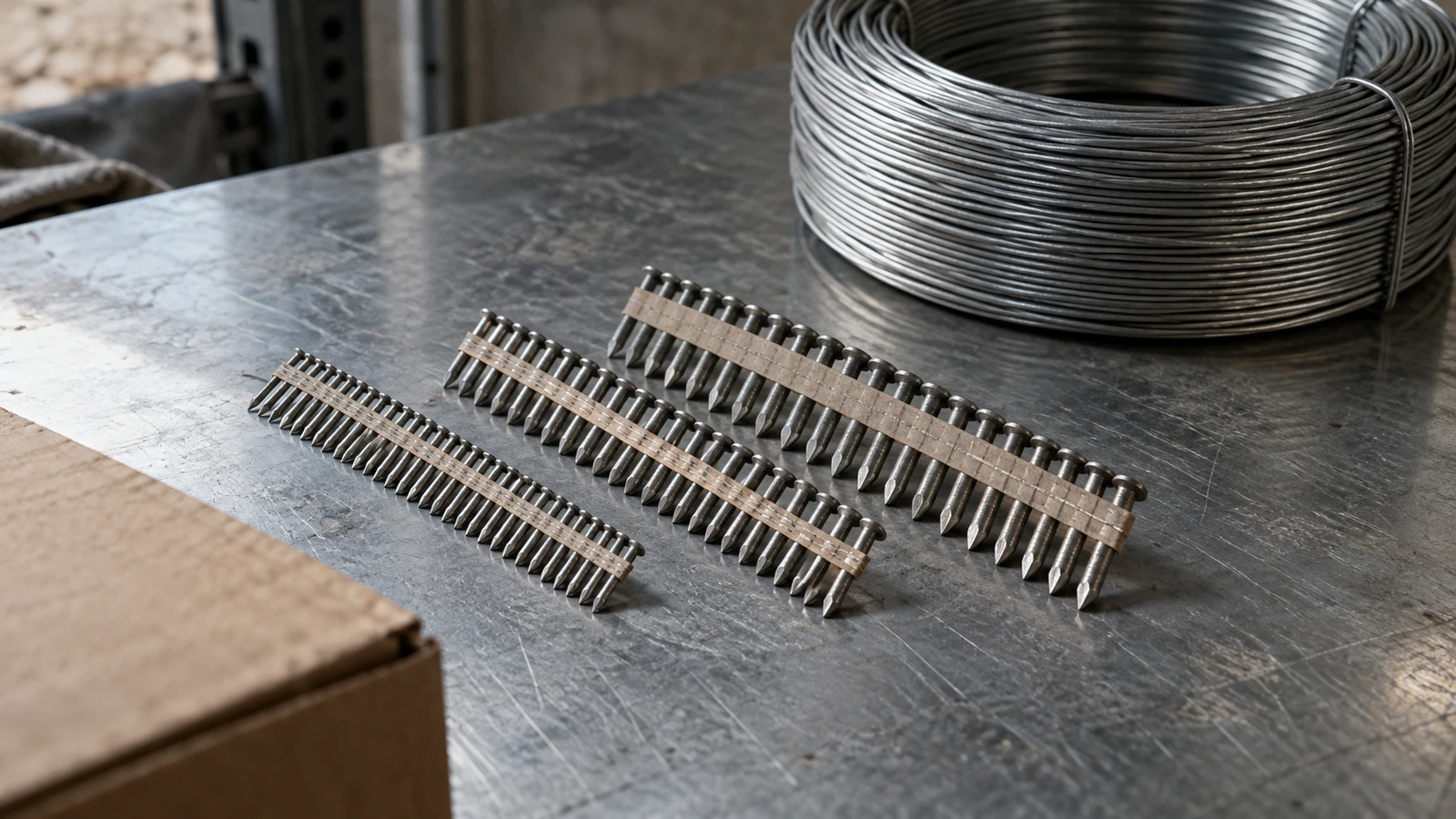
Gauge is not a cosmetic difference. Moving from one wire diameter to another changes the wire the mill has to supply, the drawing or straightening setup, the forming pressure, the collation spacing and often the tooling itself.
That is why a quotation for two similar-looking nails can differ by more than the obvious material cost. The second gauge may require a different die set, a slower line speed, or a wire size that has its own minimum purchase quantity from the wire mill, which then becomes a minimum order quantity for the nails. It is also why pneumatic nail MOQ by gauge varies between suppliers who are running the same product.
Pneumatic nail MOQ by gauge: the four cost blocks
Four blocks make up the figure, and each of them behaves differently as the quantity grows.
| Cost block | What drives it | What a buyer can change |
|---|---|---|
| Setup | Die changes, tooling, first-off approval | Order a gauge the line already runs, or accept the setup in the price |
| Wire | Diameter, finish and the mill's own minimum | Choose a finish and diameter that are already stocked |
| Collation and forming | Strip length, angle, glue or paper | Match a collation pattern the plant already produces |
| Packing and freight | Carton count, weight, pallet build | Adjust carton size to hit a sensible pallet quantity |
Setup, wire and collation: where the minimum comes from
The practical minimum for a given gauge is usually set by whichever of the four blocks is largest, and that is different for each product. A standard gauge in a standard finish may be limited by packing, because the carton and pallet quantity have to make sense.
A non-standard gauge may be limited by the wire mill's own minimum, which can be measured in tonnes rather than in thousands of nails. When a supplier declines a small trial in a new diameter, that is usually the reason, and it is the explanation ProAirNails gives when pneumatic nail MOQ by gauge cannot be reduced on a new specification.
Reading a quotation that quotes three gauges
Comparing gauges is only possible when the quotation says what is included. The comparison below is the one that stops a buyer choosing on price per thousand alone.
| Line in the quotation | What it should state | Why it matters |
|---|---|---|
| Gauge and diameter | The wire diameter, not just the trade name | Two gauges described by name can differ in diameter by region |
| Finish and coating weight | The finish and the coating figure | Coating is a meaningful part of cost and a large part of service life |
| Collation | Angle, strip count and the tool family | Wrong collation costs more than the nail price difference |
| Minimum quantity | The figure, and what sets it | Explains whether the minimum can move at all |
Where gauge is the variable under discussion, the ASTM specification for driven fasteners is a useful common reference for how nails and staples are described, and it gives both sides a vocabulary that does not depend on a regional trade name. For the underlying units and how they are declared, the NIST Office of Weights and Measures reference on units explains the measurement conventions behind the numbers on a label.
Volume, repeats and the honest break point
The useful question is not what the minimum is, but where the price stops improving. That break point is different for every product, and a supplier who cannot describe it is guessing as much as the buyer is.
- Ask for the price at three quantities, not two, so the shape of the curve is visible.
- Ask which cost block disappears as volume rises, and which one never moves.
- Separate the price of a repeat order from the price of a new specification, because they are different products commercially.
- Plan the annual volume rather than the first order, so the gauge you choose is one the line can keep running.
- Record the collation and finish on the approval, so the repeat order is genuinely a repeat.
Sampling before a container
A sample is the cheapest way to check a gauge decision, but it is not free to produce either, which is why sampling tends to have its own small minimum or a charge that is credited against the first order. That arrangement is normal and worth agreeing in advance rather than discovering after the samples arrive, and it is the point at which the discussion about pneumatic nail MOQ by gauge usually becomes concrete.
What an MOQ does not tell you
A minimum order quantity says nothing about holding performance, coating life or how the nail behaves in a particular tool. Those are properties of the product and the joint, and they are settled by a trial rather than by an order size. ProAirNails quotes a gauge against a described joint for that reason.
It is also not a measure of a supplier's quality. A low minimum can be the sign of a flexible plant running stock gauges, and it can equally be the sign of a trader with no line at all. The useful part of the number is what it tells you about setup, not what it suggests about capability.
FAQ
Why does pneumatic nail MOQ by gauge change so much?
Because the gauge decides the wire, the dies, the forming pressure and often the collation setup, so each change carries its own fixed cost.
Is a longer nail always a higher minimum?
Not necessarily. Length affects collation and packing, while diameter is more likely to force a tooling change.
Can a trial order be smaller than the stated minimum?
Often, as a paid sample or a setup-charged run, with the charge credited against the first production order.
Why is a stainless nail minimum so much higher?
The wire is more expensive, less commonly stocked and slower to form, so every cost block is larger.
Does the finish affect the minimum?
It can. A coating that has to be run specially adds setup and may add its own wire minimum.
How do I compare two suppliers fairly?
Compare the same gauge, finish, collation and packing, and ask what sets each minimum rather than only what the figure is.
What if my annual volume is far below the minimum?
Choose a gauge and finish the plant already runs, or accept a higher price for a non-standard run.
Does collation affect price?
Yes. Strip count, angle and the glue or paper system all change the forming and packing stages.
Is MOQ negotiable?
Sometimes, but the more useful negotiation is over which gauge, finish and collation you order.
What should an enquiry include?
The gauge, finish, collation, tool, annual quantity and the carton format you need.
What to send for a gauge comparison
Send the joint and the annual volume rather than a single part number, and ask for the price at three quantities in each gauge. ProAirNails quotes pneumatic nails, coil nails and brad nails against a described application and can explain which block is setting the minimum on each line. Start at Contact Us.