
Why buyers care about pneumatic staple pins in wood assembly
If you are sourcing for cabinetry, furniture, or millwork, choosing a pneumatic staple pins manufacturer is rarely about the fastener alone. It is about how reliably that fastener supports speed, fit, and finish on the shop floor. In a frame-and-trim assembly, especially one built from wood stock with a decorative edge or molded profile, the staple has a quiet but important job: hold parts in place without slowing the workflow or creating avoidable surface damage.
That matters because workshop assembly is often a balance between strength and appearance. A staple that drives cleanly can help secure trim, back panels, light structural members, or temporary positioning during adhesive curing. A poor staple choice can bend, split material, jam the tool, or leave marks that turn into rework. For engineers and sourcing teams, the decision is not just “what fits the gun,” but “what fits the product, the material, and the production pace.”
What the workshop image suggests about real-world use
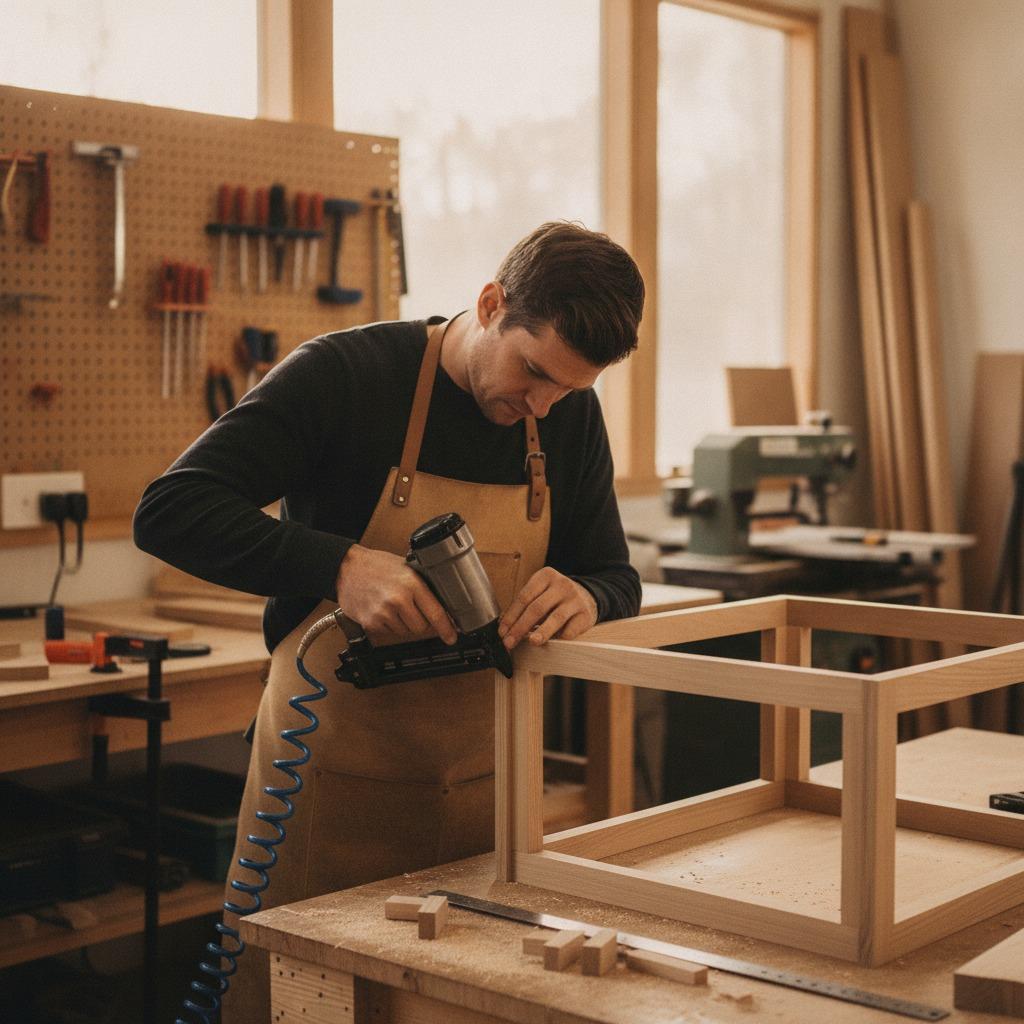
The assembly pictured appears to be a wood-framed cabinet or furniture panel with a white decorative trim piece attached to a vertical member. The frame looks like light-colored wood stock, while the added profile may be painted wood, MDF, or another coated material. The blue coiled hose and handheld pneumatic tool point to air-powered fastening, which is common in cabinet shops and small-batch woodworking lines.
That kind of application usually rewards fasteners that behave consistently in softer woods and mixed-material builds. A trim piece with a stepped or grooved cross-section can look simple from the outside, but it often needs careful handling during fastening. If the staple is too aggressive, it can crush the profile. If it is too light, the piece may lift before adhesive sets.
Quick buyer takeaways before you place an order
Match the staple to the substrate
Wood species, MDF, coated trim, and composite parts do not react the same way. Buyers should ask whether the staple is intended for dense hardwood, softwood, engineered board, or trim work where surface appearance matters more than deep structural holding power. This is where the difference between general fasteners and purpose-made air driven staple pins becomes clear.
Check feeding consistency, not just size
In production, a fastener that looks correct on paper can still perform badly if it feeds inconsistently. Jams and partial drives waste time fast. For a pneumatic staple pins manufacturer, dimensional consistency and strip quality matter as much as metallurgy in day-to-day use.
Think about the finish line
If the staple will be hidden under molding, that gives more room. If it sits near exposed trim, the surface finish becomes more sensitive. In those cases, shops often prefer fastening that minimizes breakout and leaves a smaller visual footprint. That is one reason many buyers compare air staple pins manufacturer options with an eye toward both performance and appearance.
Where pneumatic staple pins fit in manufacturing
In cabinet and furniture production, pneumatic staple pins are commonly used for panel assembly, trim installation, temporary holding during glue-up, and light-duty joining where speed is valued. They are especially useful in workshop fabrication, custom joinery, and small-batch production where operators may switch between tasks quickly.
They are not a universal answer. For load-bearing joints or assemblies expected to take heavy service, buyers should treat staples as part of a fastening system rather than the only structural element. Adhesive, joinery, and clamping all still matter. Staples support the process; they do not magically replace it.
Common sourcing mistakes
One common mistake is assuming all staples behave the same once they fit the tool. Another is buying for the lowest unit cost and discovering the real cost in jams, misfires, or rejected parts. A third is overlooking the geometry of the workpiece itself. A rectangular frame with mitered or butt-jointed corners places different stress on the fastening line than a flat trim strip on a large panel.
Buyers should also avoid vague specifications. Ask for the staple series, crown width, leg length, wire gauge, and recommended materials. If the supplier cannot clearly explain the intended use, that is a warning sign. It may be fine for general shop supply, but less reassuring for repeat production.
Practical questions to ask a supplier
When speaking with a pneumatic staple pins manufacturer, ask how the fasteners are designed to perform in air tools, what materials they are suited for, and whether they are intended for trim, casework, panel assembly, or other woodworking tasks. If your shop uses air driven staple pins across different stations, ask about compatibility across tool models and feeding styles. Those details save more time than a glossy brochure ever will.
It also helps to request sample quantities before committing to a production run. Not because every project needs a lab-style trial, but because actual wood, actual trim, and actual operators often expose problems that paperwork misses.
FAQ
Are staple pins mainly for holding trim in place?
Often, yes. In woodworking and furniture assembly, they are commonly used for trim, light framing support, and temporary or semi-permanent fastening while glue cures. The exact role depends on the product design.
Can I use the same fastener for cabinet frames and decorative molding?
Not always. Cabinet frames and molded trim can respond very differently to driving force and leg length. The safer approach is to match the fastener to the densest or most delicate part of the assembly.
What should a buyer prioritize first?
Start with fit to the tool, then material compatibility, then feed reliability. After that, look at surface impact and overall shop efficiency. Price matters, but in production it usually matters after uptime.
Next step for sourcing teams
If you are comparing suppliers, ask for technical details tied to your actual application, not just general fastener claims. A good pneumatic staple pins manufacturer should be able to speak clearly about woodworking use, pneumatic feeding, and the kinds of assemblies where the fasteners are best suited. For cabinet, furniture, and millwork teams, that is the difference between a part that simply fits and a part that keeps the line moving.