
A brad nails manufacturer for furniture buyers must support clean finishing and steady bulk delivery at the same time. Gauge, length, surface finish, carton packing, and tool fit all affect how smoothly the nails perform in daily production.
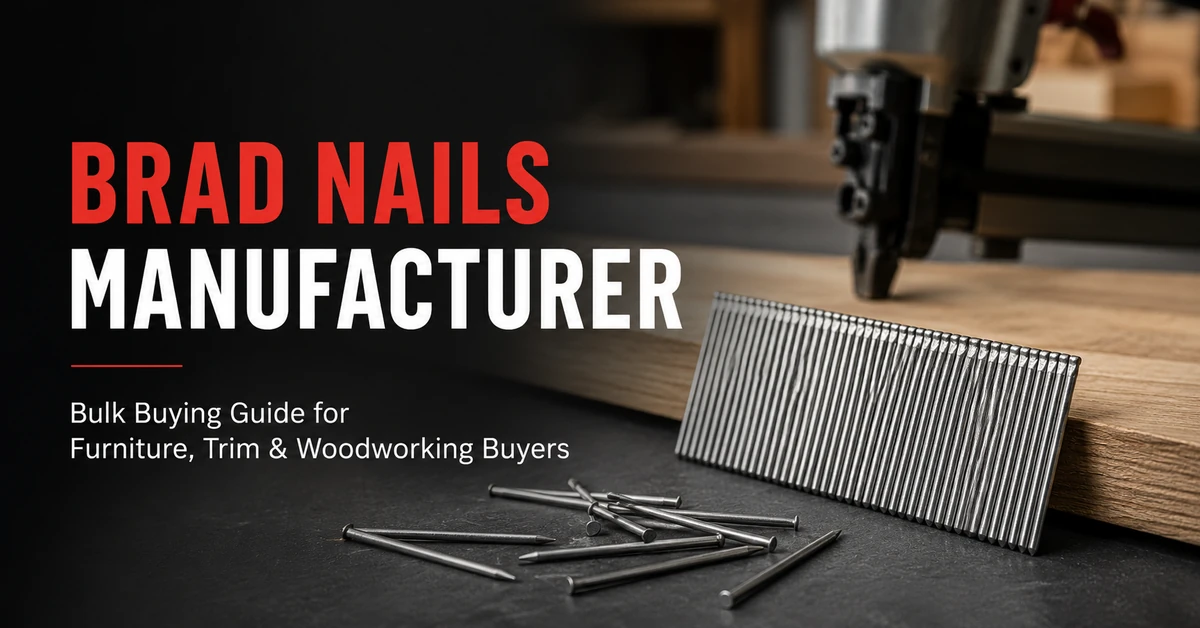
Brad nails for furniture need to do two things at the same time: hold parts securely and leave a clean finish. That balance is why furniture factories, cabinet makers, trim producers, and woodworking buyers pay close attention to gauge, length, surface finish, and nail gun compatibility.
For bulk buyers, the best brad nail is not simply the cheapest one in the quotation sheet. If the nail bends, jams, leaves a larger mark than expected, or arrives in weak cartons, the real cost shows up on the production line.
Where Brad Nails Are Usually Used
Brad nails are widely used in decorative trim, cabinet backs, light frames, moldings, picture frames, panel work, and furniture components where a smaller head is preferred. They are often paired with pneumatic brad nailers, which means consistency is essential.
16 Gauge vs 18 Gauge Brad Nails
| Option | Typical Use | Buyer Note |
|---|---|---|
| 16 gauge brad nails | Thicker trim, stronger frames, heavier wood parts | More holding power, but a more visible mark. |
| 18 gauge brad nails | Fine trim, cabinet work, light furniture parts | Cleaner finish and lower splitting risk in many applications. |
Many furniture factories keep both sizes available. The final decision depends on wood density, part thickness, finish requirement, and the nailer used in production.
Finish and Material Choices
Galvanized brad nails are common because they offer a practical balance of cost and corrosion resistance. Stainless steel brad nails may be chosen for more demanding environments, but buyers should confirm whether the added cost is necessary for the final application.
What a Brad Nails Manufacturer Should Provide
- Stable gauge and length tolerance across repeat orders.
- Clean collation that feeds smoothly in compatible tools.
- Surface finish options for different storage and use conditions.
- Export cartons strong enough for warehouse handling and container shipping.
- OEM label and packing support for distributors.
Common Purchasing Mistakes
One common mistake is approving a sample without testing it in the buyer's actual nail gun. Another is ignoring carton quality. A product may look good in a sample box but still create complaints if bulk cartons deform during transport. A third mistake is using one nail length across too many furniture parts instead of matching penetration depth to the assembly.
Supplier Selection Checklist
| Checkpoint | What to Ask |
|---|---|
| Tool fit | Which nailer models or specifications are compatible? |
| Product range | Are 16 gauge, 18 gauge, galvanized, and other options available? |
| Quality control | How are wire diameter, length, head, and collation inspected? |
| Bulk packing | Can cartons, labels, and pallets match importer requirements? |
| Repeat orders | Can the factory keep the same specification and packaging over time? |
FAQ
Are 18 gauge brad nails good for furniture?
Yes. They are commonly used for fine trim, cabinet parts, and light woodworking where a smaller visible mark is preferred.
When are 16 gauge brad nails better?
They are useful when the part needs stronger holding power or the wood section is thicker.
Can ProAirNails supply brad nails for bulk orders?
ProAirNails supplies brad nails and related pneumatic fasteners for overseas B2B buyers, including furniture and woodworking applications.
For sourcing support, visit ProAirNails.
A practical brad nails manufacturer should help buyers confirm the right nail length, finish, and private-label packing before furniture production begins.
When comparing a brad nails manufacturer, buyers should review sample performance, carton strength, and repeat-order consistency instead of looking only at the first price.