
Choosing a Sofa Staples Manufacturer: what buyers actually need to check
If you are sourcing fastening consumables for furniture production or repair, choosing a sofa staples manufacturer is not just a price exercise. The right staple affects how cleanly upholstery goes down, how well materials hold over time, and whether a production line keeps moving without jams or inconsistent fastening. In sofa work, a staple is a small part with an outsized effect.
Buyers often start by looking for a sofa staples supplier that can ship quickly and quote competitively. That matters, but it is only part of the picture. You also need staples that feed reliably in pneumatic tools, suit the thickness of the material stack, and arrive in packaging that protects the strips from bending or corrosion. Miss one of those points and the cheap purchase becomes an operational nuisance.
What the product actually is
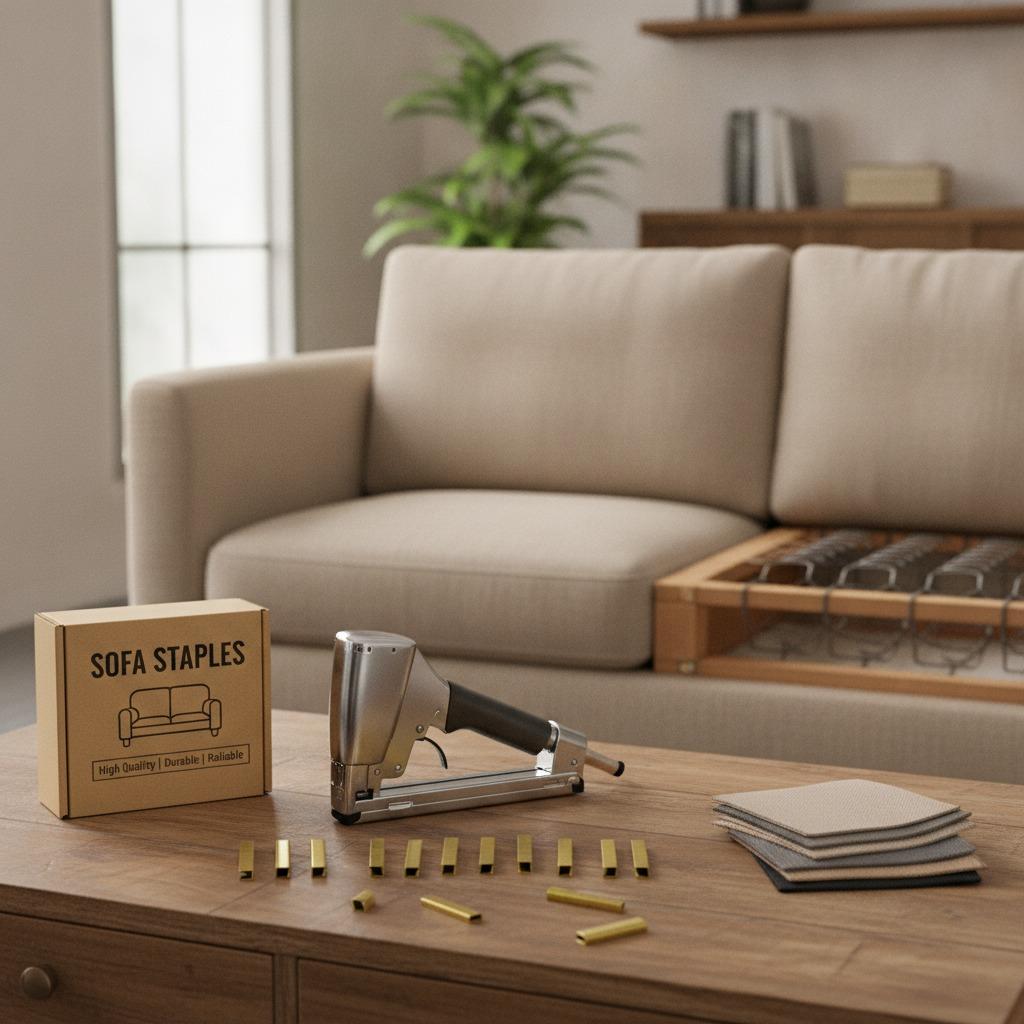
The product category here is straightforward: sofa staples, also used broadly as upholstery staples. The visible setup shows a pneumatic staple gun, a box labeled “SOFA STAPLES,” and long connected strips of golden or brass-toned staples. That format is typical for magazine-fed stapling tools used in upholstery shops and furniture plants.
The staples appear to be narrow-crown fasteners supplied in strips, which is the practical form for high-volume work. They are likely intended for fastening fabric, webbing, padding, and backing materials on sofas and similar upholstered items. The exact steel grade, coating, and dimensions are not visible, so those should be confirmed directly with the supplier before ordering at scale.
Why staple quality matters in furniture production
Upholstery fastening looks simple from the outside, but the demands are less forgiving than many people expect. A staple that bends too easily may not penetrate dense substrate cleanly. A strip with poor forming consistency may feed badly through the gun. Too much variation in leg length, crown width, or finish can create uneven holding power or cosmetic problems, especially on visible or load-bearing areas.
In furniture repair, the issue is a little different. Technicians need a staple that behaves predictably across mixed materials—older frame wood, foam, fabric, or backing layers. In production, the concern is repeatability. A plant wants the same fastening behavior from box to box, shift to shift. That is where a reliable upholstery staples manufacturer earns its place.
Key details to verify before you buy
Staple geometry
Start with the basics: crown width, leg length, and strip compatibility. The image suggests a narrow-crown format, but exact measurements are not readable. Those dimensions need to match the stapler magazine and the material stack you are fastening.
Material and finish
The visible staples have a gold or brass-like appearance. That may indicate a plated or coated finish, but the image alone does not confirm the metal type or corrosion resistance. If the staples will be used in environments with storage humidity or long service life expectations, ask for the coating specification rather than assuming the finish is decorative.
Packaging and feed consistency
Long connected strips are standard, but the strip quality matters. Poorly aligned staples can cause misfeeds, especially in pneumatic guns. Packaging should keep the strips straight and protected during shipping. A cardboard box is common, yet the real question is whether it arrives with minimal deformation.
How manufacturers and buyers usually compare options
When comparing suppliers, it helps to think in terms of use case, not just catalog language. A sofa staples supplier for repair shops may prioritize smaller order flexibility and mixed SKUs. A factory buyer may care more about stable specification control, bulk packaging, and consistent supply over time. Both care about fast delivery, but the decision criteria are not identical.
Marketing phrases like “high quality,” “durable,” and “reliable” are common on packaging, including the box shown here. Treat those as starting claims, not proof. Ask for the actual technical sheet, sample strips, and the compatibility guidance for the tools you use.
Common mistakes buyers make
The first mistake is assuming all upholstery staples are interchangeable. They are not. Even small differences in crown width or leg length can create feed issues or weak fastening. The second mistake is ordering by appearance alone. A brass-toned finish can look premium, but what matters is the material performance behind it. The third mistake is ignoring tool compatibility until after the first pallet arrives. By then, you are already dealing with downtime.
Another practical caution: if you work across multiple sofa styles, do not overcommit to one staple size without testing it on the actual build-up. Webbing, foam, cloth, and wood stack differently from one model to the next.
Practical buyer questions to ask a supplier
Before placing a purchase order, ask for the staple dimensions, the base metal and coating, the quantity per box, and confirmation of stapler compatibility. If the supplier offers several sizes, request sample strips of each one. A short bench test often reveals more than a product page ever will.
You should also ask how the product is packed for transit and whether the supplier can support repeat orders with the same specification. For manufacturers, that continuity matters as much as the first shipment.
FAQ
Are sofa staples only for sofas?
No. They are typically used in broader upholstery work, including chairs, benches, and repair jobs, depending on size and tool fit.
Do brass-colored staples mean brass material?
Not necessarily. The visible color may come from a finish or coating, so confirm the actual material specification.
What should I test first?
Test feed reliability, penetration, and hold strength on the exact materials you plan to fasten.
Next step for sourcing teams
If you are shortlisting a sofa staples manufacturer, start with a sample request and a specification check rather than a bulk commitment. For furniture plants, upholstery shops, and repair operations, that small step usually saves more time than it costs. If you need a supplier comparison sheet, build one around size, finish, strip consistency, packaging, and tool compatibility. That gives you a usable basis for selection instead of a pile of similar-looking boxes.