
Why an Exhibition still matters when you’re sourcing pneumatic fasteners
An Exhibition can look like a simple row of booths, but for buyers of collated nails and staples it is often the fastest way to separate a real manufacturing partner from a polished brochure. That matters because pneumatic fasteners are not a one-spec-fits-all purchase. A coil nail roll, a straight collated strip, and a staple strip may all look straightforward on a poster, yet the way they feed, finish, and perform in production can change the whole buying decision.
For engineers, sourcing managers, and product teams, the real value of an International Exhibition is comparison. You can stand in front of multiple suppliers, handle samples, ask about collating method, and check whether a fastener line is aimed at furniture assembly, upholstery, cabinet production, packaging, or general workshop use. That kind of direct inspection is difficult to replace with emails and PDFs, especially when the question is not just “Can you make it?” but “Can you make it consistently?”
What the HUAJIAN display suggests about the market
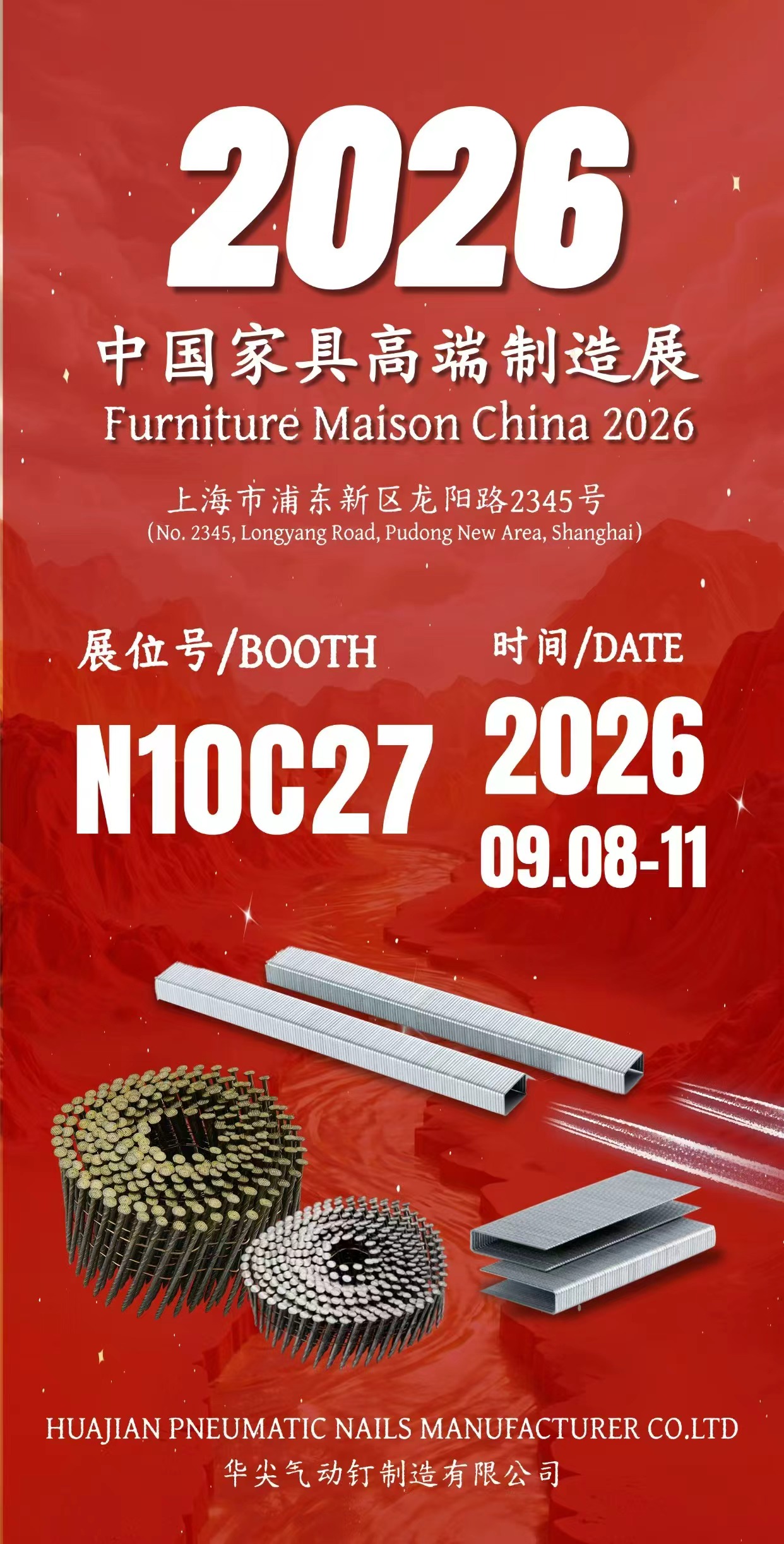
The poster for HUAJIAN PNEUMATIC NAILS MANUFACTURER CO., LTD. shows three familiar categories: coil nail rolls, strip or straight collated nails, and staple strips. That mix is practical, not decorative. It points to a supplier focused on pneumatic feeding formats rather than loose fasteners alone. In manufacturing terms, that usually means wire nail and staple forming, followed by collating or strip-and-coil forming so the product can run through nail guns smoothly.
The visual differences on the display are worth noticing. Some fasteners appear bright or silver-toned, while the coil nails have a more gold or brass-like appearance. That usually signals different finishes or coatings, although the exact treatment is not shown. A buyer should treat those appearances as a prompt for questions, not proof. Ask what coating is used, whether it is intended for general indoor work or better corrosion resistance, and whether the finish affects gun feeding or holding power. It is a small point until a production line starts jamming.
Quick comparison: coil nails, strip nails, and staples
Coil nail rolls
Coil nails are commonly selected when production speed matters. The ring form carries a high number of fasteners in a compact footprint, which is useful in packaging, crating, and some furniture operations. They are efficient, but the buyer still needs to confirm compatibility with the intended nail gun and the required feed angle.
Strip or straight collated nails
Strip nails are familiar in woodworking shops and cabinet lines because they are easy to handle and store. Their rectangular bundle format makes visual inspection simple. They are often preferred where clean feeding and straightforward replenishment are valued more than maximum count per roll.
Staple strips
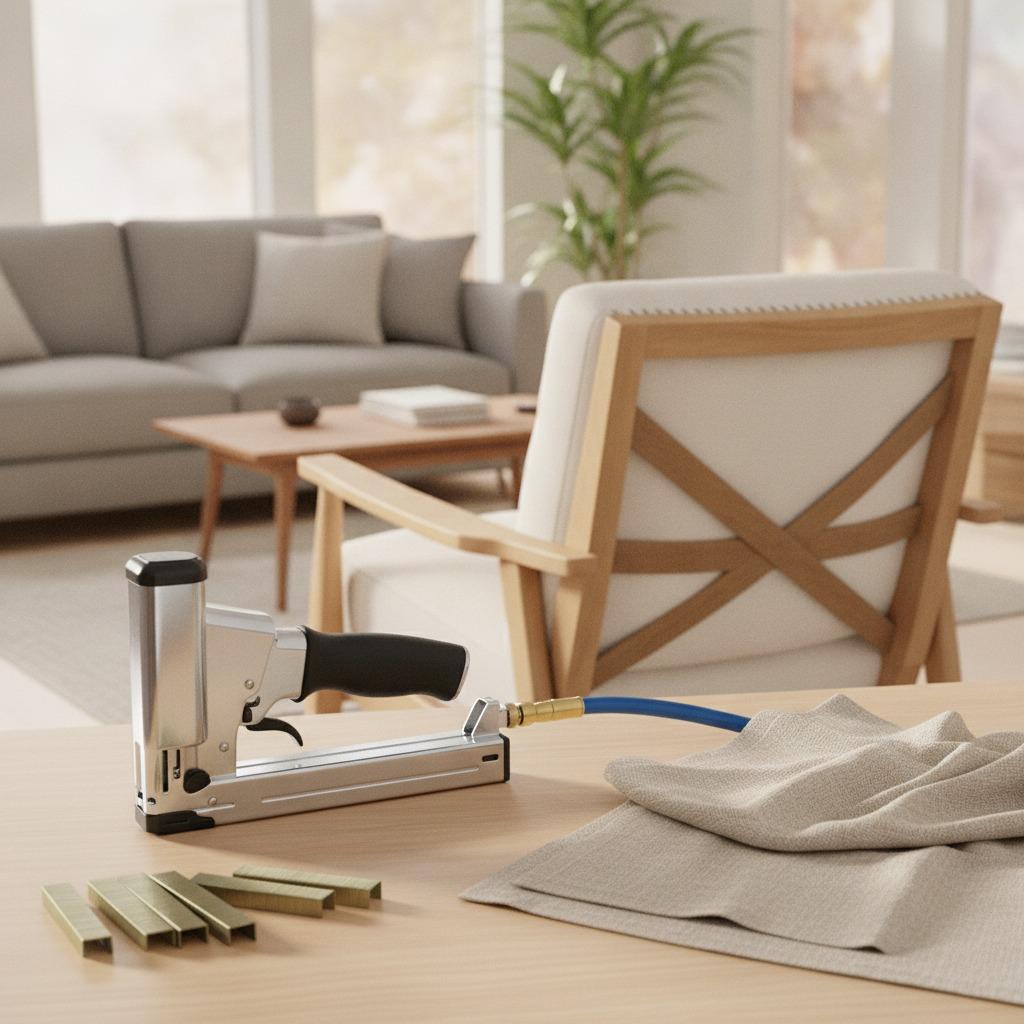
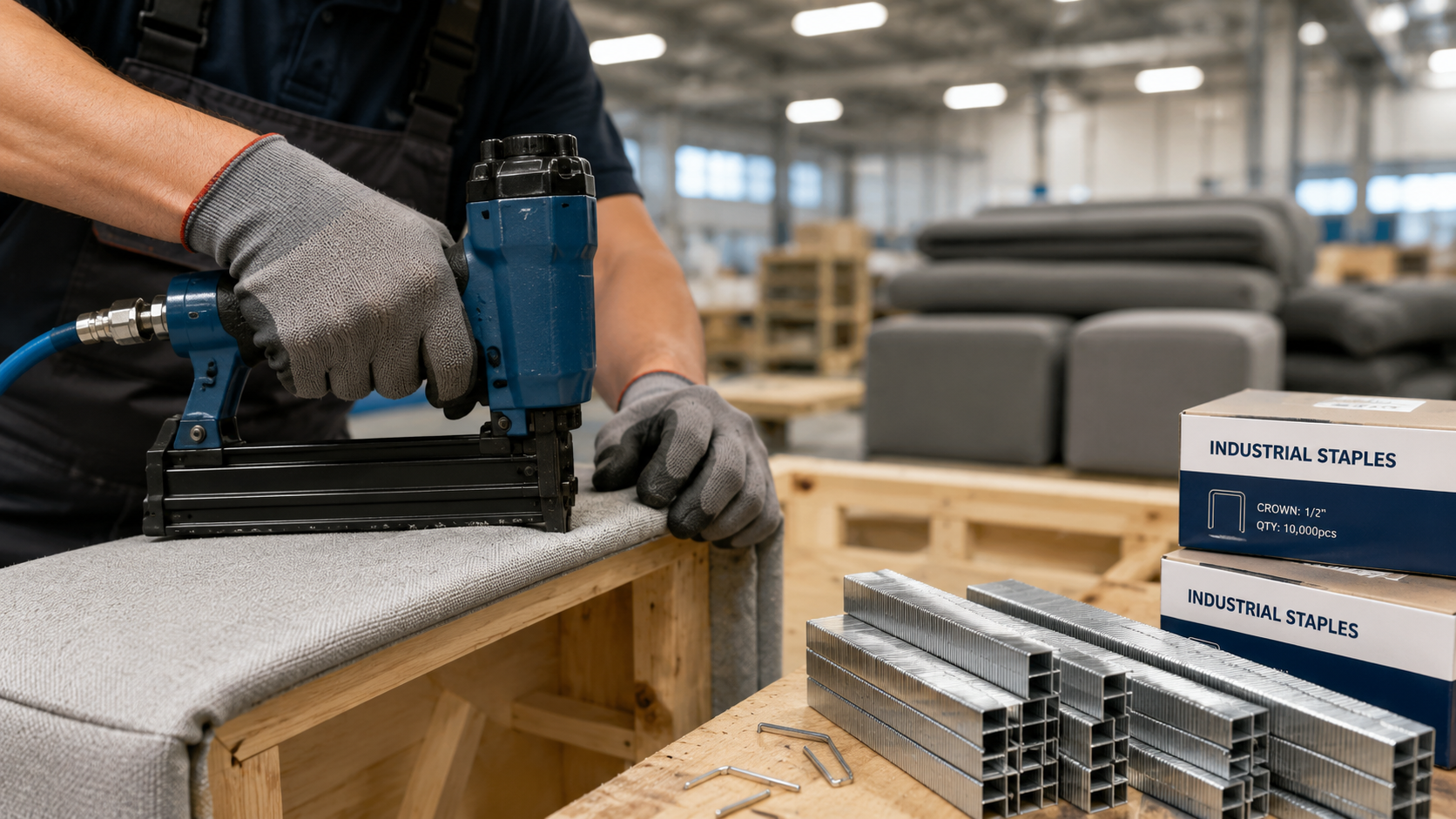
Staples are a different conversation. Upholstery, light assembly, and certain packaging tasks depend on the staple profile, crown width, and feed reliability. The poster does not show dimensions, so no one should assume universal compatibility. Buyers should bring their own tool requirements to the discussion, not the other way around.
What to check before you leave the booth
A good Exhibition visit should leave you with more than a stack of business cards. For pneumatic fasteners, the useful questions are usually concrete and a little unglamorous:
Does the supplier produce the wire nail or staple body in-house, or are they mainly a collating house? What coating options are available, and what is the purpose of each one? Can they support the specific feed format your nail gun requires? Are the collated bundles stable in transit, or do they deform under handling and temperature swings? Those details matter because a fastener that looks fine in a display tray can still cause trouble in bulk shipping or on a fast-moving line.
It is also worth asking how the supplier controls consistency from batch to batch. Not every buyer needs the same depth of documentation, but anyone sourcing for repeated production runs should know whether samples and production lots are truly comparable. If the answer is vague, take that seriously.
Buyer mistakes that show up later, not on the show floor
The most common mistake at an International Exhibition is to focus on appearance and overlook fit. Bright finish can look impressive, but finish alone does not tell you if the fastener is right for the material, the tool, or the work environment. Another mistake is assuming all collated nails in a given shape behave the same way. Collation angle, strip length, coil density, and backing method all affect feeding.
Buyers also sometimes under-specify the application. “Furniture use” is too broad. A fastening pattern for upholstered chairs is not the same as a cabinet frame or a crating operation. If the supplier understands the end use, the conversation gets much better very quickly. If not, you may still get a quote, but it may not be the right one.
Why this matters for sourcing teams
Fasteners are low-profile until they stop a line. That is why the best sourcing teams use an Exhibition visit to narrow the field before price negotiations begin. A supplier like HUAJIAN, shown at Furniture Maison China 2026, offers the kind of product range that can support several woodworking and packaging applications, but the real value is in verifying whether the offered nail and staple formats fit your equipment and production conditions.
For buyers planning to visit Shanghai Pudong New Area, Longyang Road 2345, during Furniture Maison China 2026, the dates matter as much as the booth number: 2026-09-08 to 2026-09-11, Booth N10C27. That kind of detail helps you plan face time, sample review, and the awkward but necessary follow-up questions that rarely happen over email.
Practical next step
If you are preparing for an Exhibition visit, bring the tool model, the current fastener spec sheet, and a short list of end-use requirements. Ask for samples of the exact collated format you need, not just a general product brochure. If the supplier can talk clearly about coil nails, strip nails, staple strips, and finishing options without drifting into vague claims, you are probably in the right booth.
In fastener sourcing, that is usually the first useful filter. The rest comes later, after the samples reach your line and the real test begins.