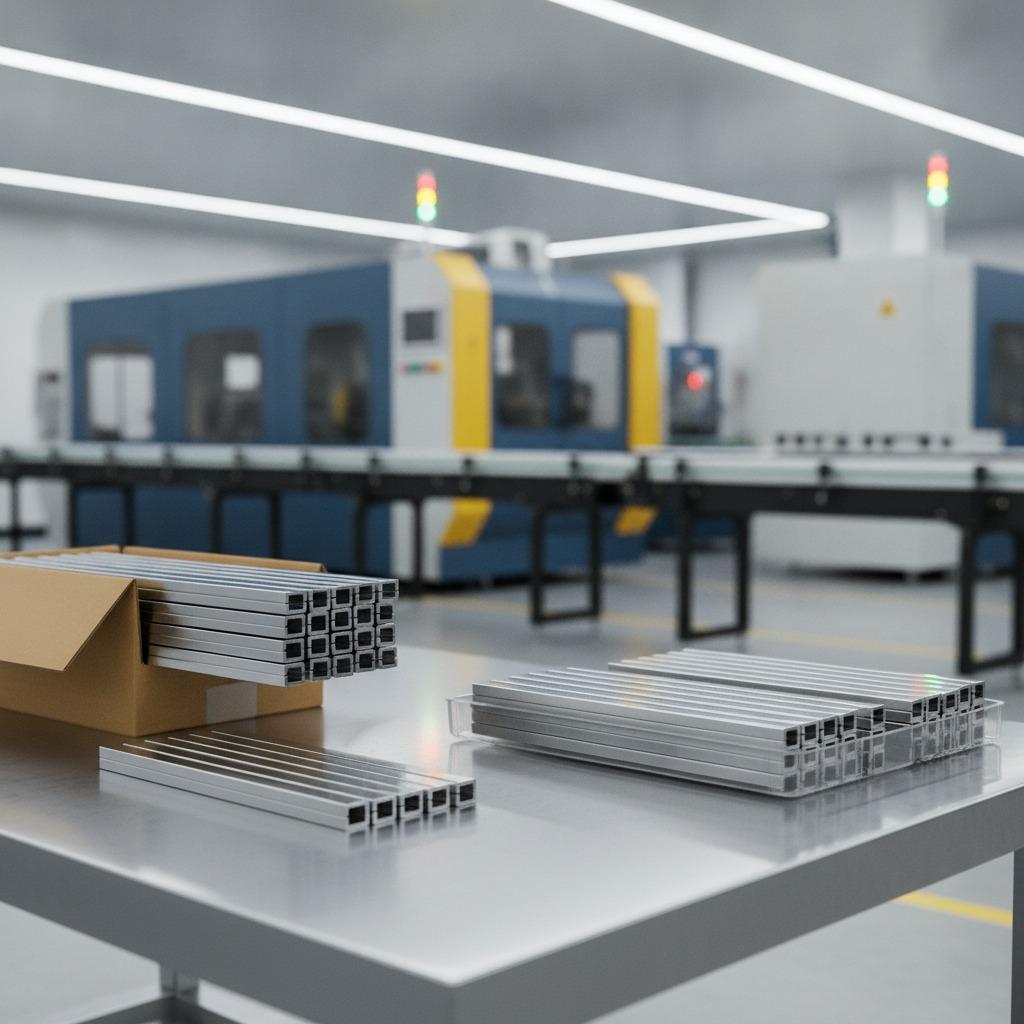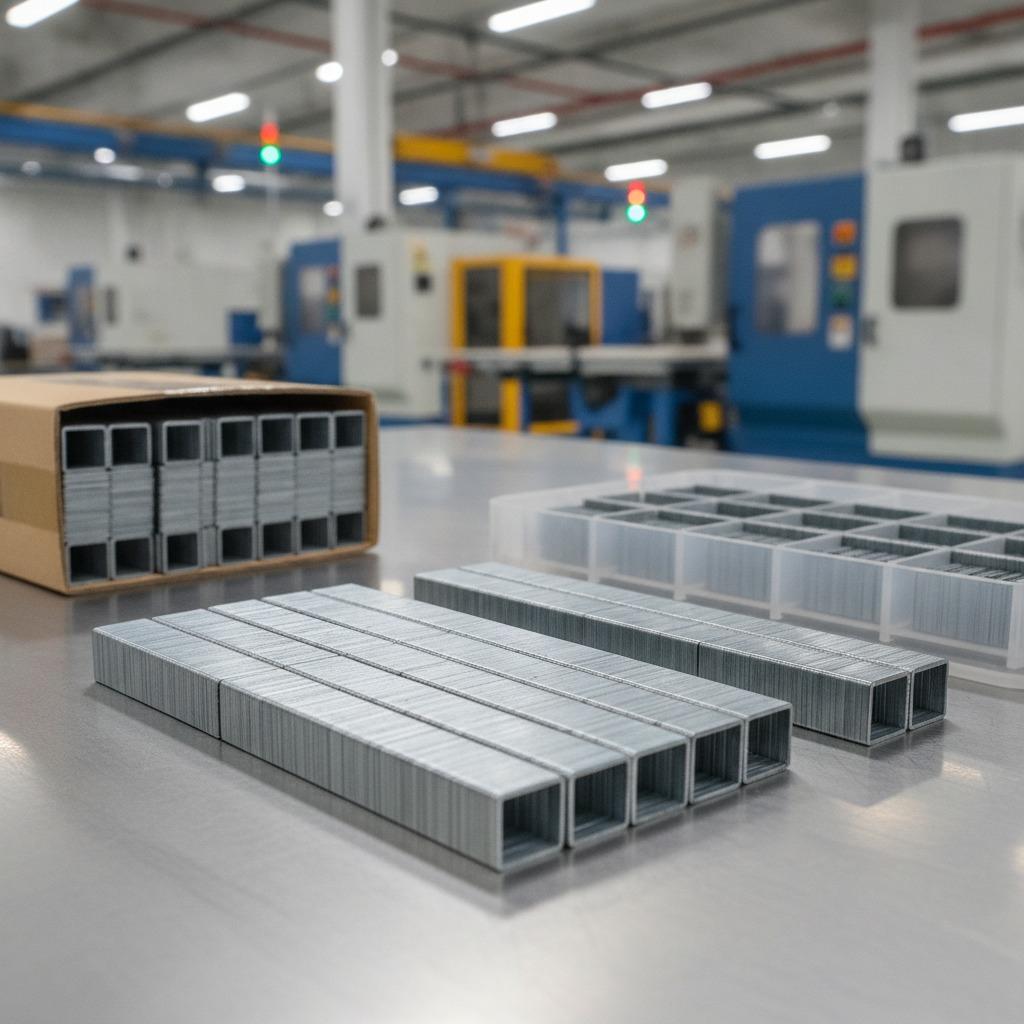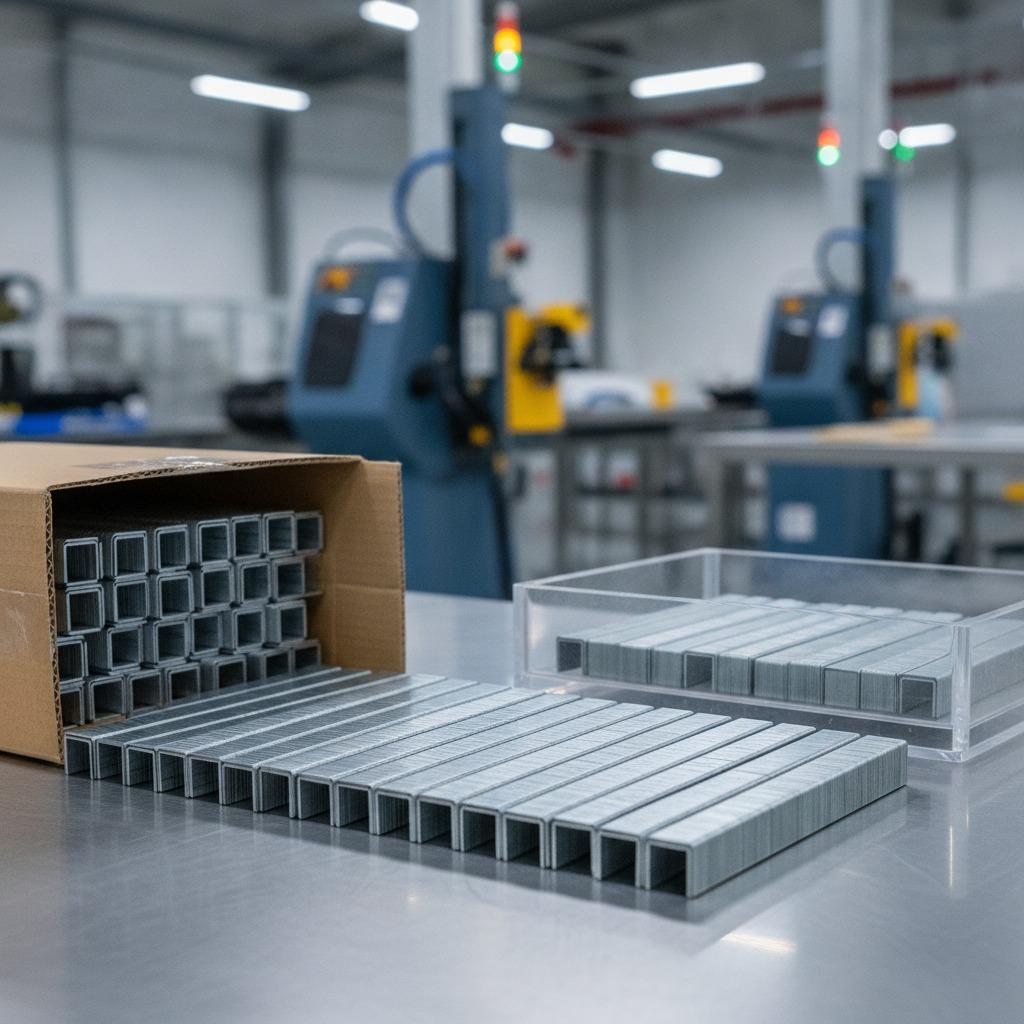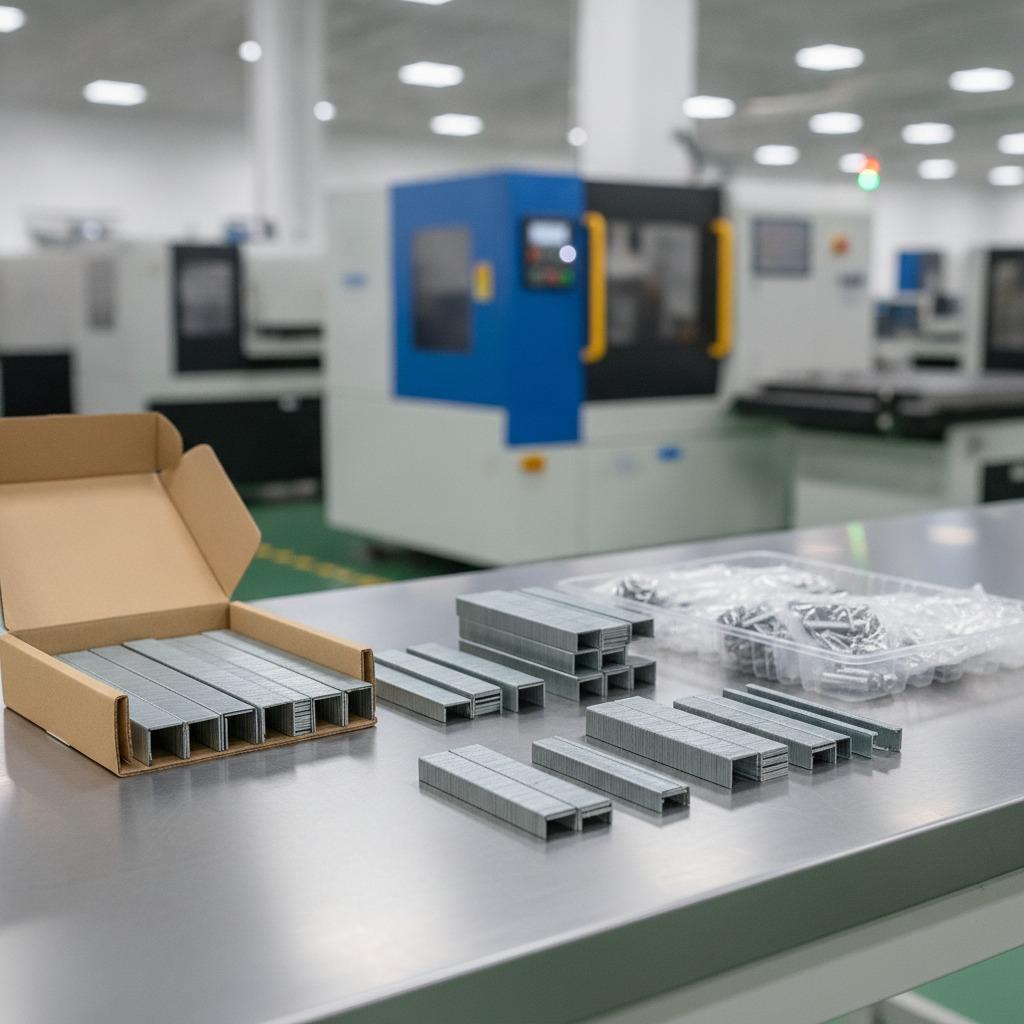

How to Choose a Coil Nails Manufacturer for Pneumatic Fastening
Choosing a coil nails manufacturer is not simply a matter of comparing carton prices. The fastener must match the nailer, substrate, application, and production pace. A mismatch can cause feeding problems, bent nails, damaged workpieces, or unnecessary downtime. This guide explains what sourcing managers and production engineers should verify before approving a supplier, particularly when buying bulk collated nails for pneumatic fastening equipment.
Start with the fastening system, not the nail carton
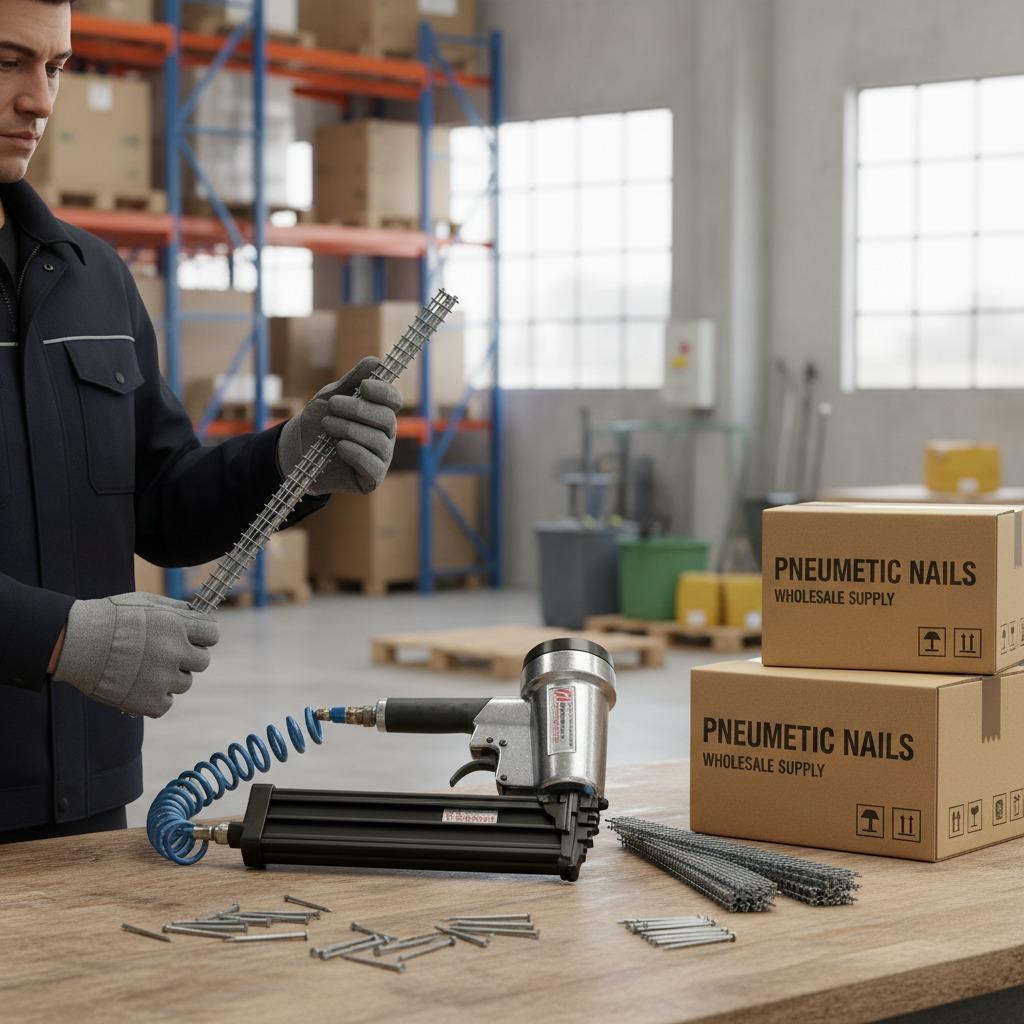
Collated fasteners are part of a working system. The nail, collation method, magazine, nose assembly, air supply, and substrate all affect the result. The product information available for the equipment shown indicates a pneumatic nailer with a metallic body, an elongated magazine, a rear air inlet, and a flexible compressed-air hose. Nails are also shown as loose pieces, bundled strips, and a strip being handled.
That presentation suggests a bulk pneumatic fastening setup, but it does not confirm the exact nailer class. It is important not to assume that every long-magazine tool accepts coil nails. Some tools use wire- or plastic-collated coils, while others use straight strips. Before requesting a quotation, confirm the magazine design and the fastener format specified by the tool maker.
Quick buyer checklist
- Confirm whether the tool accepts coil or strip-collated nails.
- Specify nail length, diameter, shank profile, head style, and point style.
- Identify the collation material, angle, spacing, and connection pattern.
- State whether the application is indoor, outdoor, temporary, or exposed to moisture.
- Request material and coating information rather than accepting “silver” or “steel” as a complete description.
- Check compatibility with the nailer magazine, driver blade, and nose assembly.
- Ask how samples are packed and marked for production-line approval.
Understand the difference between fastener types
Coil nails
Coil nails are joined into a wound or circular magazine format, allowing a pneumatic tool to carry a relatively large quantity of fasteners. This can be useful in pallet and crate assembly, packaging production, and other repetitive operations where stopping to reload affects throughput. The actual capacity and firing rate depend on the nailer and should be verified from the equipment documentation.
Strip-collated nails
Strip-collated nails are arranged in a straight magazine format. The pictured tool appears to have a long black magazine and a strip-style arrangement may be involved, although the exact configuration is not confirmed. This distinction matters: a supplier may describe a product broadly as a collated nail while the tool requires a specific strip angle, collation pattern, or fastener geometry.
Buyers searching for roofing coil nails should be especially careful about application assumptions. Roofing work may require particular head dimensions, corrosion protection, and compatibility with roofing nailers. The available product information does not confirm that the illustrated nails are intended for roofing. They should not be approved for exposed roofing use without verified specifications.
Review the manufacturing route and quality controls
A typical steel nail manufacturing route may include wire preparation or drawing, cutting, heading, point formation, surface treatment where required, inspection, and mechanical collation. These steps are general industry practices; the precise process used by a particular supplier must be confirmed directly.
For a production buyer, the useful question is not whether the supplier uses an impressive process description. It is whether the supplier can control the features that affect feeding and fastening. Ask how nail length and diameter are checked, how bent or poorly formed pieces are removed, and how collation integrity is verified. A strip or coil that separates in transit or in the magazine can create more cost than a modest unit-price difference.
Material and surface treatment also deserve a written specification. The visible fasteners appear metallic gray or silver, but that appearance does not identify the steel grade, hardness, galvanizing method, or corrosion resistance. If the application involves outdoor storage, damp packaging areas, or treated timber, request the applicable coating description and sample evaluation. Do not infer corrosion performance from color.
Match the nails to the application
Pallet and crate manufacturers usually prioritize reliable feeding, holding power in wood, and high-volume handling. Packaging lines may also care about carton labeling, bulk packing, and consistent replenishment. Construction and carpentry buyers need to consider the wood species, fastening direction, access conditions, and the tool’s operating requirements.
Framing coil nails, when specified for an appropriate coil nailer, may be considered for repetitive wood framing or sheathing tasks. However, the term alone is not enough for approval. Confirm the fastener dimensions, nailer compatibility, and intended substrate. A nail that performs acceptably in softwood packaging may not be suitable for a structural or code-sensitive assembly.
Questions to ask a coil nails manufacturer
Send the supplier a complete technical request rather than a product photograph alone. Include the tool brand and model if known, the required nail format, target dimensions, application, estimated monthly volume, and packing preference. Ask the supplier to confirm:
- Available nail lengths and diameters.
- Head, shank, and point configurations.
- Collation type and compatibility with the specified magazine.
- Steel and coating options.
- Inspection points during production and final packing.
- Sample identification and batch traceability practices.
- Packaging suitable for warehouse handling and bulk distribution.
Also ask for a representative sample in the exact format intended for production. Test it in the actual pneumatic tool, with the intended air system and representative timber. Observe feeding, firing, depth consistency, jam frequency, and the condition of the workpiece. A short workshop trial often reveals incompatibility faster than a long email exchange.
Common purchasing mistakes
The most common error is ordering by nail length alone. Diameter, head geometry, collation, and tool compatibility can be equally important. Another mistake is treating the nailer and fastener as unrelated purchases. The pneumatic tool shown includes a rear air connection, magazine, trigger, and contact area, but its exact pressure requirement, firing rate, nail range, and safety features are not provided. Those details must be checked before pairing it with a new fastener.
It is also risky to approve a low-cost sample without checking the full shipment. Ask how the supplier controls mixed specifications, damaged cartons, and variation between batches. For industrial users, dependable replenishment and clear product identification may matter more than a small initial price reduction.
Practical next step for buyers
Prepare a one-page fastener specification and send it to qualified suppliers. Include a photograph of the nailer, a sample magazine if possible, the current fastener, the intended application, and any required surface treatment. Request samples before placing a bulk order, then record the test results internally.
The available equipment and fastener presentation point to pneumatic, repeated fastening for uses such as pallets, crates, woodworking, construction, furniture, and workshop production. They do not, by themselves, establish a specific nailer class or application approval. Treat that uncertainty as a reason to verify details, not as a reason to guess. A capable supplier should be willing to confirm compatibility in writing and support a controlled sample evaluation before production purchasing.