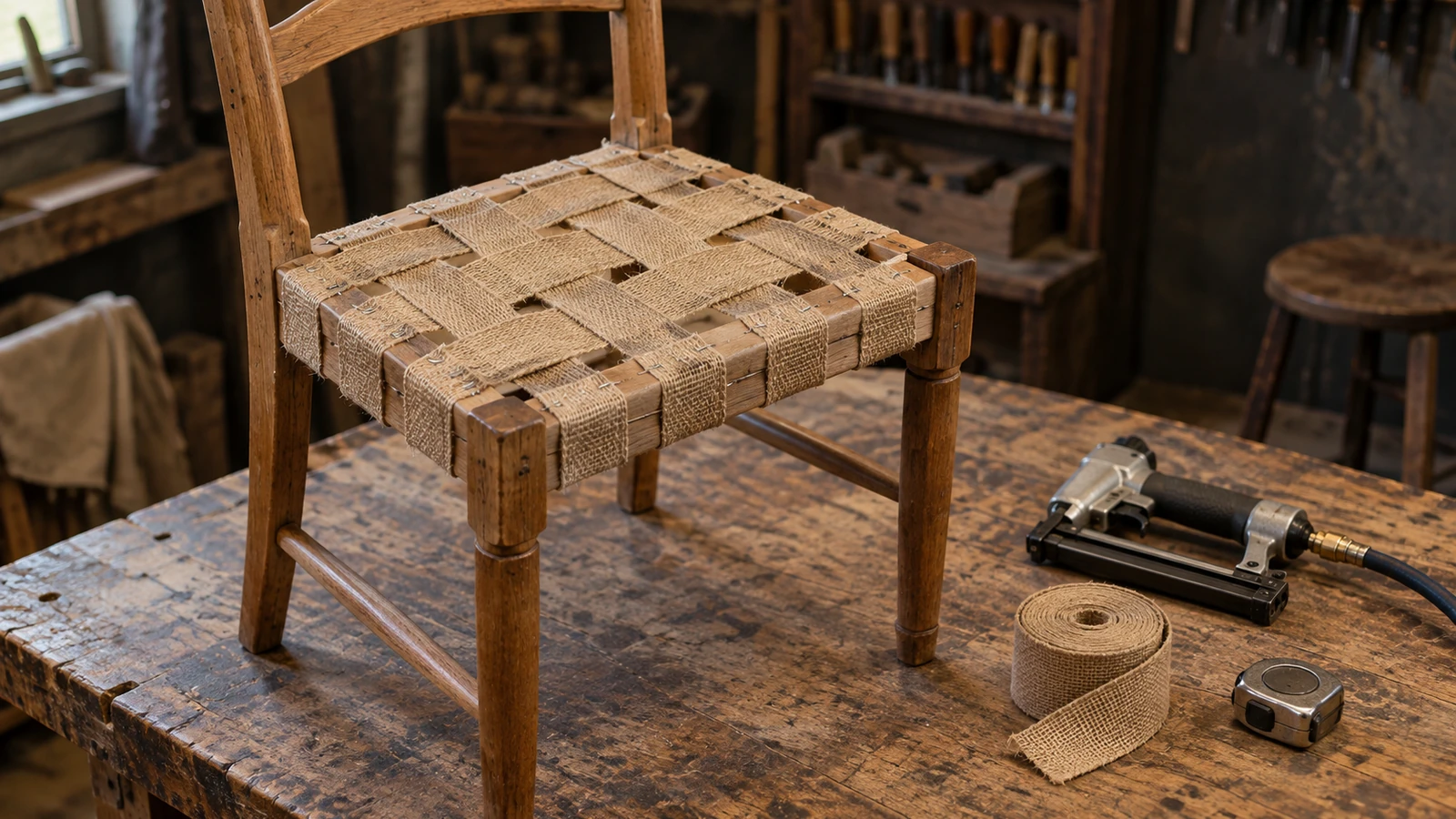

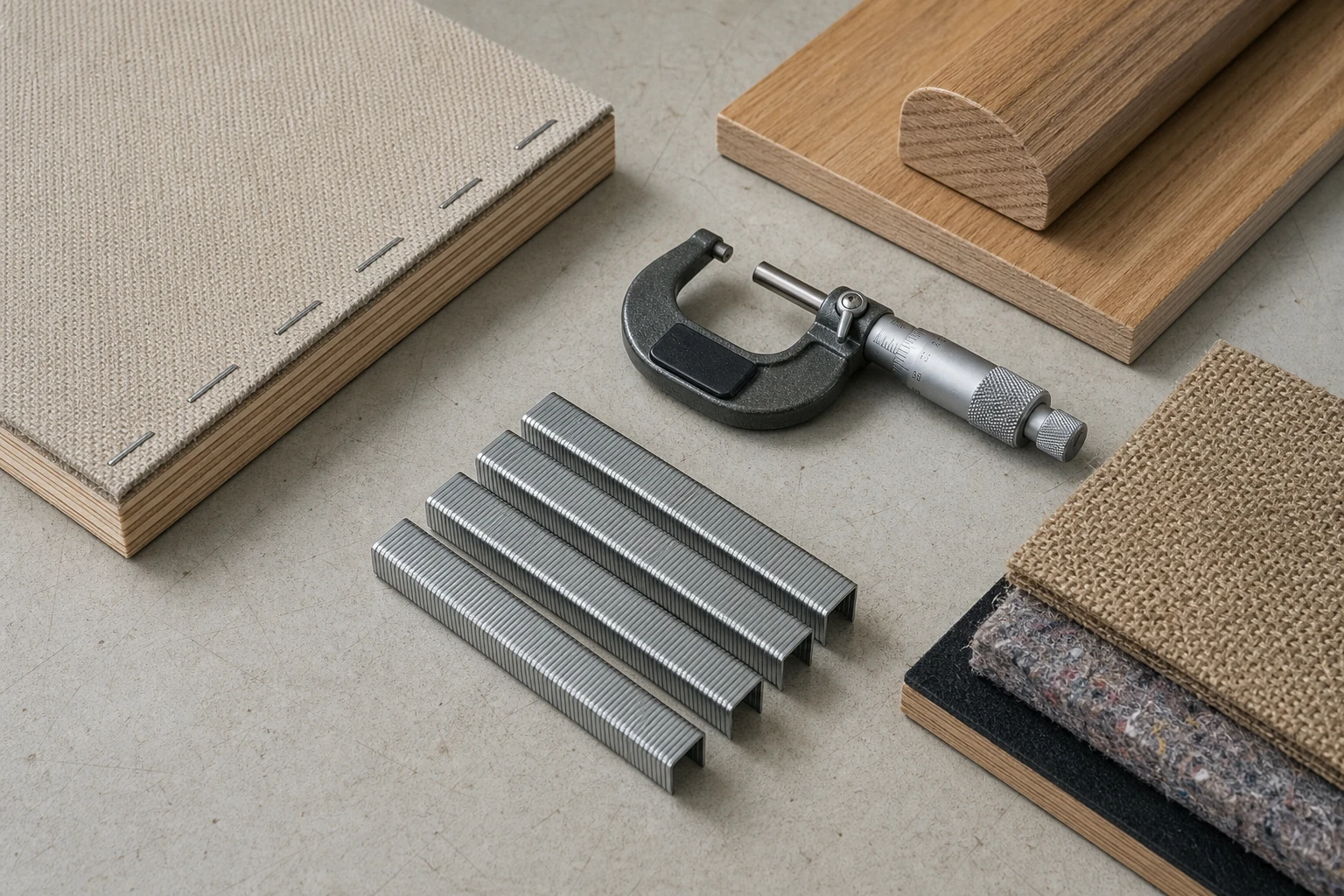
20 gauge staples sit within a practical application range defined by crown width, leg length, wire geometry, tool compatibility, material stack, and the failure consequence of the joint. Gauge alone does not tell a buyer whether the staple will hold fabric without pull-through, penetrate a wood layer without buckling, or provide enough engagement for a light assembly.
ProAirNails recommends building an application envelope rather than a list of vague uses. Test the intended stack, identify the shallow and severe boundaries, and release only the combinations that meet a declared seating and joint rule.
Define the job the crown and legs must perform
The crown distributes load at the surface; the legs penetrate and engage the backing. State whether the joint is temporary positioning, fabric attachment, light panel retention, trim assembly, packaging, or another use. Also state whether appearance, pull-through, clinching, removal, vibration, or long-term load is the governing concern.
Where 20 gauge staples fit in the fastener envelope
They may suit light-to-medium pneumatic fastening when the exact staple series and tool are compatible and a representative joint proves acceptable. They should not be described as universally “stronger” than finer wire or “safer” than heavier wire. A gauge change also changes hole size, material displacement, crown behavior, and tool family.
Specify dimensions beyond gauge
| Specification field | Buyer question | Application effect |
|---|---|---|
| Crown | What width and profile contact the surface? | Load distribution and visibility |
| Leg | What length enters the backing? | Engagement, breakout, and clinch potential |
| Wire | What actual dimensions and coating are supplied? | Penetration and material displacement |
| Point | How is the leg tip formed? | Entry path and splitting tendency |
| Collation | What series, strip, adhesive, and count fit the tool? | Loading and feed stability |
Map the complete material stack
List every layer in order: fabric, foam, film, veneer, panel, hardwood, softwood, composite, or air gap. Record thickness, density, grain or fiber direction, moisture condition, support, and edge distance. A staple that passes through a thin top layer can still fail when the backing is too hard, too soft, too thin, or unsupported.
- Use production materials from identified lots.
- Include seams, corners, and edge zones where relevant.
- Record backing thickness and support.
- Test the intended tool angle and pressure.
- Retain accepted and failed boundary coupons.
Create three boundary panels
Build an easy panel, the normal production stack, and a severe but representative boundary. Drive a defined count with the same tool and setup. The easy panel verifies basic function; the normal panel supports release; the severe panel shows whether the process still has margin or needs a different staple, tool setting, or joint design.
Judge seating and joint behavior separately
A flush crown is not automatically a sound joint. Record proud crowns, overdrive, cut fabric, crown pull-through, skew, buckled legs, breakout, splitting, clinch shape, and joint gap. Then apply the appropriate retention or service check. Surface appearance and load response answer different questions.
Choose a response from the failure mode
| Failure pattern | What it suggests | Controlled response |
|---|---|---|
| Crown cuts or sinks through fabric | Surface pressure exceeds material support | Review crown, setting, backing, and material layer |
| Legs buckle before seating | Backing resistance or alignment is too high | Review leg, point, tool, angle, and substrate |
| Crown remains proud | Energy, stack, engagement, or tool condition mismatch | Build a controlled setting ladder |
| Joint releases with crown still seated | Leg engagement is insufficient | Review length, backing, spacing, and design |
| Results vary by operator | Process window is too narrow | Standardize support, angle, pressure, and checks |
Confirm the tool series before ordering
Use the nailer’s approved staple specification, not a broad gauge label. Confirm crown, leg range, wire dimensions, strip form, adhesive, and magazine fit. Load samples safely and record feed rhythm, skips, doubles, and interventions. Isolate the tool according to the manufacturer’s instructions before clearing faults.
Use ASTM F1667 for declared fastener properties
The active ASTM F1667/F1667M-21a page covers driven fasteners, including staples, within its stated classifications, dimensions, material, properties, and workmanship scope. It does not decide which staple series, spacing, tool setting, or joint capacity is correct for the buyer’s assembly.
Keep tool safety within the approval route
The official ISO 11148-13:2017 page describes safety requirements for hand-held non-electric fastener driving tools. It does not replace a product-specific joint test, and a passing application coupon does not certify the tool or operator.
Compare total assembly cost
For 20 gauge staples, include price, shot rate, reload frequency, rejects, surface repair, tool inventory, consumable range, inspection time, and joint failures. Consolidating onto one series can simplify inventory, but only if every approved application retains adequate process margin and the wrong SKU cannot enter a higher-risk joint.
Send ProAirNails an application-stack inquiry
Provide staple series, crown, leg, wire, coating, tool, pressure, every material layer, backing, edge distance, drive orientation, spacing, joint purpose, expected load, annual volume, packaging, and acceptance evidence. ProAirNails can discuss staples, related air staple products, the wider product range, and samples through the inquiry page.
Keep approval of 20 gauge staples inside the tested stack
A coupon trial cannot prove structural capacity, every tool, every material lot, all operator technique, or long-term service. Gauge is not a substitute for engineering. ProAirNails can support identified staple evidence, while the buyer controls joint design, test method, compliance, safety, and production release.
Retain the fastener strip and boundary panels. Revalidate 20 gauge staples after changes to crown, leg, wire, coating, collation, tool, material stack, support, spacing, environment, or acceptance criteria.
FAQ
Does gauge alone identify a compatible staple?
No. Crown, leg, wire dimensions, strip form, adhesive, and tool specification also have to match.
Are medium-fine staples suitable for upholstery?
They may be for a validated stack, but fabric, backing, crown pressure, tool, spacing, and load require testing.
Why can a flush crown still fail?
The legs may have insufficient engagement, buckle, miss support, or allow the joint to release under service.
What is an application envelope?
It is the declared set of materials, dimensions, tools, settings, locations, and outcomes for which the staple is approved.
Why test an easy and severe panel?
They confirm basic function and reveal how much process margin surrounds the normal production stack.
What causes crown pull-through?
Surface weakness, narrow load distribution, excess drive, poor backing, or service load can contribute.
Should pressure be raised when legs buckle?
Not automatically. Identify substrate, point, angle, tool, and leg mismatch before increasing energy.
Can one staple reduce inventory across all jobs?
Only if every application is separately validated and wrong-use risk remains controlled.
What evidence belongs in the RFQ?
Send complete staple geometry, tool, stack, support, spacing, load purpose, defects, quantity, and acceptance method.
Which changes reopen the application envelope?
Review changes to staple, tool, materials, backing, support, angle, spacing, environment, or acceptance.