
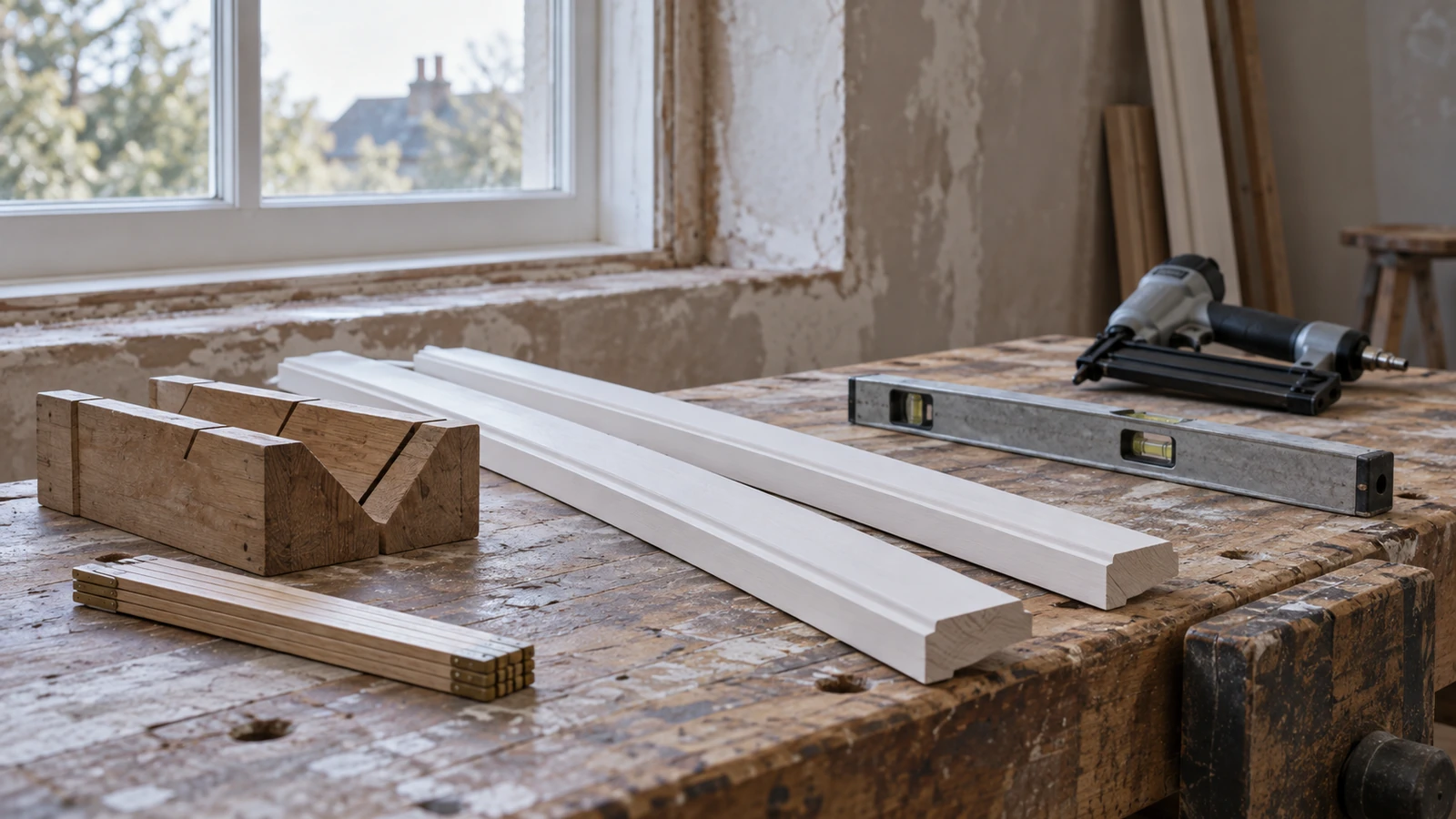
The window opening is the one thing on the wall nobody can move. The reveal is already set, the plaster is already on, and the casing has to arrive and cover whatever the bricklayer and the plasterer left behind.
Casing work is where ProAirNails gets asked about brad nails for window casing most often, usually by someone whose first window went on easily and whose fourth one has a 4 mm gap at the sill. The material and the wall decide the fixing, and they are two separate decisions.
The reveal is fixed and the casing is not
Every error in the opening collects at the casing. The reveal is out of square, the head is 3 mm low on one side, the plaster comes out further at the top than at the bottom. None of that is a defect the joiner can fix, and all of it has to disappear into the trim, which is why brad nails for window casing get asked to hold a piece that is under tension from the wall behind it.
Which means the casing is fitted to the opening rather than cut to a nominal size, and the fixing has to hold a piece of trim that is being pulled in different directions by a wall that is not flat.
MDF or softwood: two reactions to the same pin
MDF is uniform, has no grain and takes a pin without splitting, which is why it dominates painted trim. It also has almost no resistance to a pin being pulled sideways, and if the casing is under any tension from a bowed wall, that tension eventually works the fixing loose. Brad nails for window casing behave quite differently in the two materials, and the difference is worth a trial on offcuts.
Softwood has grain, and grain means a pin near an edge can split the piece. It holds far better once it is fixed, and it moves with the seasons, so a mitre that was tight in a dry building can open in a damp one. Brads do not solve either behaviour; they decide how much of it reaches the surface.
| Material | What the pin does | Where the fixing should go |
|---|---|---|
| MDF trim | Bites easily, holds poorly against lateral pull | Enough fixings to hold the length flat, with glue on the long joints |
| Softwood trim | Can split near an edge, holds well once seated | Set in from the arris by a distance the trial proves |
| Primed finger-jointed trim | Varies along the length, joints are pre-made | Fixings either side of every joint, never through one |
Brad nails for window casing: where each pin goes
Start at the mitre and work away from it, because a mitre that is closed and pinned stays closed while the rest of the length is fixed. Fix a long length from the middle outwards and the mitre will move before any pin reaches it. This is the step where most of the visible quality in brad nails for window casing is won or lost.
Pin the leg into the stud behind it and the head into the lintel or trimmer where you can, rather than only into the reveal. A casing fixed only to the reveal has nothing holding it flat against the wall, and the gap at the plaster is where that shows.
Fitting a casing to a wall that is out of square
The standard answer is to scribe the casing to the reveal, which means offering the length up, marking the deviation and cutting to the line rather than to a measurement. It is slower on the first window and much faster by the fourth, and it removes the tension that would otherwise keep working at every brad nails for window casing fixing for the life of the building.
| What the opening does | What the casing has to absorb | How the fixing changes |
|---|---|---|
| Reveal out of square by a few millimetres | The full deviation down one leg | Scribe and pin to the line rather than to a measurement |
| Head out of level on one side | The difference across the head length | Pack the low side before the pin goes in |
| Wall not flat behind the trim | A gap that varies along the length | More fixings, and pack where the gap is deepest |
| Plaster proud at the top | Local pressure on the upper third | Ease the back of the trim rather than forcing it |
Filling the gap instead is where most of the trouble starts. A wide bead of filler will shrink, crack and show under raking light, and no fixing pattern prevents that. Take the time at the saw.
Mitres, returns and the joint that opens later
A mitre is an end-grain joint with almost no strength on its own, so it relies on being closed and held by two fixings, one each side, at the moment the pin goes in. Glue the mitre as well as pinning it if the finish allows.
Where trim moves after installation, the mitre is the first place it shows. On a softwood casing in a drying building, expect the joint to open slightly in the first heating season, and design the finishing schedule around a small touch-up rather than pretending it will not happen.
What to check before the first length goes on
- Check the reveal for square and for twist, using a level on both faces rather than a tape alone.
- Check the wall plane with a straight edge, so anything that needs packing is packed before the trim is pinned.
- Confirm which thickness of trim the reveal was set for, because a 3 mm difference changes every scribe line.
- Run three test pins into an offcut of the actual trim and check the head sits below the surface without crushing or splitting.
- Decide the corner treatment first, mitre or butt, since it changes how the lengths are cut and how they are fixed.
- Keep a small block behind the fixing point if the plaster or reveal has any give in it.
What the pin cannot correct
A brad cannot straighten a bowed length, and pinning harder will not flatten a length that was stored leaning against a wall. It cannot bridge a gap between the reveal and the casing, and it does not prevent a mitre opening in a building that dries out. ProAirNails supplies trim fastenings on that understanding rather than on the promise of a gap that closes itself.
Where the trim is part of a fire-rated or acoustic assembly, the specification comes from the designer, and this article does not substitute for it. For how interior woodwork is normally described in tolerance terms, the Architectural Woodwork Institute casework supplement is a practical reference, and the USDA Wood Handbook explains why a softwood length that was flat in the workshop does not stay flat in a heated room.
FAQ
How many brads does a window casing need?
Enough to hold the length flat to the wall and each mitre closed, usually one near each end and one every 300-400 mm along the length.
Which gauge suits window casing?
A gauge that disappears under the finish coat, with a length that reaches the stud without coming through anything visible. Confirm it on an offcut.
Should the casing be fixed to the reveal or to the wall?
Both where possible. Fixing only to the reveal leaves the length free to stand off the plaster.
Why does my mitre keep opening?
Usually because the pin went in before the joint was fully closed, or because the building dried after installation.
Can I fill a gap at the reveal instead of scribing?
You can, and it will show. Filler shrinks differently to trim, and raking light finds it every time.
Do I need glue as well as pins?
On a mitre, yes where the finish allows. Adhesive holds the joint that the pins only clamp.
What if the wall bows?
Pack or plane to the straight edge first, then fix. Pins will not pull a bowed length flat.
Should primed MDF be pinned differently to bare softwood?
The technique is the same, the pressure and the edge distance differ, and a quick trial on offcuts of each settles both.
How should casing be stored before fitting?
Flat, supported and in the room it will be fitted in, so it acclimatises before it is nailed rather than after.
What should a trim enquiry include?
Material and thickness, profile, reveal condition, the tool in use, the finish specification and whether the trim is primed or bare.
What to send with a casing enquiry
Send the opening and the trim: reveal dimensions, how square it actually is, the trim material, thickness and profile, plus the tool on the bench. ProAirNails supplies brad nails, staple pins and pneumatic nails into joinery and trim work, and a photograph of the worst reveal in the building is the most useful thing you can attach to an enquiry. Start at Contact Us.