
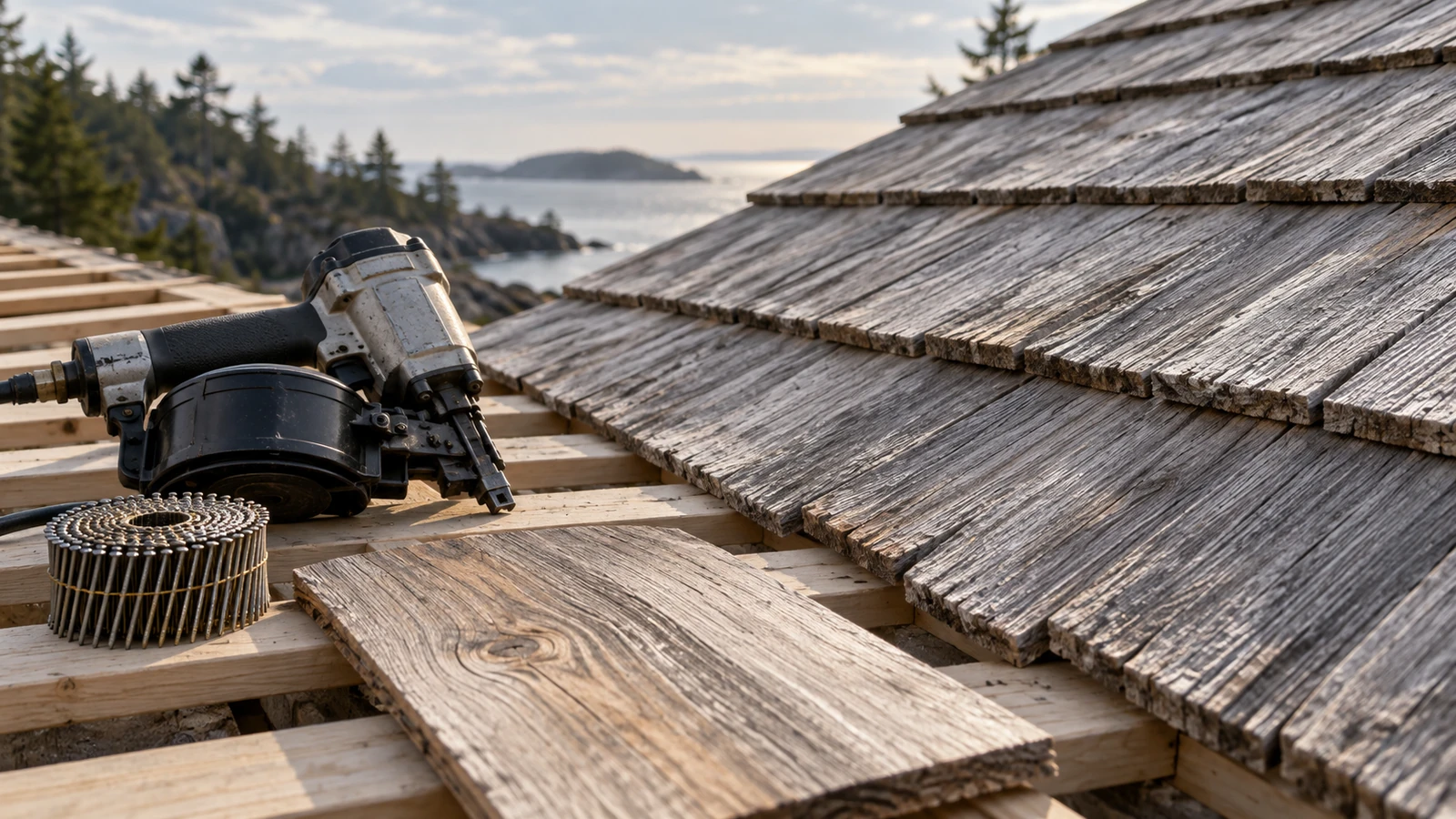
Cedar is one of the few roofing materials that gets better with age and worse with the wrong nail. The wood holds water, releases mild acid as it weathers and is expected to stay on the roof for forty years or more.
Roofers ask ProAirNails about coil nails for cedar shingles expecting a length, and the length is the easy part. The decision that cannot be undone later is the coating on the wire, and it is being made on a roof that nobody will look at again until something leaks.
Cedar is a wet, acidic roof
Shingles are laid in overlapping courses, so water is shed rather than sealed out. That means every shingle spends part of the year damp, and the underside of a course stays wetter for longer than the face above it.
Cedar also releases natural acids as it weathers. Put those two facts together and a fixing here is sitting in a mildly acidic, permanently humid environment that never fully dries out, which is a different question altogether from fastening timber that is sheltered and dry.
Why coil nails for cedar shingles fail from the head down
Roof fixings rarely snap. They corrode, and corrosion starts where water collects, which on a shingle roof is the head and the small shadow it casts on the shingle below.
Once the coating is gone the shank starts to waste. What is left holds less every season, and the failure arrives as a shingle lifting in a gale rather than as anything dramatic and visible on a calm day. Coil nails for cedar shingles are no different from any other fixing in that respect; they simply have more weather to survive.
Coating: the one choice that cannot be corrected later
Coil nails for cedar shingles chosen on price are the first component on the roof to fail, and once the courses are down the coating cannot be revisited. Electroplated wire is a dry-service product and has no place here. Hot dip galvanized or mechanically galvanized wire is the working choice for most inland roofs on non-cedar materials, and it performs well where the shingle above it dries out between rain.
Cedar changes the calculation because of the acid. Stainless steel is the answer that does not depend on how the roof drains, how sheltered the site is or how long the client intends to keep the building, and the price difference on a roof of any size is small next to lifting courses. The ASTM F1667 driven fastener specification is where coating grades and their classification are actually defined, and it is worth asking a supplier to quote against it rather than against a colour.
| Situation | What the fixing has to survive | Coating that belongs there |
|---|---|---|
| Inland roof, shingles drying between rain | Cycles of wet and dry with mild acid | Stainless, or a heavy galvanized coating as a minimum |
| Coastal or exposed site | Salt carried in on the wind | Stainless only |
| Deep shade or a roof that stays damp | Long wet periods with little drying | Stainless, because drying is what saves zinc |
| Re-roofing over an existing roof | Old cedar, old acid, old moisture | Stainless, and fresh battens rather than reused ones |
Shank and head: what a shingle actually needs
A ring shank gives withdrawal resistance that a plain shank cannot, and on a roof the load that matters is the shingle trying to lift in wind. It also drives a little harder and holds a little tighter in a shingle that may be splitting at the edges.
Head size matters for the opposite reason. A large head spreads the load and reduces the chance of the head cutting through a thin shingle, but it also stands proud and collects water if it is not seated properly. Head, shank and coating are chosen together rather than one at a time.
Two fixings per shingle, and where they go
Shingles are fixed twice, both fixings set above the weather line and below the overlap of the course above, so no fixing is exposed to running water. Two fixings also share the load of a shingle that is cupping as it dries, which is why most coil nails for cedar shingles schedules quote two and treat it as a minimum rather than an extravagance.
Keep the fixing away from the vertical edges of a shingle. A nail set too close to the edge splits the shingle as it is driven, and the crack opens further over the following winters because the fixing now holds two pieces instead of one.
Exposure, gaps and the courses above
Shingles swell across their width when they are wet, so the course above has to leave room. Tight butting closes that allowance and forces the movement into the fixings and the shingle edges, which is one of the reasons an old roof shows so many split shingles in the same rows.
Exposure, the length of shingle left visible, is set by pitch and by local practice rather than by the fixing. What the fixing has to do is hold the shingle while that exposure does its work, year after year, without becoming the part that fails first.
What you see on an ageing roof
| What you see | What it usually means | What to check first |
|---|---|---|
| Rust streaks running down the courses | Coating gone before the roof was | Coating grade against the site exposure |
| Shingles lifting at one corner | A fixing that has lost its grip in the shingle | Shank type and whether the head was seated |
| Splits running from the fixing | Fixings too close to the vertical edge | Fixing position rather than fixing size |
| Ridging along one course | Shingles butted with no room to swell | The gap left between shingles |
Checks before the first course goes on
- Confirm the coating grade against the distance to the coast and how much shade the roof gets, in writing.
- Check the battens or deck are sound, and replace anything that has already been wet for years.
- Set the tool pressure on spare shingles so the head seats just below the surface without crushing.
- Agree the exposure and the gap with the roofer before the first course is laid, not after.
- Keep one sample shingle with three test fixings in it as a record of the setting used.
- Record the moisture content of the cedar on delivery, because shingles laid dry behave differently to shingles laid wet.
What the fixing cannot do
No fixing makes a cedar roof waterproof; the overlap and the pitch do that. ProAirNails does not design the roof, and a nail specification does not substitute for the covering detail or the ventilation under it.
Two things are worth reading on the material itself. The USDA Wood Handbook covers why cedar moves and weathers the way it does, and why a fixing that relies on the wood staying put will be disappointed. The driven fastener specification covers what a coated nail is entitled to claim. ProAirNails will quote to both, and neither replaces an engineer's roof design.
FAQ
Which coil nails for cedar shingles should a coastal roof use?
Stainless steel. Salt reaches a roof even when the sea is out of sight, and zinc coatings have no answer to it.
Is plain steel acceptable under cedar?
No. Cedar holds moisture and releases acid, and a bare steel nail will start to waste within a few seasons.
Ring shank or smooth shank?
Ring shank where wind uplift matters, which is most exposed roofs. That extra withdrawal resistance is why most coil nails for cedar shingles specifications on an exposed roof end up ring shanked.
How many fixings per shingle?
Two, positioned above the weather line and covered by the course above. One fixing leaves the shingle free to curl.
Should the head be visible?
No. It should seat just below the surface of the shingle, without breaking through or crushing the wood around it.
How close to the edge can a fixing sit?
Far enough in that the shingle does not split as it is driven. The exact distance depends on the shingle width and the shank, so it belongs in a trial.
Does a fixings failure always show as a leak?
No. It usually shows as a lifted shingle in wind long before water finds its way inside.
Can shingles be refixed over old ones?
Sometimes, and always with new stainless fixings into sound material. Reusing corroded fixings is how a second roof inherits the first roof's problem.
What exposure should be used?
That is set by pitch and local practice rather than by the fixing. The fixing only has to survive whatever exposure is specified.
What should a cedar roof enquiry include?
Shingle size, exposure, pitch, site exposure to salt and shade, batten or deck detail, and the coil nailer being used.
What to send with a cedar roof enquiry
Send the roof rather than the nail: shingle size and exposure, pitch, distance to the coast, how much shade the roof takes, the batten or deck construction and the tool on site. ProAirNails supplies coil nails, pneumatic nails and pneumatic staplers into roofing and exterior timber work, and a photograph of the deck with a tape across it is enough to quote from. Start at Contact Us.