
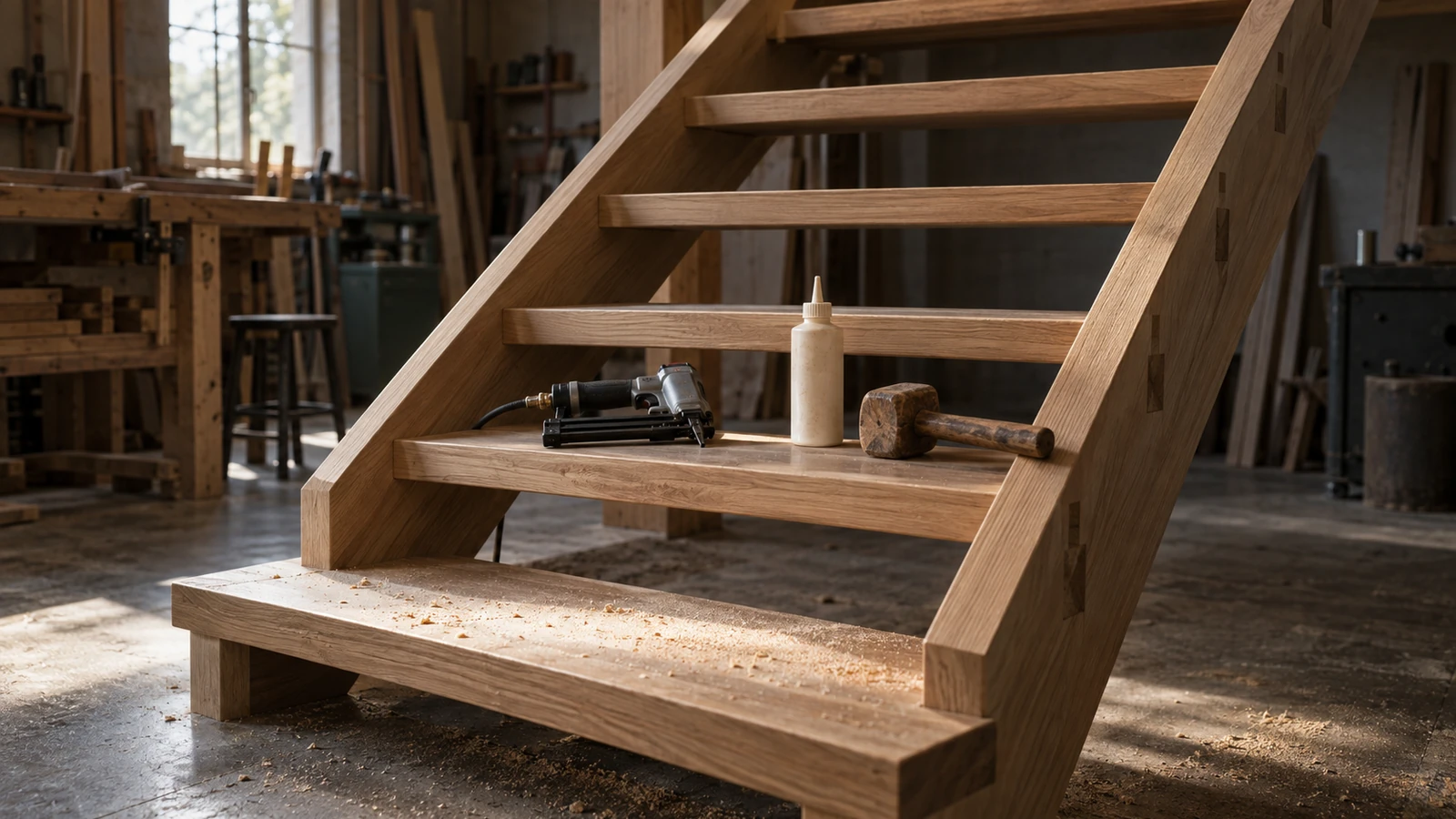
Walk up a timber stair and listen for a second before you look at anything. A creak is a small movement repeating itself under load, and nine times out of ten the joint making the noise is the one that was fixed tightest.
Joiners ask ProAirNails about brad nails for stair components because one small part is handed two unrelated jobs on the same flight: holding a joint closed while the glue grabs, and stopping a thin board creeping sideways during assembly. Neither of those jobs is holding the stair up. Working out which is which takes ten minutes at the bench and saves a callback three months later.
What a stair is actually doing when someone walks up it
Weight lands at the front of a tread. A body shifting forward adds a push, and a hand on the rail adds a little sideways load that travels down through the newel rather than through the steps. Everything ends in the stringers and the floor.
Timber is moving the entire time it is doing that. A 250 mm tread can gain or lose width between February and August, and the housing at each end does not move with it. Leave that movement nowhere to go and something has to give: a short split at the shoulder, a fixing that loosens, or the squeak that started this article.
Treads, risers and the stringer: three different joints
Look at them one at a time. Tread to riser is a light joint resisting a small shear. Riser to stringer positions the riser. Tread to stringer carries people, and it wants a housing, a screw or a bracket.
Brad nails for stair components do the light work well. They close a joint while adhesive cures, and they keep a board from creeping out of register while you reach for the clamp. Where the joint is carrying a person, the pin is only the holding order until the structural fixing is made.
Why brad nails for stair components should not lock the tread
Pin a tread into a stringer and you have built a rigid connection across the grain. When the tread tries to move with the weather it cannot, so the movement shows up at the fixing: a squeak against the shank, or a short split running in from the edge.
Where the detail allows, let the tread slide a little across its width and use the fixing to keep the assembly closed while the glue does the real work. That division is not a compromise. It is each material being used for the property it actually has.
Glue plus a brad: what each one is for
On most timber stairs the adhesive is the connection and the fixing is the clamp. Once that is clear the choice is simple, because a clamp only has to last until the glue goes off. That single sentence answers brad nails for stair components in most joinery shops, and it covers three of the four rows below.
| Joint | What carries the load | What the fixing does |
|---|---|---|
| Tread to riser | Adhesive across the joint face | Holds the boards closed and stops sliding while it cures |
| Riser to stringer | Adhesive plus a mechanical fixing | Registers the riser position during assembly |
| Tread to stringer | The housing, a screw or a purpose-made bracket | Keeps the tread seated until the structural fixing is made |
| Nosing or trim | Nothing structural | Holds a thin moulding that only has to look right |
The rows above are how the division usually falls, but the drawing wins. Where a joiner has a reason to pin a heavier joint, the reason belongs in the paperwork rather than in the habit of the bench.
Where the creak starts, and how to find it
Creaks are found by elimination, not by pressing on treads and hoping. Work outwards from the structural connection, because a noise that sounds like a tread often starts at a stringer or a newel.
| Symptom | Likely cause | What to check first |
|---|---|---|
| Creak on one tread only | A joint that opened as the timber dried | Whether the tread is standing off the stringer |
| Creak along the whole flight | Movement at the stringer or the newel connection | The structural connection, not the treads |
| Click when the tread is pressed at one end | A fixing that has lost its grip in the end grain | Distance from the end and the shank of the fixing |
| Fine split near the tread edge | Movement restrained across the width | Whether the detail allowed any movement at all |
Repair in the same order. A pin added to a joint that is already moving adds a hole and nothing else, because it brings no stiffness to the place the movement happens. Glue, a screw or an extra bracket underneath is what stops the noise.
Site conditions that change the answer
A stair in a drying building behaves differently from a stair in a finished house. The difference is wide enough to change how the flight is put together.
- Store the timber in the room where the stair will stand, so it acclimatises before assembly rather than after.
- Check moisture content on the treads, not only on the stringers, because the thin boards move first.
- Fix the stair after wet trades are finished where the programme allows, and protect it until the building is dry.
- Record the adhesive used, its open time and the temperature on the day, because that record explains most callbacks.
- Take a photograph of the joint before it is closed, so a later repair does not have to open the whole flight.
Trial assembly before the first flight
One tread on a scrap length of stringer answers everything that matters. Does the pin hold the joint closed, does the glue squeeze out evenly, and does the head sink below the surface without tearing the fibres? Twenty minutes at the bench, against a callback three months later, and the gauge chosen for the rest of the brad nails for stair components order is the one that was proved rather than guessed.
Where the stair is part of a contract with a finish specification, the Architectural Woodwork Institute casework supplement is a reasonable reference for how joints, tolerances and finishes are usually described to a client, and it gives the shop a shared vocabulary with the designer. ProAirNails asks for that same description before quoting brad nails for stair components, because the finish is what decides the acceptable hole.
Stairs, access and the safety rules around them
A stair being built is also the way everyone gets upstairs while the building is unfinished, so the sequence has to leave it usable. The OSHA requirements for stairways and ladders in construction give the baseline for temporary protection, and on most sites that baseline decides when a finished tread can go on rather than how it is pinned.
What the fixing cannot fix
No pin stiffens an undersized stringer. No pattern of pins corrects a housing that was cut loose on the bench, and nothing will hold a tread that was fitted wet and has since dried to a different width.
The boundary is worth stating plainly. This article is about assembly, not structure. Where a stair carries a structural or fire requirement, the specification comes from the designer, not from a fastener schedule.
FAQ
Can brad nails for stair components hold a tread on their own?
No. A tread-to-stringer joint carries live load, so it needs a housing, a screw or a bracket. A brad is there to hold the joint closed during assembly.
What size brad suits stair work?
A gauge that leaves a small enough hole to disappear in the finished surface, with a length that reaches into the receiving member without emerging on a visible face.
Why does a stair creak only in winter?
Because the timber has dried and a joint that was tight has opened enough to move. The creak is the symptom, not the cause.
Should treads be glued as well as pinned?
Almost always. The adhesive carries the joint, and the pin holds it while the adhesive sets.
How close to the end of a tread can a fixing sit?
Far enough to avoid a split in the end grain. The exact distance depends on the species and the fixing, so it belongs in the trial.
Can I stop a creak by adding more pins?
Rarely. If the movement is at the structural connection, extra pins add holes without adding stiffness.
What causes a fine split along a tread edge?
A fixing that restrains the tread across its width while the board tries to move with the weather.
Does the finish affect the fixing choice?
It can. A clear finish shows every mark, so the head depth and the hole size matter more than they would under paint.
How should a stair be stored on site?
Flat, supported, dry and in the space it will be installed in, so it acclimatises before assembly rather than afterwards.
What should a stair enquiry include?
The species and thickness of treads and risers, the stringer detail, the adhesive, the tool being used and the finish.
What to send with the stair enquiry
Send the joint, not the pin: the species and thickness of each part, the stringer detail, the adhesive system and the tool on the bench. ProAirNails supplies brad nails, pneumatic staplers and pneumatic nails into joinery work, and a sketch of the joint with a tape measure in the photograph is enough to quote from. Start at Contact Us.