
Buying bulk coil nails for export pallets is a volume exercise only after the specification is fixed. A lower unit price can disappear when cartons arrive damaged, coil counts vary, or a pallet line must stop while a tool setting is re-established. An export order deserves a worksheet that connects the fastener, the carton, the container, and the receiving team's checks.
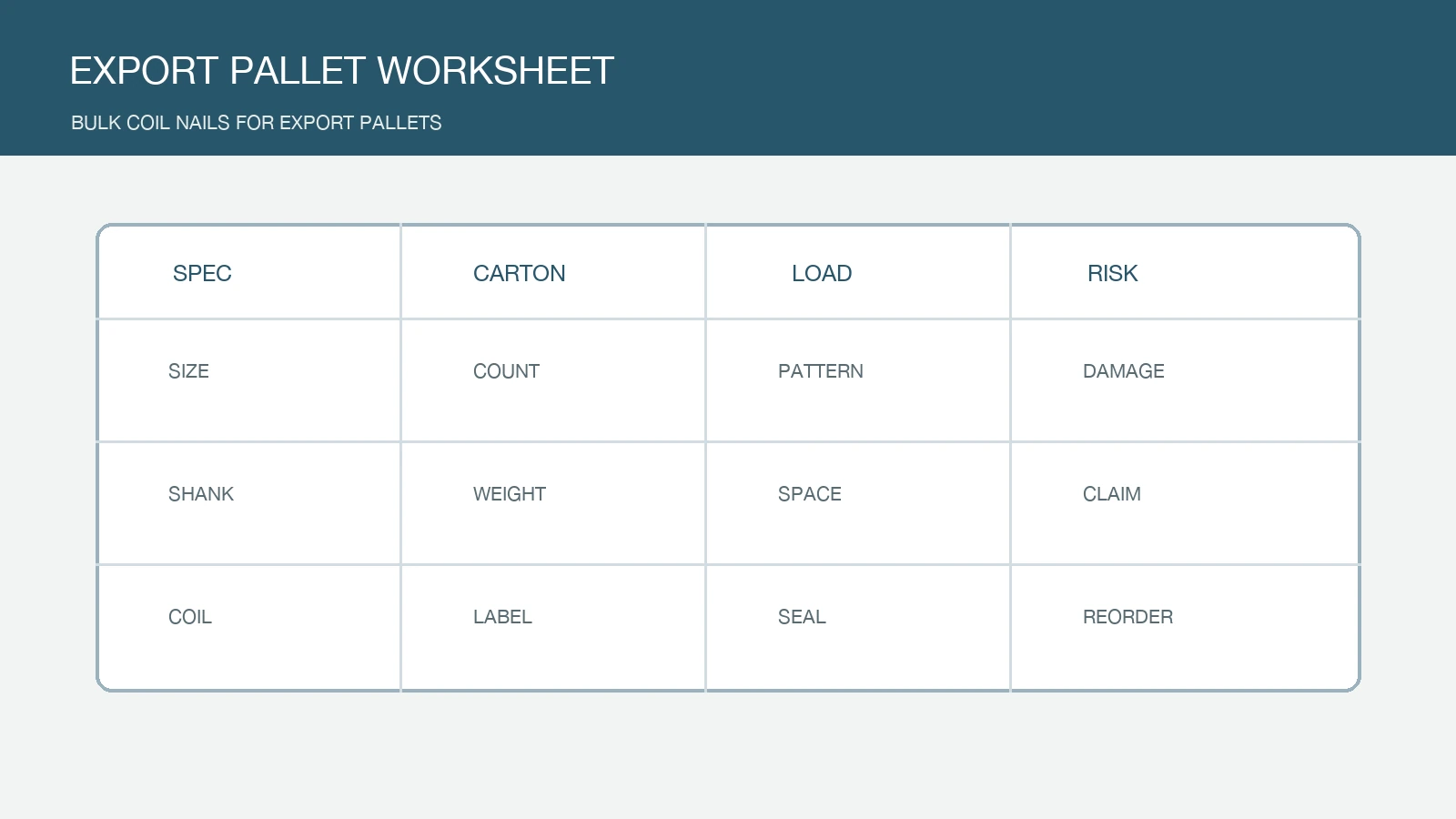
The worksheet below is written for importers, distributors, and pallet producers who compare several quotes. It does not predict freight or duty. Instead, it makes the variables visible so a supplier can quote the same basket of requirements and the buyer can explain why a bid is acceptable.
Write the landed-cost basket
| Cost line | Input to request | Why the line can move |
|---|---|---|
| Fastener | Length, diameter, shank, coating, coil count | A substitute dimension changes both performance and weight |
| Carton | Boxes per case, case weight, dividers, marks | Weak packing creates damage and receiving labor |
| Container | Cases per pallet, pallet footprint, loading pattern | Unused space can raise the effective cost per box |
| Risk allowance | Inspection, shortage, damage, and claim process | Unclear evidence makes a small variance expensive |
Ask every supplier to separate product cost from packing and loading assumptions. If a quote combines them, request the underlying counts. A buyer can then compare bulk coil nails for export pallets on a like-for-like basis rather than selecting a number that hides a different case quantity.
Use a carton-count reconciliation
Before the order is released, calculate expected pieces from coil count, coils per box, boxes per case, cases per pallet, and pallets per container. Keep the calculation beside the purchase order. At receipt, count cases and inspect a sample of boxes against the same worksheet. This does not require opening every carton, but it gives the warehouse a defined exception rule.
- Photograph the container seal and pallet labels before unloading.
- Record damaged corners, crushed dividers, and exposed coils.
- Compare the carton code with the purchase order and approved sample.
- Hold unexplained shortages until the supplier reviews the lot.
For private-label orders, include artwork revision and barcode data in the reconciliation. A correct coil in the wrong carton can still create a costly receiving error.
Choose bulk coil nails for export pallets around the joint
Bulk buying should never remove the application check. State which pallet designs will be produced, which timber is typical, and whether the tool is carried by hand or fixed in a station. The buyer should confirm length, shank style, point, head, collation, and coating against that joint. If several SKUs are packed in one shipment, give each one a separate sample and carton code.
Many buyers start with bulk coil nails because the format supports rapid driving. That benefit is real only when the coil diameter, indexing, weld or wire condition, and nailer magazine are compatible. A mixed container should be tested by SKU, not approved by a single representative coil.
Build a supplier score from evidence
| Score lane | Green evidence | Amber evidence |
|---|---|---|
| Specification | Controlled drawing and retained sample match | Gauge only or generic product name |
| Capacity | Run plan, lead time, and repeat-order record | Capacity stated without a product scope |
| Packing | Case test, pallet pattern, label proof | Carton count described but not checked |
| Claims | Named contact, lot evidence, response timing | Promise to solve issues without a route |
A supplier does not need to reveal confidential customer data. A redacted packing record, a sample inspection sheet, and a clear change-notice process can still show whether the controls are used. The ISO 9001 requirements page offers a common language for controlled processes and improvement. The ASTM F1667/F1667M specification can help align terminology for driven fasteners. These references support the conversation; the buyer still owns the application trial.
Plan for container movement
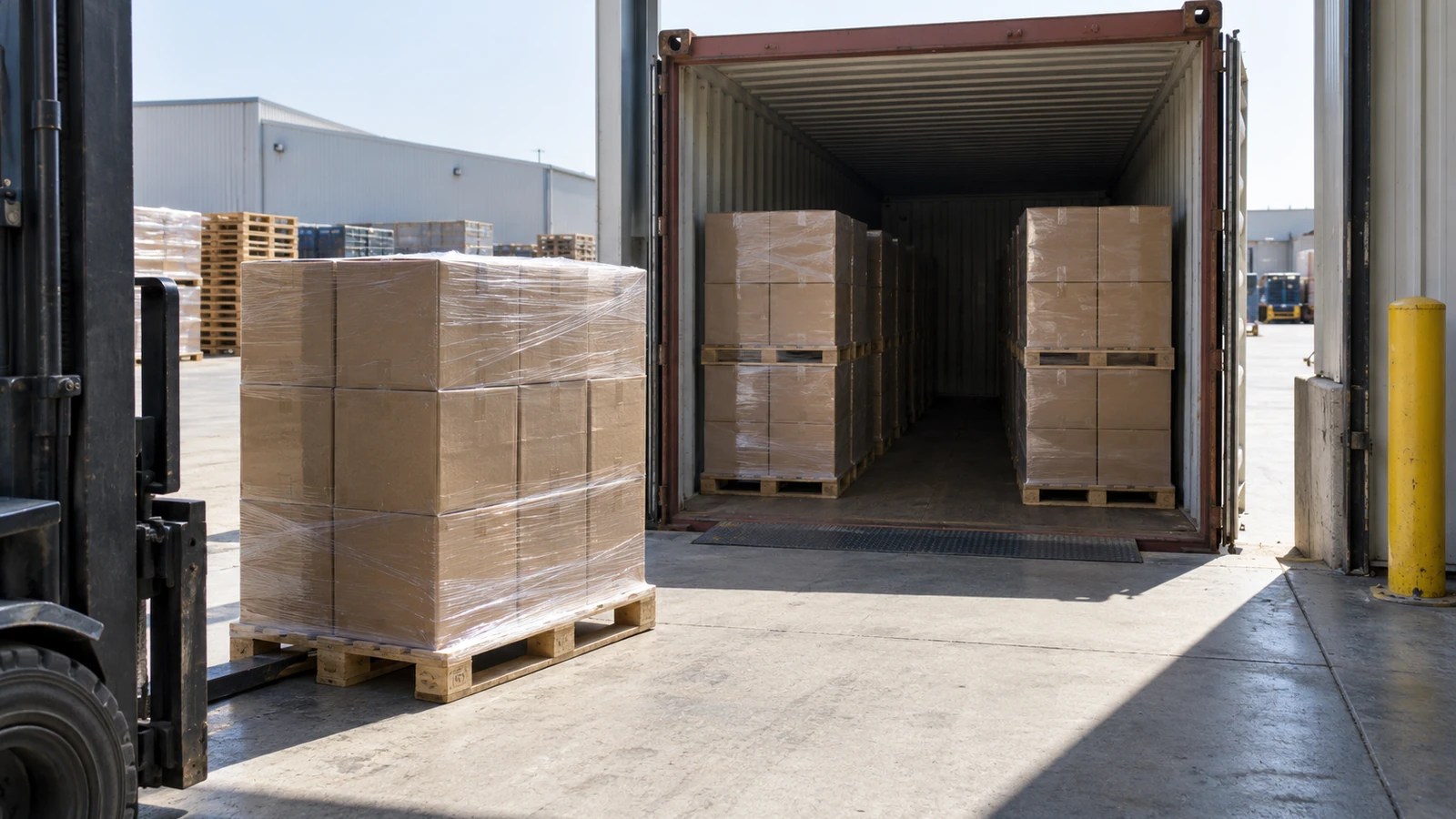
Export pallet fasteners are moved several times before use. Ask how cartons are stacked, whether straps or stretch wrap are used, and how heavy cases are kept from crushing lighter ones. Add a receiving photo checklist and a quarantine location to the purchase file. If a case arrives wet or open, preserve the evidence before re-packing it.
Do not assume that a dry carton means a dry coil. Storage at the receiving site may expose open cases to humidity. State the preferred storage condition and the time limit for an opened case. The note should also say how an operator identifies a partial coil after a line change.
Use a receiving exception rule
For bulk coil nails for export pallets, define who can release a carton when the count, label, or packaging differs from the worksheet. A named decision owner keeps a small receiving variance from becoming an unrecorded production substitution.
Lock the reorder bridge
The reorder record should carry forward the approved coil, carton artwork, piece count, pallet pattern, and inspection plan. Ask the supplier to confirm whether wire, tooling, adhesive or weld, coating, carton board, or loading pattern has changed. A new sample is justified when a change could alter feeding, holding, corrosion behavior, or receiving accuracy.
ProAirNails helps teams compare coil nails, review pneumatic nails, add related staples, and send an export RFQ through Contact Us. For bulk coil nails for export pallets, a clear worksheet is often more valuable than another page of general promises.
FAQ
What should a quote for bulk coil nails for export pallets include?
It should identify dimensions, shank, point, coating, coil count, boxes and cases, pallet pattern, lead time, and the packing and inspection assumptions behind the price.
How can I compare two bulk coil nails quotes?
Put both quotes into the same basket: product specification, usable pieces, carton configuration, container loading, inspection, and claim handling.
Should one sample approve a mixed container?
No. Each SKU that differs in size, shank, coating, or collation should have its own sample and carton code.
What is a carton-count reconciliation?
It is a simple calculation and receipt check that connects coil count, boxes, cases, pallets, and container quantity to the purchase order.
Why inspect cartons before opening them?
Photos of seals, labels, wet marks, crushed corners, or broken straps preserve evidence that can be lost during unloading and re-packing.
Can a lower unit price be the better export option?
Only after packing, damage exposure, usable quantity, freight assumptions, and claim support are compared on the same basis.
How should opened partial coils be identified?
Keep the original carton label or transfer it to a controlled partial-coil tag with SKU, lot, remaining quantity, and date opened.
When is a new sample needed for a reorder?
Use a new sample when wire, dimensions, shank, coating, collation, tooling, carton, or loading changes could affect the approved result.
What storage note should an importer give the warehouse?
State how to protect cartons from moisture, how to rotate opened cases, and how to isolate a coil that has unknown lot identity.
Can ProAirNails support a private-label export order?
ProAirNails can align product codes, carton artwork, quantities, samples, and the evidence needed for a repeatable B2B release.