
A bulk nails supplier should be evaluated as a system, not as a low unit price. Large orders expose weaknesses that a small sample can hide: carton counts drift, mixed lots enter a shipment, a substitute coating appears, or the supplier cannot explain how capacity is reserved. A scorecard gives purchasing, quality, and logistics one shared decision.
The scorecard below is designed for a buyer who is comparing several quotes. It does not create a universal ranking. It forces each supplier to show the same information and makes unknowns visible before the purchase order is released.
Score the quote in five lanes
| Lane | Evidence to request | Decision question |
|---|---|---|
| Product | Drawing, dimensions, finish, tool fit, sample | Will the fastener do the intended job? |
| Process | Material traceability, inspection, change control | Can the supplier repeat the approved sample? |
| Packing | Inner box, master carton, label, count method | Can the warehouse identify and pick it correctly? |
| Logistics | Lead time, loading plan, documents, contingency | Can the order arrive when the customer needs it? |
| Service | Response owner, claim route, reorder record | Who acts when the order is not right? |
Use a simple status—confirmed, sample needed, or unresolved—before using numerical scores. A supplier with a high average can still have one unresolved field that blocks release, such as an unverified strip angle or an unclear carton count.
A bulk nails supplier should receive the same question set as every competing source. Consistent questions make a quote comparable and stop a buyer from rewarding a supplier simply because it answered fewer fields. Keep the unanswered items visible until samples or documents close them.
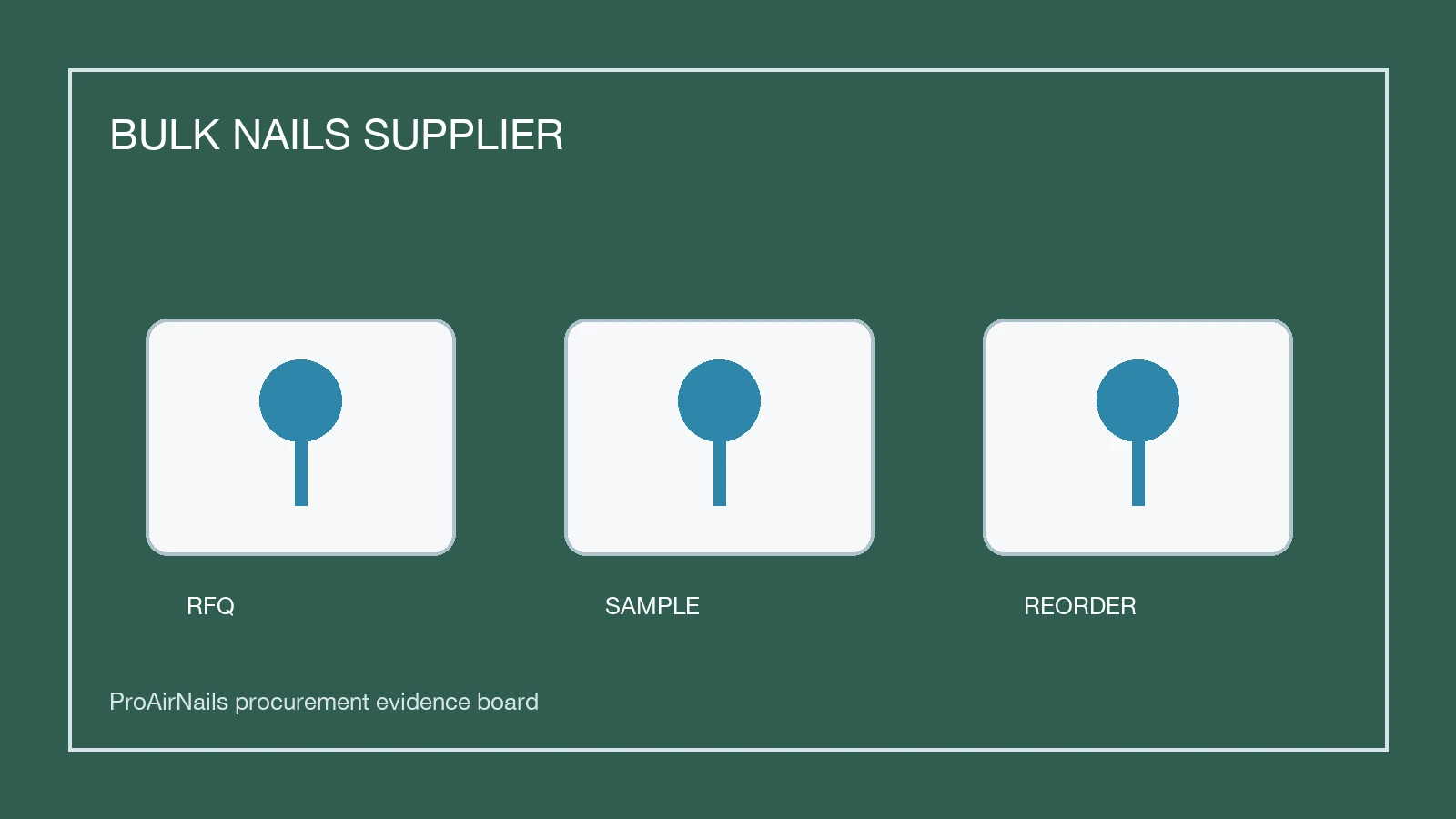
Ask for one controlled RFQ response
Send each supplier the same product table. Include item code, nail family, diameter or gauge, length, point, head or crown, coating, collation, quantity per box, boxes per carton, target ship window, and destination. Ask the supplier to mark any substitution rather than silently filling a blank.
Request a drawing or marked-up sample where the product has a special point, angle, weld, adhesive, or finish. A line such as “standard quality” is not a substitute for a measurable field. It also becomes difficult to settle a later claim when the quotation contains no accepted reference.
When a bulk nails supplier is ready for a trial
Move to sampling only when the bulk nails supplier has declared the product, pack, and timing clearly. A sample is not a way to avoid a specification; it is a way to test the specification under controlled conditions.
Use samples to test the commercial promise
The sample should be large enough to test feeding, seating, visible-face result, and packing. Drive it with the customer tool and the customer material. Count the pieces in the box if the order is sold by count. Retain one unopened inner box so the buyer can compare the approved label and carton condition at delivery.
- Code every sample and photograph the packaging before opening it.
- Record tool, pressure, substrate, operator, and test date.
- Separate feed observations from finished-surface observations.
- Write a short acceptance note that another person can understand.
Make capacity a documented question
Capacity is not just a number of tons per month. Ask which lines can make the product, what other orders share the line, how material is reserved, and what happens if the ship window moves. For seasonal orders, ask how the supplier protects the approved product when several customers need the same wire, coating, or carton format.
| Capacity prompt | Good evidence | Warning sign |
|---|---|---|
| Line assignment | Named line or process route | Capacity stated without product link |
| Material plan | Incoming material and lot reservation | Material promised only after order placement |
| Peak period | Clear queue and escalation owner | Lead time changes by verbal update |
| Substitution | Written approval before change | Equivalent material used without notice |
Turn carton details into a warehouse control
Bulk orders often fail at receiving because the product is technically acceptable but difficult to identify. Confirm inner quantity, master-carton quantity, gross and net weight, product code, lot code, country marking, and barcode or label format. If the buyer uses an ERP, match the supplier label to the receiving fields before shipment.
The ISO 2859-1 sampling reference can help teams discuss lot sampling and acceptance language. The ISO 9001 overview can support discussion of documented release and corrective action. Neither determines the right sample size for every fastener order; the buyer still needs a risk-based plan tied to product use and supplier history.
Build the reorder record before the first shipment
A reorder should point to the approved quote, sample code, carton photograph, product drawing, and change-notification rule. When a supplier says “same as last time,” the purchasing team should be able to verify what last time actually meant. This is especially important when a product has multiple coatings, lengths, or private-label packs.
ProAirNails recommends treating the scorecard as a living purchasing record. Update it after the first receiving inspection and after any claim, so the next order reflects evidence rather than memory.
ProAirNails can help buyers compare pneumatic nails, brad nails, drywall screws, and B2B order requirements within one documented procurement path.
FAQ
What should a bulk nails supplier quote include?
It should include dimensions, finish, collation, packing quantities, lead time, shipping terms, sample status, and any proposed substitutions.
Is the lowest price the best supplier choice?
Not automatically. Unclear specifications, weak packing evidence, or unstable lead times can cost more than the unit-price difference.
How large should a bulk nail sample be?
It should be large enough to test feeding, seating, appearance, count, and packaging under real operating conditions.
Should I score suppliers numerically?
Use numerical scores only after blocking unknowns are identified; a high average should not hide a critical unresolved field.
What is a useful capacity question?
Ask which line will make the product, how material is reserved, and how the supplier protects the ship window during peak demand.
Why inspect the carton before opening?
The unopened carton preserves evidence of label, damage, lot identity, and handling conditions that can disappear after unpacking.
What should change control cover?
It should cover wire, dimensions, coating, collation, adhesive, tooling, packing, and inspection changes.
How can a buyer reduce warehouse errors?
Match the supplier label, product code, inner count, master count, and lot information to the warehouse receiving fields.
What does “same as last time” need behind it?
It needs a previous approved sample, quote, drawing, carton record, and clear change-notification rule.
Can ProAirNails support mixed product orders?
Yes. The buyer should separate each product code, specification, pack format, and acceptance record even when the shipment is consolidated.