
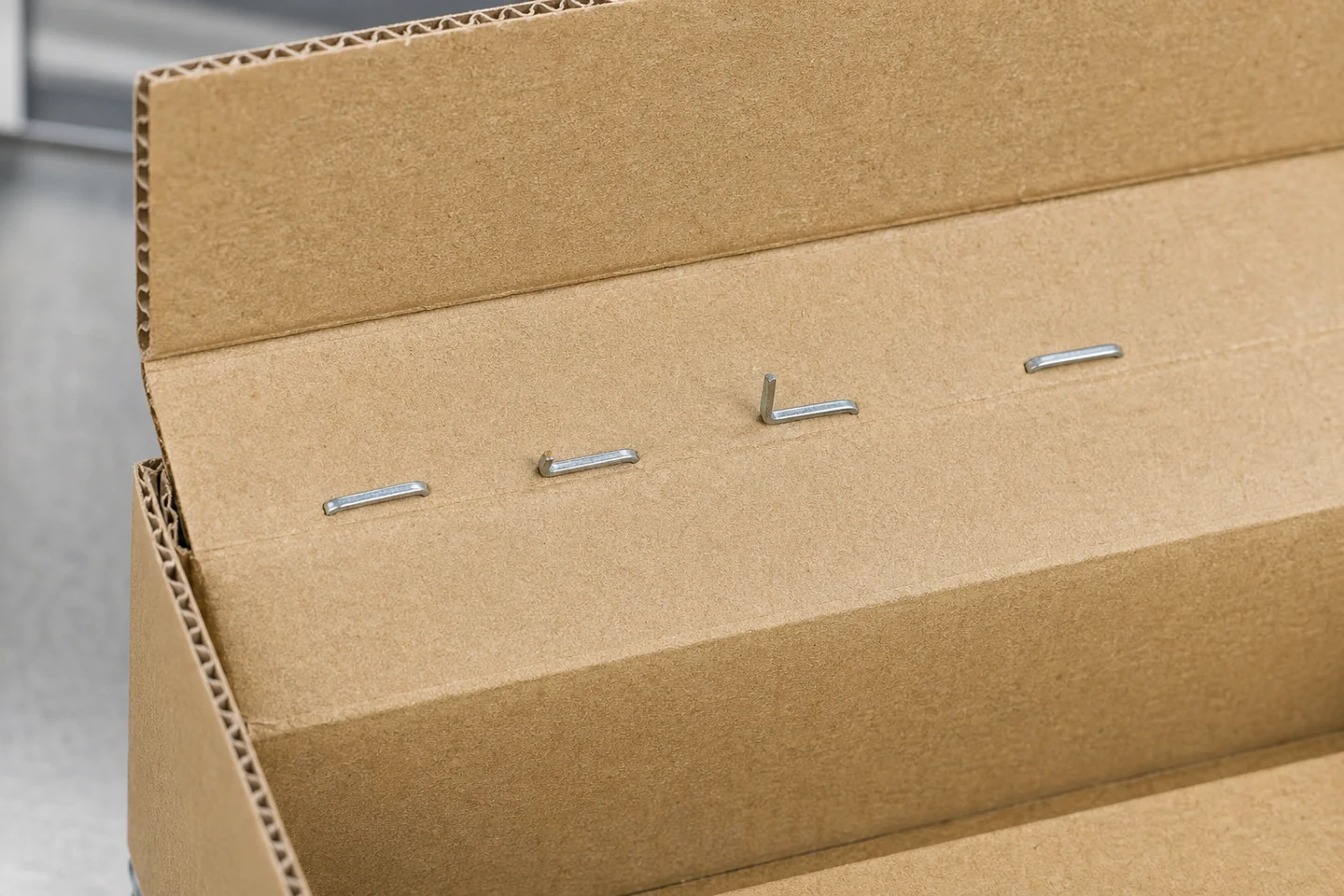
When carton staples clinch unevenly, inspect both legs before pressing the proud side flat or reopening the closure. One leg may meet the anvil correctly while the other misses its forming path because of crown angle, flap movement, unequal board stack, tool wear, staple distortion, or incomplete contact.
ProAirNails recommends marking the outside crown and inside legs as one matched position. Record closure direction, flap overlap, board grade, tool orientation, support, and sequence number.
Measure the two legs separately
Record each leg's final height, direction, contact area, and distance from the intended clinch line. Note whether the crown is level outside the carton and whether either leg cut, crushed, or lifted the linerboard.
A single closure rating can hide an important difference: two shallow legs, one flat and one proud, crossed legs, or a leg that never reached the anvil.
Match the clinch pattern to the next check
| Inside pattern | Possible direction | Controlled comparison |
|---|---|---|
| One leg flat, one standing | Angle, anvil alignment, uneven stack | Square contact on a fixed stack |
| Both legs turn the same way | Tool orientation or anvil condition | Marked tool and carton direction |
| One leg cuts through liner | Concentrated load or damaged point | Unused staples and board controls |
| Clinch changes across flap | Overlap thickness or support variation | Stack map and backing position |
Preserve at least one accepted closure from the same run. The control shows the normal crown, leg, board, and anvil relationship more clearly than a tool setting alone.
Inspect the staple before adjusting the tool
Confirm crown width, leg length, wire, point, coating, collation, and tool compatibility. Check unused strips for twisted crowns, unequal legs, spacing damage, adhesive residue, and mixed references. Keep the carton label or staple lot identification.
Qualified personnel should inspect the driver, clincher or anvil, nose, guides, wear, debris, and adjustment according to the equipment instructions. Do not grind or bend forming parts as an informal correction.
Control the corrugated stack and support
Map the number of board layers, flap edges, score lines, printing or coating, crushed flute, moisture condition, and contents support. A closure over two uniform flaps presents a different forming path from one near a score, void, or variable overlap.
Run a trial with representative cartons at the normal orientation and pace. Keep staple, tool, operator, support, and closure location fixed while changing only one approved variable. Open selected samples carefully and compare both inside and outside faces.
Use ProAirNails data for a useful product discussion
ProAirNails can review the staple series, crown and leg dimensions, tool model, carton stack, clinch photographs, package reference, and production rhythm when discussing supply compatibility. Clear measurements help prevent a generic request for a stronger staple when the main issue may be alignment or support.
The limitation is clear: an even-looking clinch does not establish package integrity, tool safety, staple conformity, or performance through distribution. Those conclusions require the applicable closure test and packaging criteria.
Release the closure with two-sided criteria
Define acceptable crown seating outside, leg formation inside, liner damage, flap compression, spacing, and action for a proud leg. Include checks at start-up, after adjustments, and at defined production intervals.
Use the same opening method for audit samples so inspection does not bend the legs after formation. Record whether the carton was empty, supported by contents, or compressed during closure, because the backing condition can change how the staple reaches and follows the anvil.
Explore the ProAirNails Air Staple Pin category and wider pneumatic fastener range. Send staple dimensions, tool reference, board stack, inside and outside photographs, and trial results through the ProAirNails inquiry page when carton staples clinch unevenly.
FAQ
Can I hammer a proud carton staple leg flat?
That changes the original closure and may damage the board. Follow the approved rework rule after documenting why the leg did not form correctly.
Does a crooked clinch mean the staple is the wrong size?
Size or compatibility may contribute, but tool angle, anvil alignment, flap stack, support, wear, and staple condition can also produce uneven legs.
Should carton closures be inspected from both sides?
Yes. The outside crown and inside clinch reveal different parts of the forming event, and both may affect appearance, handling, and acceptance.
A two-sided ProAirNails closure record makes carton staples clinch unevenly a measurable forming issue instead of a hidden box-floor defect.