
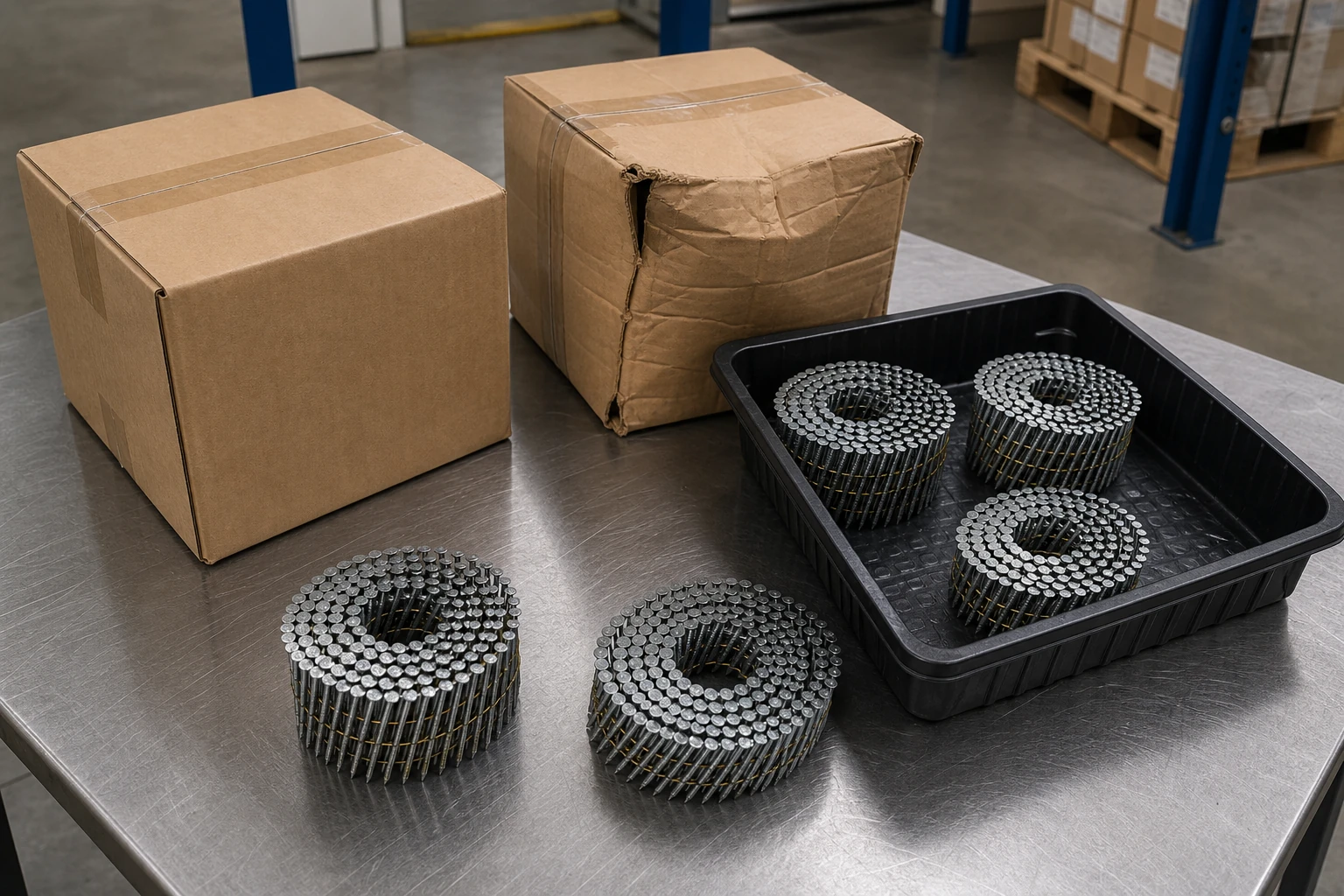
A coil nail carton drop damage review should preserve the received package, identify the impact face or corner, and trace damage inward through the carton, separators, coil positions, collation, and feed behavior. A crushed corner does not prove every coil is unusable, while an outer box that springs back can still hide oval coils or displaced wire.
ProAirNails recommends treating the carton as a layered evidence record. Photograph before opening, map every coil to its original position, compare damaged and remote areas, and use a controlled tool trial only after identity and geometry are documented.
Freeze the received state
Do not push the corner back, retape the box, move coils into a clean carton, or discard loose wire before recording the condition. Photograph all faces, closure, labels, moisture signs, pallet position, and adjacent cartons. Note who handled the package and whether it was dropped, found damaged, or received with unknown history.
Mark the suspected impact path
Number faces, edges, and corners. Record crushing, puncture, abrasion, tape release, internal movement, and witness marks. If the event was observed, document height, orientation, floor, and package state without treating memory as an instrument reading. If it was not observed, call the origin suspected rather than confirmed.
| Evidence layer | Record | Question |
|---|---|---|
| Outer carton | Face, corner, crease, puncture, closure | Where did load enter? |
| Inner support | Crush, displacement, missing clearance | How was energy transmitted? |
| Coil position | Row, level, distance from impact | Is damage localized? |
| Fastener assembly | Ovality, loose turns, wire, heads | What product feature changed? |
| Tool event | Loading, advance, first feed, recovery | Does the change affect use? |
Open the carton as a map
Remove contents in a fixed order and assign each coil a location code. Preserve separators and protective materials in place long enough to photograph contact marks. Compare coils nearest the impact with those from the opposite side. Mixing positions destroys the most useful evidence about containment scope.
- Use a clean tray for loose fragments.
- Measure coils in their free state.
- Photograph the leader and end condition.
- Keep carton and product lot identities together.
- Record every reshaping or handling action.
Read coil geometry without forcing it
Check outside condition, roundness, width, inner opening, pitch, wire joints, protrusions, crossed turns, bent heads, and loose nails. Do not squeeze a coil round before measurement. Compare more than one clock position and record support condition because a flexible assembly can produce different readings when held or laid flat.
Separate carton failure from product failure
A damaged carton may have protected its contents by absorbing energy. Conversely, a small carton crease can align with a concentrated load on one coil. Report packaging condition, product condition, and functional evidence as separate results. Do not reject or release solely from the drama of the outer box.
Use a controlled drop only for a defined question
Build a representative filled package with the approved count, internal arrangement, closure, and conditioning. Choose orientation and drop severity from the distribution question, then inspect with the same map used at receiving. A development drop can compare packaging options; it should not be presented as a reconstruction when the original event is unknown.
Place drop standards within scope
The official ISO 2248:1985 page describes vertical impact testing of complete, filled transport packages by dropping with predetermined atmosphere, height, and attitude. It does not select those conditions for a coil nail route or define acceptable product damage.
Consider the complete distribution sequence
The active ASTM D4169-23 page provides a uniform basis for laboratory evaluation of shipping units through anticipated distribution hazards. A single drop cannot represent compression, vibration, handling, and climate together. Select the sequence from the real route and preserve the unopened unit where the method requires it.
Make disposition follow the pattern
| Pattern | Immediate control | Next evidence |
|---|---|---|
| Carton crushed, coils unchanged | Hold sampled carton pending review | Expanded geometry and pack comparison |
| Nearest coils oval | Contain mapped impact zone | Position-based inspection and tool trial |
| Loose wire throughout carton | Hold full carton or defined lot scope | Collation and production comparison |
| One puncture with local bent heads | Segregate affected coils | Count depth and adjacent-carton check |
| No map or identity remains | Do not merge with released stock | Conservative quarantine and new evidence |
Connect inspection to the nailer carefully
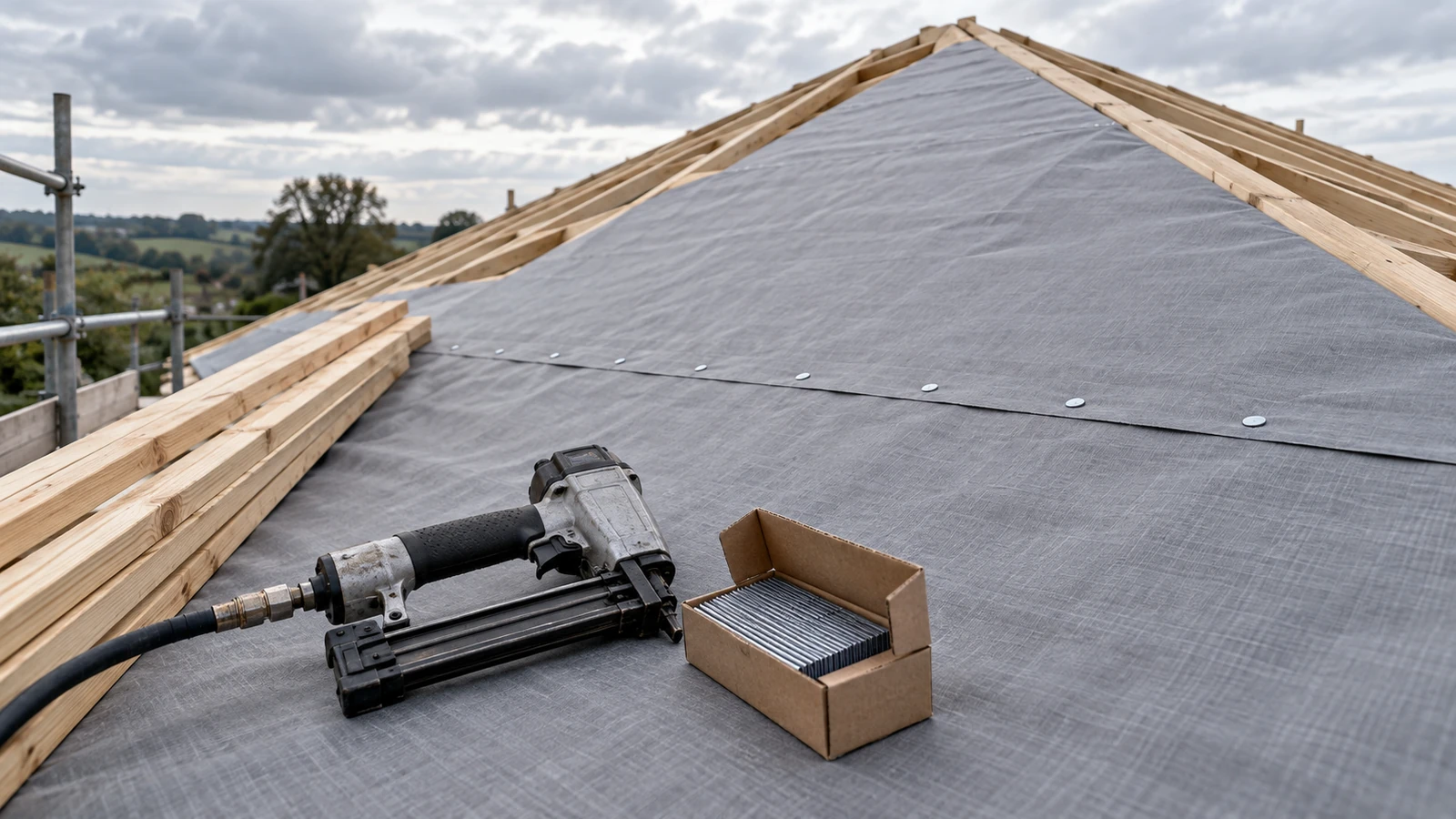
Use the named tool, magazine, pressure, substrate, loading route, and event count. Record loading resistance, skips, doubles, wire fragments, depth, and interventions. A tool trial can reveal functional effects but cannot prove structural performance or validate unsampled coils. Follow the tool manufacturer's safety instructions.
Send an impact-ready inquiry
Provide nail and coil specification, carton dimensions and count, separators, closure, pallet location, received images, impact map, coil positions, measurements, route, tool, defects, and acceptance. ProAirNails can discuss coil nails, related pneumatic nails, the wider product range, and packaging samples through the inquiry page.
Limit the claim to the mapped evidence
A coil nail carton drop damage review cannot reconstruct an unobserved event with certainty or prove every carton, route, tool, and future shipment. Laboratory drops are controlled comparisons, not universal transport guarantees. ProAirNails can support product and pack evidence; the buyer controls receiving disposition and application release.
Retain the affected carton, nearest and remote coils, loose fragments, and location map. Repeat the coil nail carton drop damage review when carton design, internal arrangement, quantity, pallet pattern, carrier, route, or tool requirements change.
Use the coil nail carton drop damage review to find how far the impact traveled and which exact stock the evidence supports.
FAQ
Should a crushed carton be opened immediately?
Photograph and map it first so opening does not erase the received condition.
Can an intact-looking coil still be affected?
Yes. Check roundness, wire, pitch, leaders, and feed behavior rather than relying on a top view.
Why record each coil position?
Position shows whether damage decreases with distance from the impact and helps define containment.
Should an oval coil be reshaped before measuring?
No. Record the free as-received condition before any correction.
Does one passing drop certify export packaging?
No. The result applies to the declared package, conditioning, orientation, severity, and inspection.
What is a witness mark?
It is a crease, abrasion, puncture, or contact trace that helps connect packaging layers.
Can outer damage and product damage be one grade?
Keep them separate so packaging absorption is not confused with product failure.
When is a tool trial useful?
Use it after geometry and identity are recorded to check controlled loading and feed effects.
What should remain quarantined?
Keep uncertain, mixed, deformed, fragmented, or unmapped stock outside released inventory.
What changes reopen package approval?
Review changes to count, carton, supports, closure, pallet, route, carrier, storage, or product geometry.