
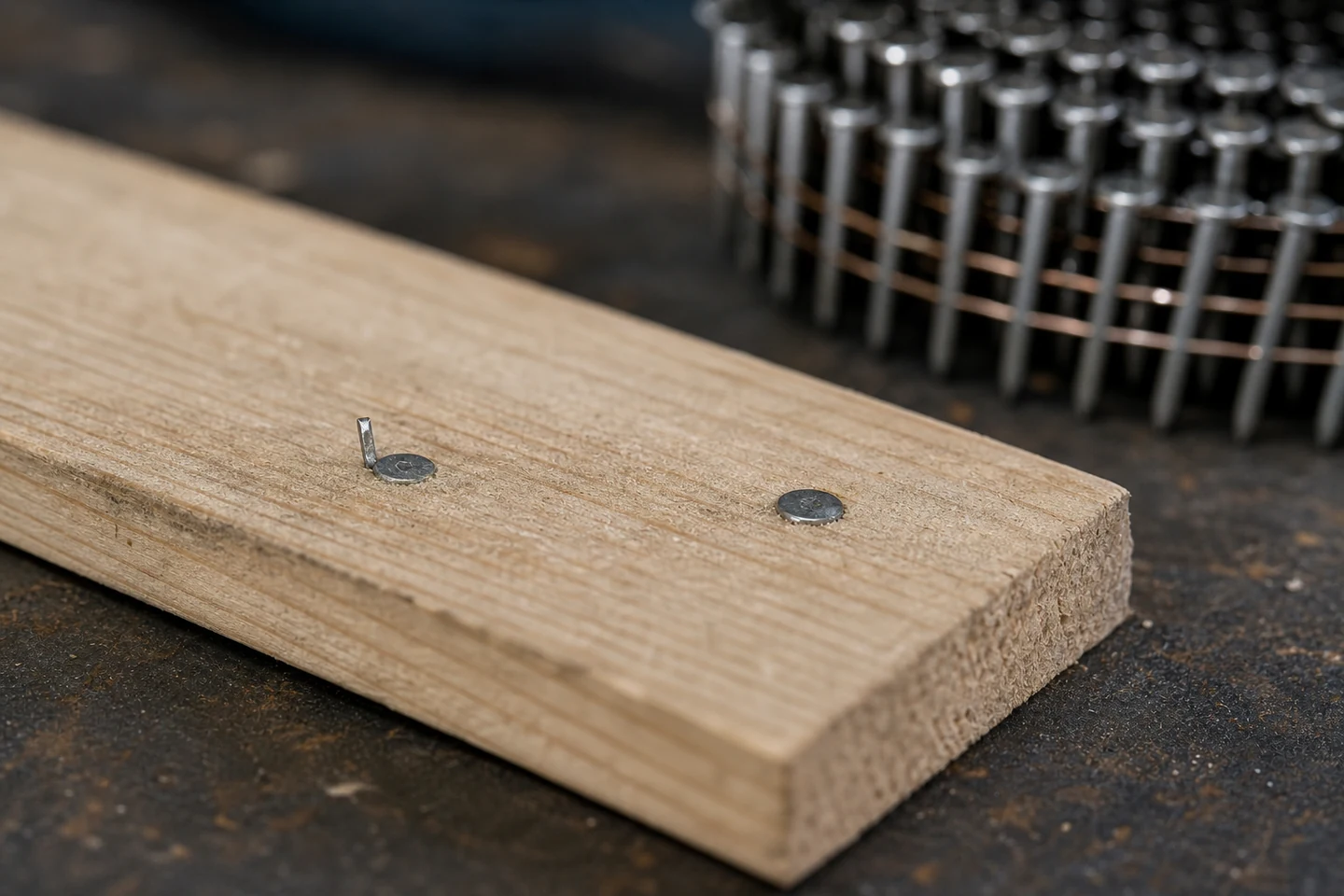
When coil nail collation wire protrudes beside a driven head, preserve both the fastener and the wire before deciding where the fragment came from. The wire may remain attached at a weld, break from an adjacent nail, shift during feeding, become trapped near the nose, or appear more visible because the nail did not seat as expected.
Isolate the tool according to its instructions if the event is associated with a jam, abnormal sound, damaged nail, or unsafe condition. Do not fire another nail through a suspected obstruction.
Classify what is protruding
Photograph the head and wire from above and at a surface-level angle. Note whether the wire is attached to the driven nail, loose in the wood, folded under the head, or connected to another nail. Record its length, direction, and height without bending it flat.
Inspect the remaining coil and nose area for a matching break. Bag any loose wire or nail pieces with the coil and carton identity.
Reconstruct the last three feed positions
Mark the affected nail and the two preceding fastening locations if known. Record whether those nails seated normally, whether collation pieces were visible, and whether the tool hesitated or changed sound. The event may begin before the location where the fragment is noticed.
- Carton and coil condition before loading.
- Magazine support and adjustment for nail length.
- Feed-pawl engagement and strip alignment.
- Nose and driver condition at isolation.
Match the wire shape to the path
| Wire evidence | Possible direction | Controlled check |
|---|---|---|
| Wire remains welded to head or shank | Weld separation and driving interaction | Compare unused welds and drive samples |
| Loose short fragment near head | Earlier break or fragment carried into nose | Inspect feed path and prior positions |
| Wire folded below a proud head | Incomplete seating or trapped collation | Check nail depth and nose condition |
| Repeated fragment direction | Feed alignment or consistent weld orientation | Preserve coil index and tool setup |
Inspect unused collation without pulling it apart
Compare coil flatness, weld positions, wire continuity, nail spacing, loose turns, and handling damage. Do not flex or separate the sample before the original condition is documented. Check whether the affected area corresponds to a crushed carton side or distorted coil turn.
A visible weld variation does not by itself establish performance. Use the agreed product criteria and a controlled compatible-tool sample.
Retain at least one undriven section before testing. It provides a reference for wire position and weld orientation that has not been changed by the magazine, feed pawl, driver, or workpiece.
Run a limited feed-and-surface check
After qualified tool inspection, use representative lumber and the approved operating setup. Record every fastening position, head seating, visible collation, feed sound, and coil index. Stop at the first protruding fragment, jam, damaged nail, or abnormal cycle.
Cross-check a confirmed coil in the inspected tool and the suspect coil in a confirmed compatible tool where the procedure permits. Keep pressure, pace, loading, magazine setting, lumber, and operator constant.
Define removal and containment
Follow the product and workplace method for removing a sharp wire fragment and evaluating the driven fastener. Hold affected coils or tools when the event repeats, unused collation is damaged, or feed components show abnormal condition. Record quantities and batch references.
The limitation is important: this inspection does not certify a tool, prove lot conformity, or establish joint strength and service safety. Those conclusions need the applicable service, sampling, and product requirements.
Review the Coil Nail category and the wider pneumatic fastener range. Send coil reference, tool model, carton condition, fragment photographs, feed sequence, and sample results through the inquiry page when coil nail collation wire protrudes.
FAQ
Is visible wire beside a coil nail normal?
Collation separates during driving, but a sharp or raised fragment at the finished surface should be evaluated against the product and application acceptance criteria.
Can the wire simply be hammered flat?
Flattening removes evidence and may damage the surface or fastener. Preserve the condition first and follow the approved removal and repair procedure.
Does one protruding fragment mean the whole coil is defective?
No single event proves lot condition. Preserve the coil, inspect the feed system, and apply the defined sampling and containment plan.
A preserved feed sequence makes coil nail collation wire protrudes a traceable collation event rather than an unexplained sharp edge.