
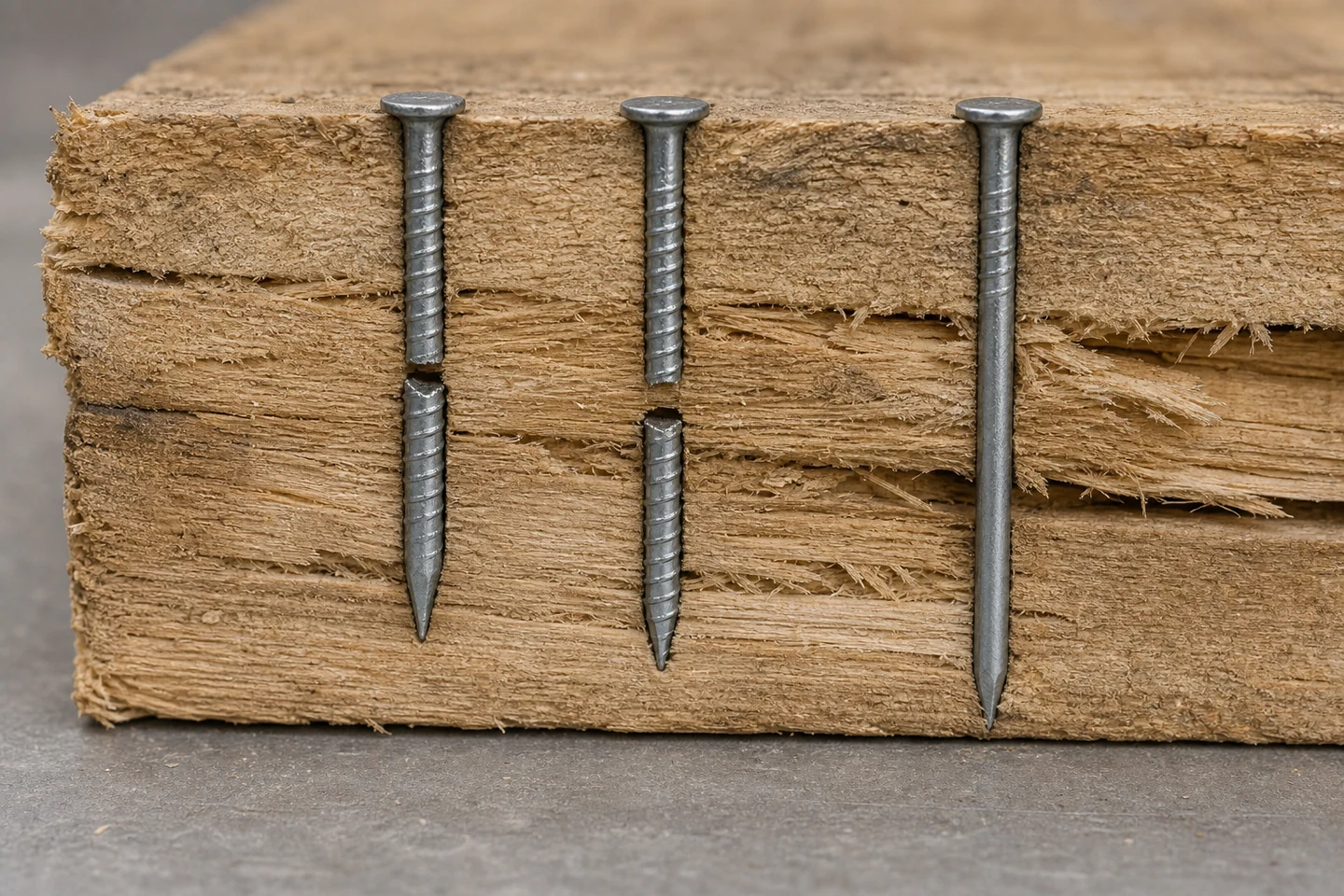
When a coil nail shank breaks during driving, preserve the embedded fragment and the remaining nail sequence before cutting or extracting the sample. A fracture can follow severe path deflection, a hard inclusion, side loading, damaged nail geometry, collation interference, unsuitable tool-fastener fit, or a tool condition that changes how the driver transfers force.
ProAirNails recommends recording the shot number, coil position, tool angle, workpiece support, material location, sound, visible head result, and whether any fragment left the nose or surface.
Locate the fracture without changing it
Inspect every face for a partial head, missing head, side exit, split, bulge, metallic mark, or unusual entry crater. Use an approved non-destructive method where available before sectioning. Mark the intended section plane and keep the original driving direction visible.
Do not grip and twist the exposed fragment before documentation. Extraction can smear the fracture face, straighten a deflected shank, or enlarge the path around an obstruction.
Classify depth and path together
| Fracture location | Possible direction | Evidence to retain |
|---|---|---|
| Near the head or entry | Driver contact, side load, damaged presentation | Head, nose mark, and leading coil segment |
| At a sudden path turn | Hard feature or grain deflection | Sectioned material around the bend |
| Near a joint interface | Gap, movement, mixed resistance | Fit-up and support condition |
| At repeating coil intervals | Collation or handling pattern | Ordered coil sequence and package data |
Compare at least one intact nail from the same production run. The labeled control helps distinguish normal surface marks from features unique to the fractured event during later review.
Retain the fracture faces and coil order
Collect all recovered pieces in separate labeled containers. Photograph fracture faces without cleaning or fitting them together aggressively. Record shank type, diameter, length, coating, point, head, collation, weld or carrier position, and visible corrosion or deformation.
Keep unused nails ahead of and behind the failed position in sequence. Check for bent shanks, head overlap, damaged collation, loose wire or plastic, crushed wraps, mixed references, and storage damage.
Separate material path from tool condition
Section representative workpieces only where the design and safety procedure allow. Look for knots, dense grain, fastener intersections, metal, masonry, voids, misaligned members, or a moving interface. Qualified personnel should inspect the driver, nose, feed gate, canister support, and wear components under the tool instructions.
After clearance, run a limited trial with confirmed compatible nails and representative material. Keep support, tool angle, pressure, operator, pace, spacing, and material orientation fixed. Change one approved variable and stop at the first abnormal result.
Build a ProAirNails evidence package
ProAirNails can review the nail specification, tool model, collation type, fracture photographs, coil sequence, package reference, material stack, and sectioned path when discussing supply compatibility. A fracture surface alone does not identify every contributing condition.
Define containment for work completed since the last confirmed intact drive. An embedded broken fragment may leave inadequate engagement, a concealed sharp piece, surface damage, or an uncertain joint. Use an approved repair and inspection rule rather than adding a second nail beside an unknown path.
The limitation is clear: this fracture map does not establish metallurgical cause, nail-lot conformity, tool safety, structural capacity, or performance across every substrate. Formal conclusions may require qualified tool inspection, material examination, and application testing.
Review the ProAirNails Coil Nail category and broader pneumatic nail range. Send the nail and tool references, fracture pieces, coil-order photographs, material details, and trial record through the ProAirNails inquiry page when a coil nail shank breaks during driving.
FAQ
Can I drive a second coil nail beside the broken one?
Only under an approved repair plan. The first path may contain an obstruction or hidden fragment, and nearby driving can cause another deflection or split.
Does a shiny fracture face prove the nail was brittle?
No. Appearance alone is not enough. Side loading, deformation, impact, material path, corrosion, and handling can affect the surface and require qualified interpretation.
Should the rest of the coil be discarded?
Quarantine and identify it according to the quality procedure. Preserve its order and package data so tool, material, handling, and product factors can be compared.
A labeled ProAirNails fracture map makes coil nail shank breaks during driving a preserved failure path rather than a missing head with no context.