
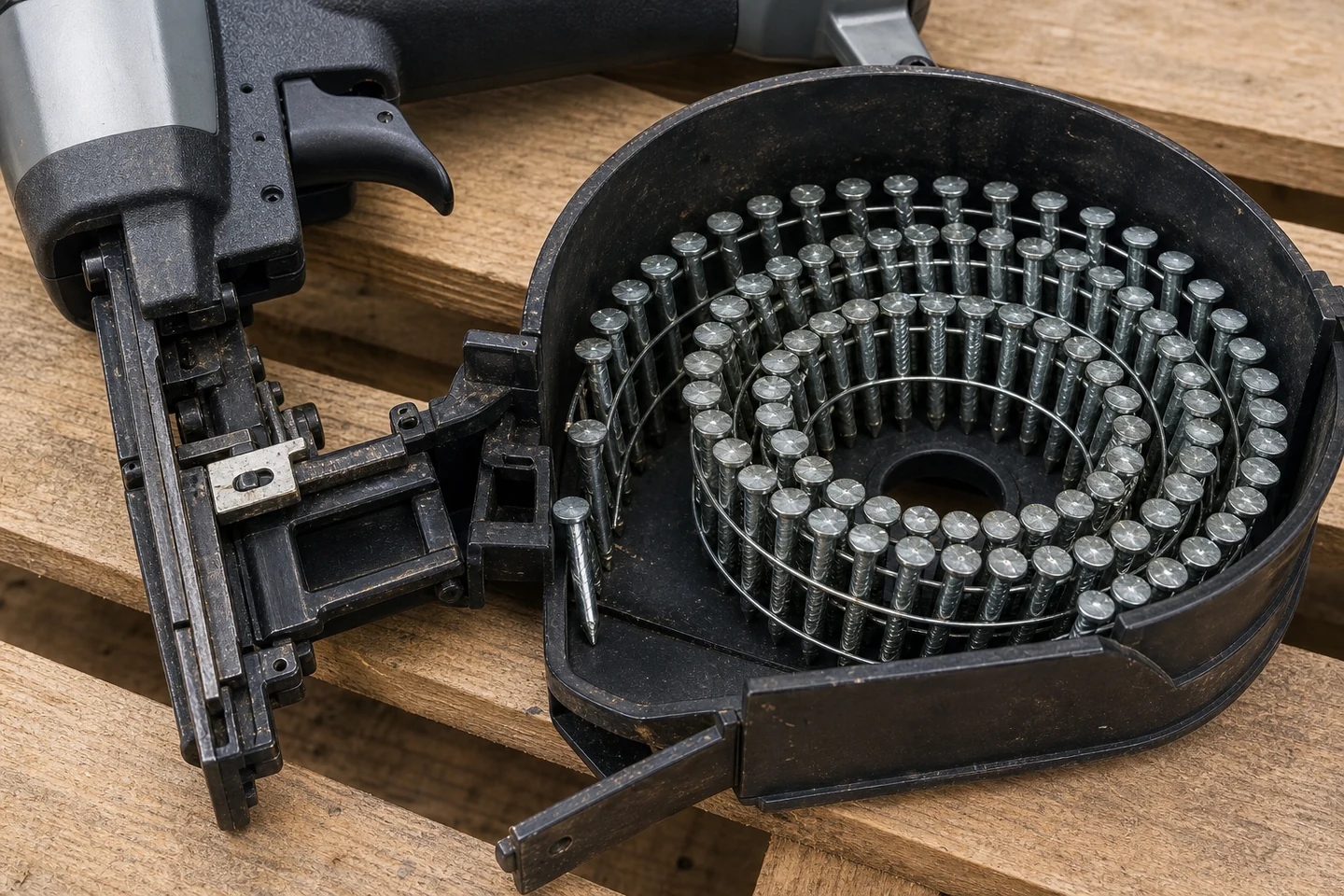
When a coil nailer dry fires with nails loaded, preserve the leading nail position before cycling the tool again. The canister may contain a full coil while the pickup area is empty because the carrier stopped, the feed pawl missed, the coil tilted, the leading segment kinked, or the nail spacing no longer matches the feed sequence.
Disconnect the energy source and follow the tool manufacturer's clearing procedure. ProAirNails recommends marking the last successful nail, next available nail, coil rotation, support setting, and shot count.
Confirm that the event was a true feed gap
Record whether the tool produced only air, left a shallow mark, drove a fragment, or fired after a delay. Inspect the workpiece and nose before assuming no fastener moved. A broken or partially presented nail can create a different risk from an empty driver channel.
Photograph the canister, leading segment, gate, and remaining coil without pulling the carrier forward. Keep loose wire or plastic fragments with their original location.
Trace the leading nail back through the coil
| Feed clue | Possible direction | Evidence to retain |
|---|---|---|
| Leading nail stops before gate | Carrier drag, kink, support position | Coil level and segment shape |
| Gate is occupied but driver misses | Presentation or timing condition | Nail angle and qualified tool inspection |
| Gap follows damaged collation | Broken weld, wire, or plastic carrier | Original coil sequence and fragments |
| Dry fires occur after opening cover | Loading route or leading nail placement | Operator sequence and support setting |
Do not hand-bend the leading segment into the feed gate. That changes spacing and can create a second jam or double feed.
Inspect support, pawl, and carrier condition
Confirm the canister support position for the nail length and check whether the coil sits level. Qualified personnel should inspect the feed pawl, springs, gate, driver channel, wear surfaces, and debris according to the tool instructions.
Inspect the coil for head overlap, nail spacing, weld condition, straightness, loose nails, crushed wraps, and storage damage. Keep the carton and lot reference.
Recreate the feed sequence at controlled pace
After service clearance, load a confirmed compatible coil using the documented route. Keep tool, support, pressure, operator, nail reference, and work material fixed. Run a limited trial at a defined pace and stop at the first abnormal feed.
At ProAirNails, a useful review includes tool model, coil type, nail length and shank, collation, canister setting, jam position, package condition, and shot sequence. These details help separate product compatibility questions from tool-service questions.
Define the stop rule before production resumes
Set the permitted trial count, action after one dry fire, containment threshold, and inspection requirement for workpieces exposed to an uncertain shot. Record clean cycles as well as failures.
Review the fastening sequence on the workpiece as well. A dry shot can leave one location empty while the operator continues to the next mark, so finished assemblies may need a defined count or visual check. Do not assume the missing fastener is always obvious after parts are stacked or covered.
For repeat events, compare coil positions from the beginning, middle, and end of a package. This can reveal whether handling, wrap restraint, or local collation damage changes as the coil is consumed. Keep the failed segment intact until photographs and identification are complete.
The limitation is important: this feed check does not establish tool safety, coil conformity, joint performance, or suitability at every production speed. Use the tool manual and applicable service and quality requirements.
Review the ProAirNails Coil Nail category and broader pneumatic nail range. Send the tool model, coil reference, canister setting, leading-nail photographs, fragments, and sequence through the ProAirNails inquiry page when a coil nailer dry fires with nails loaded.
FAQ
Can I keep firing after one dry shot?
Stop and inspect using the manufacturer's procedure. Repeated cycling can move damaged collation, create a jam, or leave the workpiece fastening sequence uncertain.
Does a full canister prove the nails are feeding?
No. The coil supply can be full while the leading segment, support, pawl, gate, or carrier prevents the next nail from reaching pickup.
Will more air pressure correct a missed feed?
Feed presentation is not generally corrected by higher pressure. Stay within specifications and inspect the mechanical feed and coil condition.
A preserved ProAirNails feed map turns coil nailer dry fires with nails loaded into a traceable sequence rather than an unexplained skipped shot.