
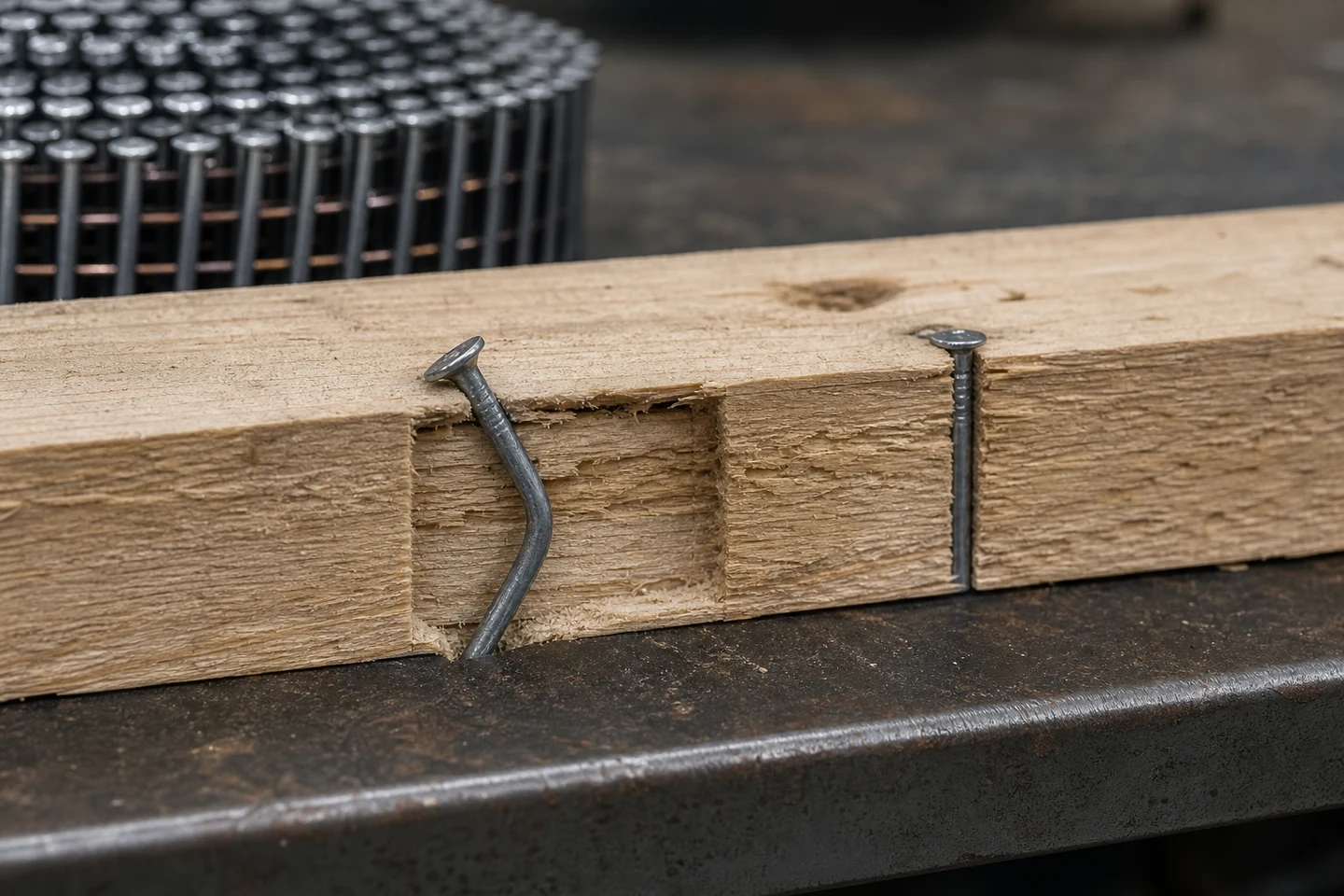
Coil nails bending during driving may remain hidden until a head tilts, a nail exits the side, the joint fails to close, or a sample is cut open. Grain, knots, board gaps, angled contact, damaged nails, point and shank geometry, feed disturbance, and tool condition can all change the internal path.
Preserve the affected board and mark tool direction, nail position in the coil, board grain, support, and fastening sequence. Do not pull the nail before the path is recorded.
Read the surface clues before sectioning
Photograph the head, entry fibers, board edge, reverse face, and nearby fasteners. Note a tilted head, raised side, torn fibers, unusual sound, incomplete seating, side breakout, or collation fragment. Mark knots, checks, joints, and unsupported spans.
Surface clues select the section location but do not prove the shape below.
Open the path in stages
Use an approved workshop method to expose the nail without straightening it. Approach from the side that preserves the suspected curve. Photograph the full path and close views with a scale, then compare an apparently successful nail from the same joint.
Record where the bend begins: below the head, at the first board interface, near a knot, beside a gap, or close to the point.
Match bend shape to the next test
| Path shape | Possible direction | Controlled comparison |
|---|---|---|
| Curve begins at entry | Tool angle, damaged nail, surface movement | Square contact on supported clear wood |
| Curve follows grain | Runout or density boundary | Rotate representative boards |
| Sharp change near knot | Hard local feature | Map knot and clear-grain positions |
| Bend at board interface | Gap, movement, mixed density | Clamp and support the full stack |
Check the nail before blaming the wood
Preserve remaining coil positions and inspect nail straightness, point, shank, head, welds, spacing, and collation. Look for a nail damaged during handling or feeding. Confirm nail dimensions and collation compatibility with the tool and application.
Do not manually separate the suspect coil before photographing its original shape and index.
Measure the actual joint stack and support under the entry point. A flexible top board, hidden gap, uneven clamp, or unsupported edge can let the parts move as the point crosses the interface. That movement may start a bend even when the visible tool angle appears square.
Cross-check tool, coil, and material
After qualified tool inspection, compare a confirmed coil in the original tool and the suspect coil in a confirmed compatible tool. Use supported representative lumber and keep pressure, pace, angle, magazine setup, nail length, and operator fixed. Stop at the first abnormal event.
If the bend follows material features, investigate the wood and joint. If it follows one tool or coil across clear controls, inspect that system under the applicable service or quality procedure.
Repeat the comparison across several marked positions rather than selecting only clear grain. Include representative knots, edges, board interfaces, and normal production pace so the test shows both stable and borderline conditions.
Set containment from repeatable evidence
Hold tools, coils, or material when bending repeats beyond the defined acceptance level, damaged unused nails are found, or the same path pattern follows one input. Record batch, tool, board, location, and sample count.
The limitation is clear: a sectioned path does not establish joint strength, lot conformity, tool safety, or full pallet performance. Those conclusions require the appropriate design, sampling, service, and quality criteria.
Review the Coil Nail category and the broader pneumatic fastener range. Send tool and coil references, lumber details, support, feed sequence, surface clues, and section photographs through the inquiry page when examining coil nails bending during driving.
FAQ
Why do coil nails bend inside wood?
They may meet grain runout, knots, gaps, mixed density, an angled entry, damaged geometry, or a feed and tool condition that starts the nail off-axis.
Will higher air pressure straighten a bending nail?
No. More energy may drive the same redirected path faster and increase breakout or damage. Stay within tool specifications and identify the controlling variable.
Can a bent nail still provide the required holding power?
Surface appearance cannot answer that. Deflection changes engagement and may damage the joint, so use the required performance and acceptance method.
A preserved cross-section makes coil nails bending during driving visible and comparable across material, tool, and coil changes.