
Coil nails double feeding can describe several different events: two nails entering the nose together, one driven nail plus one displaced nail, a loose nail moving ahead of the strip, or a feed mechanism advancing more material than expected after a cycle. The jam must be preserved before the term can become a useful diagnosis.
Stop according to the nailer manufacturer's isolation and clearing instructions. Do not fire again to “see if it clears,” and do not pull the nails apart before the feed position has been photographed.
Write the event sequence in six lines
- Tool model and confirmed fastener specification.
- Coil reference, batch, collation type, and remaining coil condition.
- Loading method and magazine adjustment.
- Work position and contact sequence immediately before the event.
- What the operator heard, felt, and observed.
- Exact location of both nails after isolation.
This short sequence is more useful than a conclusion such as “bad coil” or “tool problem.” It gives the next inspector a reproducible starting point.
Preserve four views of the feed path
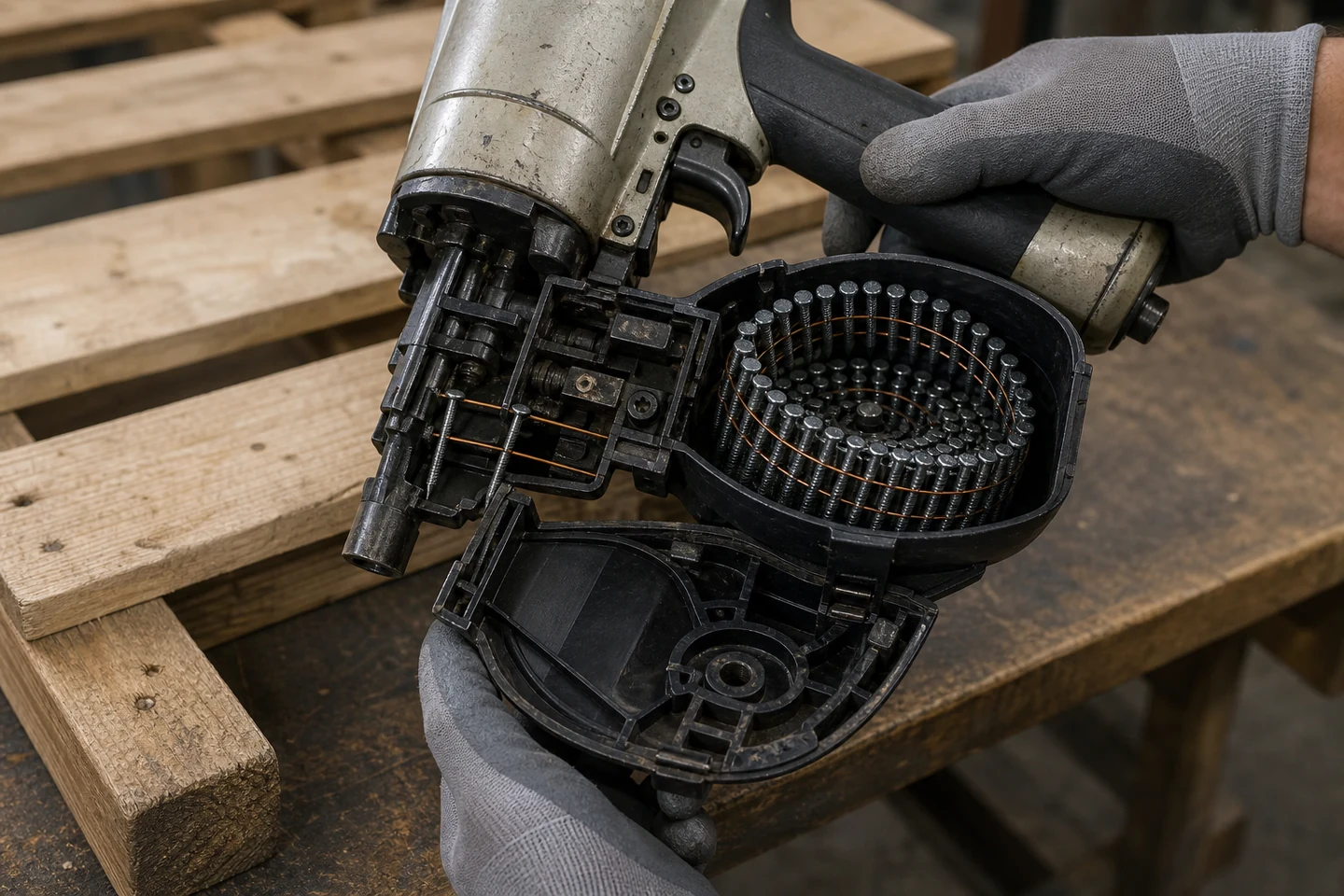
Photograph the full magazine, the coil center and outer turn, the feed pawl area, and the nose. Include the disconnected tool state without showing unsafe handling. Record whether the nails remain attached to both collation wires, whether one nail is loose, and whether the strip is twisted or lifted.
Bag any loose pieces with the coil and carton identity. A detached nail without its original position removes evidence about how it reached the nose.
Use checkpoints from carton to driver blade
| Checkpoint | Observation | Question |
|---|---|---|
| Carton and coil | Crushing, flatness, loose turns, damaged collation | Did the strip enter the tool in a controlled shape? |
| Magazine setup | Coil support, height, door closure, loading path | Was the tool adjusted for the nail length and coil? |
| Feed mechanism | Pawl engagement, debris, wear, return movement | Did the mechanism index one position consistently? |
| Nose and driver | Obstruction, bent nail, damaged components, trapped wire | Did an earlier incomplete cycle create the second position? |
Compare a controlled coil and a controlled tool
After qualified inspection and only under the approved procedure, compare the suspect coil in a confirmed serviceable compatible tool and a confirmed coil in the inspected original tool. Use limited, documented samples and stop at the first abnormal feed. This crossed comparison can show whether the event follows the coil, follows the tool, or appears only in one combination.
Keep loading, nail length, magazine setting, workpiece, operating method, and test team consistent. Changing several conditions can make the jam disappear without identifying the controlling variable.
Separate double feed from unintended double actuation
Two marks in a workpiece do not automatically prove two nails entered the nose together. Trigger mode, contact movement, recoil, workpiece bounce, and operating technique can produce two tool cycles. Conversely, a single cycle can leave a second nail displaced in the feed path.
Use the tool manual, trained personnel, and workplace safety procedure to distinguish actuation behavior from feed behavior. Never use a troubleshooting test to bypass a safety feature.
Define containment from repeatable evidence
Hold affected coils or tools when the same event repeats, damaged feed components are found, coil geometry is outside the agreed condition, or loose fasteners and collation appear in unused stock. Record quantities, batch references, tools, photographs, and disposition.
The limitation is clear: this event reconstruction does not certify a tool, establish a defect rate, or prove batch conformity. Those decisions need the applicable service inspection, sampling plan, product criteria, and safety authority.
Review the Coil Nail category and the broader pneumatic fastener range. Send the tool model, coil reference, carton condition, event sequence, and preserved feed-path photographs through the inquiry page when investigating coil nails double feeding.
FAQ
Why does a coil nailer feed two nails at once?
Possible factors include damaged or loose collation, coil deformation, incorrect magazine setup, feed-pawl behavior, nose obstruction, an incomplete earlier cycle, or an incompatible fastener. Preserve the jam before selecting a cause.
Can higher air pressure fix a double-feed problem?
Pressure is not a general correction for two nails in the feed path and may add risk or damage. Follow the tool specifications and inspect the loading, coil, feed, nose, and actuation sequence.
Should the rest of the carton be tested after one jam?
Use the receiving and quality plan. Representative controlled sampling may be appropriate, but running the full carton can destroy evidence or expose the tool to repeated abnormal feeds.
A preserved event record makes coil nails double feeding a specific mechanical investigation rather than a vague production complaint.